

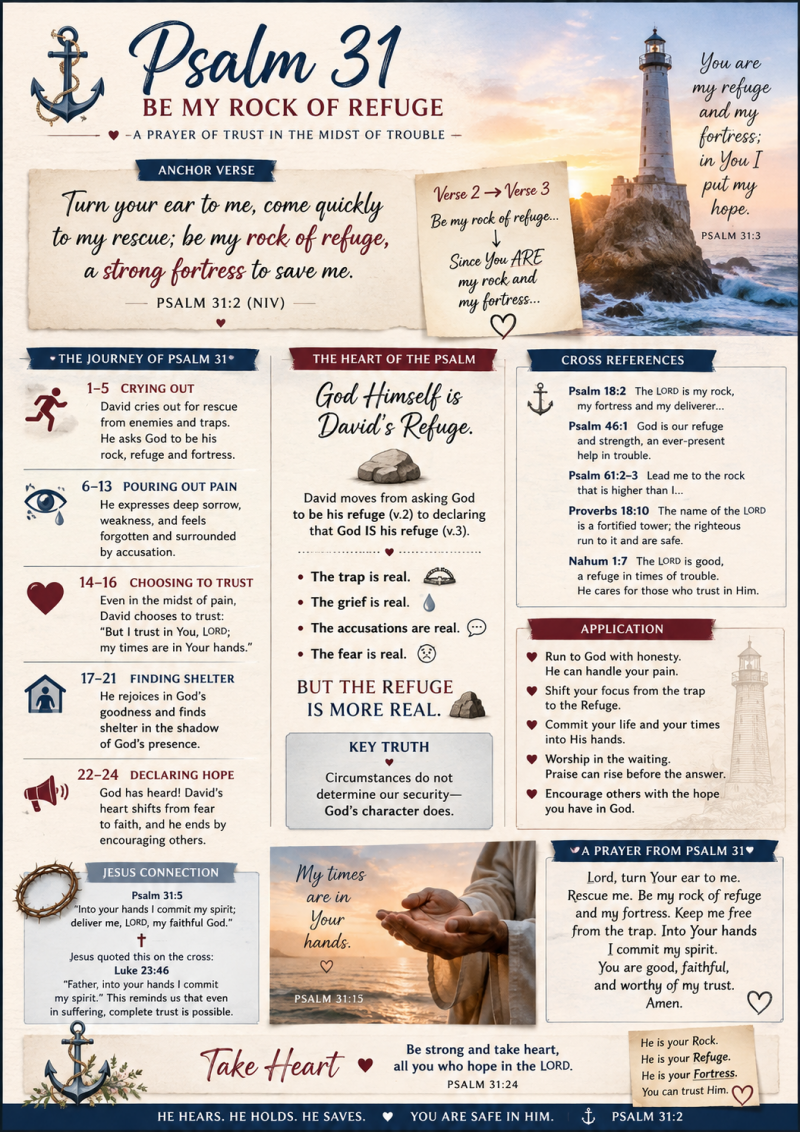
Psalm 31 is one of David’s heartfelt prayers written in a time of deep trouble. He feels surrounded by enemies, abandoned by friends, worn out in body and soul, and afraid. Yet the whole psalm moves back and forth between honest pain and solid trust in God. It ends with praise and a call for others to keep trusting the Lord too.

“Turn your ear to me, come quickly to my rescue; be my rock of refuge, a strong fortress to save me.”
- ⚓ Psalm 31:2
In simple terms, David is saying:
“Lord, lean in and listen carefully to me. Don’t take Your time—I need You right now. Be the solid rock I can hide behind and the strong fortress that keeps me safe.”
That picture of God as a rock and a fortress runs through the whole psalm. David is not pretending everything is fine. He admits he is exhausted, lonely, and scared. But instead of looking for safety in people or his own strength, he keeps turning to the Lord as his only real place of safety.
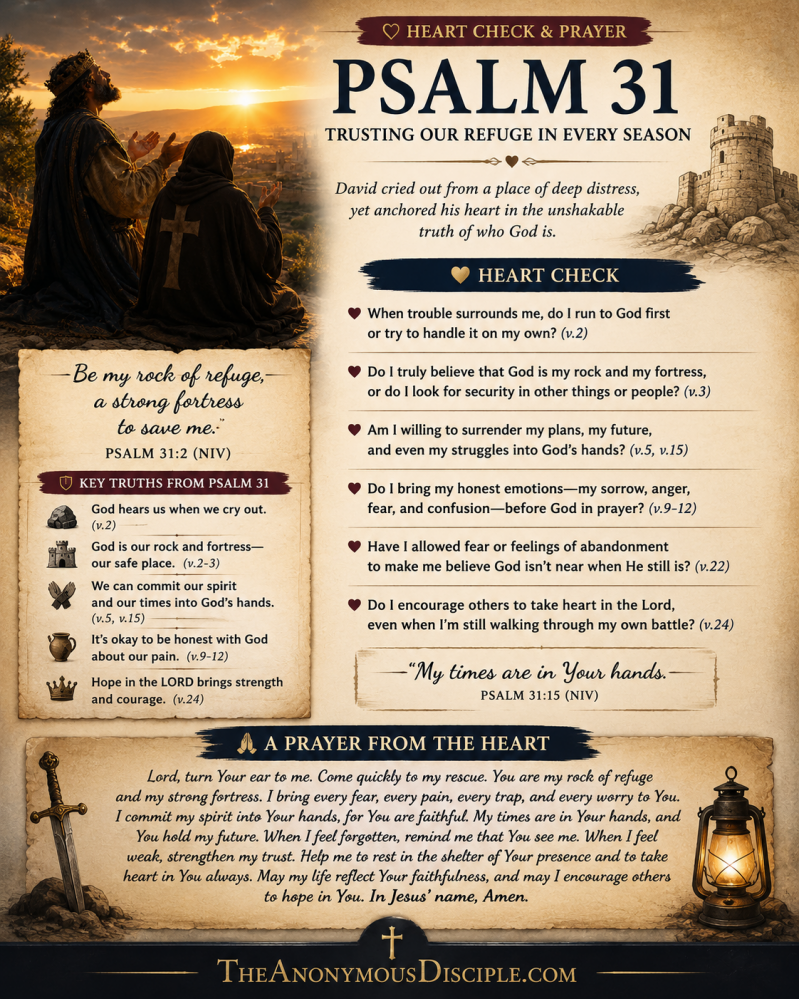
❤️🔥The heart of the psalm is this: when life feels like it is falling apart and danger is all around, we can still cry out the same simple prayer David prayed in verse 2. We ask God to listen, to come quickly, and to be our rock and fortress. And because He is faithful, that prayer is never wasted.
Study Notes
📖 Deep Dive — Psalm 31
⚓ Anchor: Psalm 31:2
Psalm 31:2 (NIV)
“Turn your ear to me, come quickly to my rescue; be my rock of refuge, a strong fortress to save me.”
🏺 Setting the Scene
Psalm 31 is a prayer of David from a place of serious distress. He speaks of enemies, traps, grief, weakness, slander, fear, and abandonment.
Yet there's something striking about the psalm:
David keeps moving back and forth between distress and trust.
He doesn't pretend he's okay.
He tells God exactly what's happening—and then deliberately reminds himself who God is.
You can almost see the rhythm:
Trouble → Prayer → Trust → Trouble → Prayer → Trust → Praise
That's important because biblical faith isn't the absence of fear or distress.
It's knowing where to run with them. 🕊️
⚓ Psalm 31:2 — “Turn Your Ear to Me”
Psalm 31:2 (NIV)
“Turn your ear to me, come quickly to my rescue; be my rock of refuge, a strong fortress to save me.”
There are four movements in David's prayer:
👂 Hear me.
“Turn your ear to me.”
🏃 Rescue me.
“Come quickly to my rescue.”
🪨 Shelter me.
“Be my rock of refuge.”
🏰 Protect me.
“A strong fortress to save me.”
David isn't asking for vague encouragement.
He's saying:
“God, I need You to intervene.”
And notice the imagery: rock and fortress.
A rock doesn't move when everything around it does.
A fortress doesn't remove the battle—it provides protection in the battle.
That becomes one of the central truths of Psalm 31:
🪨 God doesn't merely give David refuge.
God IS David's refuge.
❤️ And Then Look at Verse 3
This is really interesting.
Verse 2:
Psalm 31:2 (NIV)
“Be my rock of refuge…”
Then immediately:
Psalm 31:3 (NIV)
“Since you are my rock and my fortress, for the sake of your name lead and guide me.”
Look at that shift:
Verse 2: Be my rock.
Verse 3: You ARE my rock.
😭❤️
David's prayer moves almost immediately from request to confession.
“God, be this for me…”
followed by:
“Because this is who You already are.”
That is such a good model for prayer.
Lord, help me trust You—because You are trustworthy.
Lord, protect me—because You are my refuge.
Lord, guide me—because You are my God.
Our circumstances don't establish God's character.
God's character steadies us inside our circumstances.
🪤 “Free Me From the Trap”
Psalm 31:4 (NIV)
“Keep me free from the trap that is set for me, for you are my refuge.”
David believes enemies are actively plotting against him.
But his attention doesn't remain fixed on the trap.
It shifts to the Refuge.
That's spiritually significant.
Sometimes we spend enormous amounts of energy studying the trap:
What might happen?
What are they doing?
What if this goes wrong?
How do I protect myself?
David acknowledges the trap—but then immediately remembers:
“You are my refuge.”
The trap may be real.
But so is God.
✝️ A Verse Jesus Prayed From the Cross
Then we reach one of the most important lines in the psalm:
Psalm 31:5 (NIV)
“Into your hands I commit my spirit; deliver me, LORD, my faithful God.”
Jesus used these words at His death:
Luke 23:46 (NIV)
“Jesus called out with a loud voice, ‘Father, into your hands I commit my spirit.’ When he had said this, he breathed his last.”
That gives Psalm 31 extraordinary depth.
David's words of trust during suffering eventually become Jesus' words of trust during the crucifixion.
And notice what Jesus demonstrates:
Trusting the Father doesn't always mean immediate escape from suffering.
Sometimes trust means:
“Father, even here, I place myself completely into Your hands.”
🕊️
That's surrender at its deepest level.
😔 David Doesn't Hide His Pain
The psalm becomes intensely personal:
Psalm 31:9–10 (NIV)
“Be merciful to me, LORD, for I am in distress; my eyes grow weak with sorrow, my soul and body with grief. My life is consumed by anguish and my years by groaning…”
David doesn't sanitize prayer.
He tells God:
I'm exhausted.
I'm grieving.
I'm overwhelmed.
Biblical faith doesn't require pretending pain isn't painful.
God invites honesty.
And David continues:
Psalm 31:12 (NIV)
“I am forgotten as though I were dead; I have become like broken pottery.”
That's a devastating image.
Something once useful and valued now feels shattered and discarded.
But watch what comes next.
❤️ “BUT I Trust in You”
After describing everything going wrong:
Psalm 31:14–15 (NIV)
“But I trust in you, LORD; I say, ‘You are my God.’ My times are in your hands…”
There it is.
BUT.
David doesn't say:
“My enemies disappeared, therefore I trust You.”
He says:
“BUT I trust in You.”
The circumstances haven't necessarily changed.
David's focus has.
And then comes one of the most comforting statements in Scripture:
👐 “My times are in your hands.”
His enemies don't control his future.
His circumstances don't control his future.
Fear doesn't control his future.
God holds his times.
And that connects beautifully back to verse 5:
“Into your hands I commit my spirit.”
Verse 5: My life goes into Your hands.
Verse 15: My times are already in Your hands.
❤️
🌤️ Hidden in His Presence
Then David gives us another beautiful refuge image:
Psalm 31:20 (NIV)
“In the shelter of your presence you hide them from all human intrigues; you keep them safe in your dwelling from accusing tongues.”
Notice where the shelter is:
“the shelter of your presence.”
Not merely a location.
Not merely changed circumstances.
His presence.
That connects directly to our anchor:
Psalm 31:2 — “Be my rock of refuge…”
God Himself is the safe place.
🕊️ David Thought God Hadn't Heard Him
There's another little moment I love:
Psalm 31:22 (NIV)
“In my alarm I said, ‘I am cut off from your sight!’ Yet you heard my cry for mercy when I called to you for help.”
David admits something.
Fear made him reach the wrong conclusion.
“God can't see me.”
But then:
“Yet You heard…”
His feelings told him one thing.
God's faithfulness proved another.
That's worth remembering:
Feeling abandoned by God is not evidence that God has abandoned you.
💪 The Psalm Ends Completely Differently Than It Began
At the beginning:
“Come quickly to rescue me!”
At the end:
Psalm 31:24 (NIV)
“Be strong and take heart, all you who hope in the LORD.”
Look what happened.
David entered the psalm needing encouragement.
He leaves the psalm giving encouragement.
Prayer has moved him from:
“God, rescue me!”
to:
“Everyone who hopes in God—take heart!”
His circumstances may not even have changed yet.
But David has remembered who holds him.
🧵 The Thread Through Psalm 31
I think the central thread looks like this:
🪤 The trap is real.
😔 The grief is real.
🗣️ The accusations are real.
😨 The fear is real.
But the Refuge is more real. 🪨
And our anchor captures the entire thing:
Psalm 31:2 (NIV)
“Turn your ear to me, come quickly to my rescue; be my rock of refuge, a strong fortress to save me.”
David isn't standing outside the fortress asking God for directions.
He's running into God Himself.
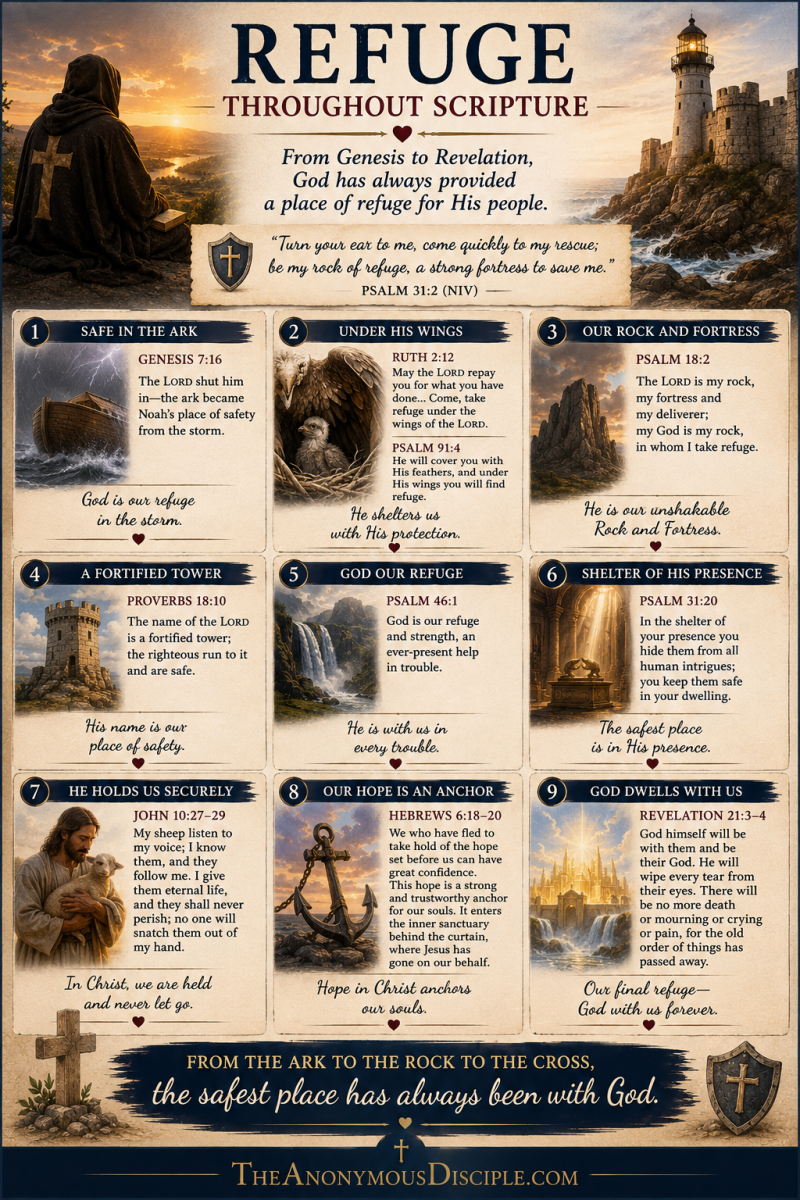
🔗 Cross References for Our Anchor
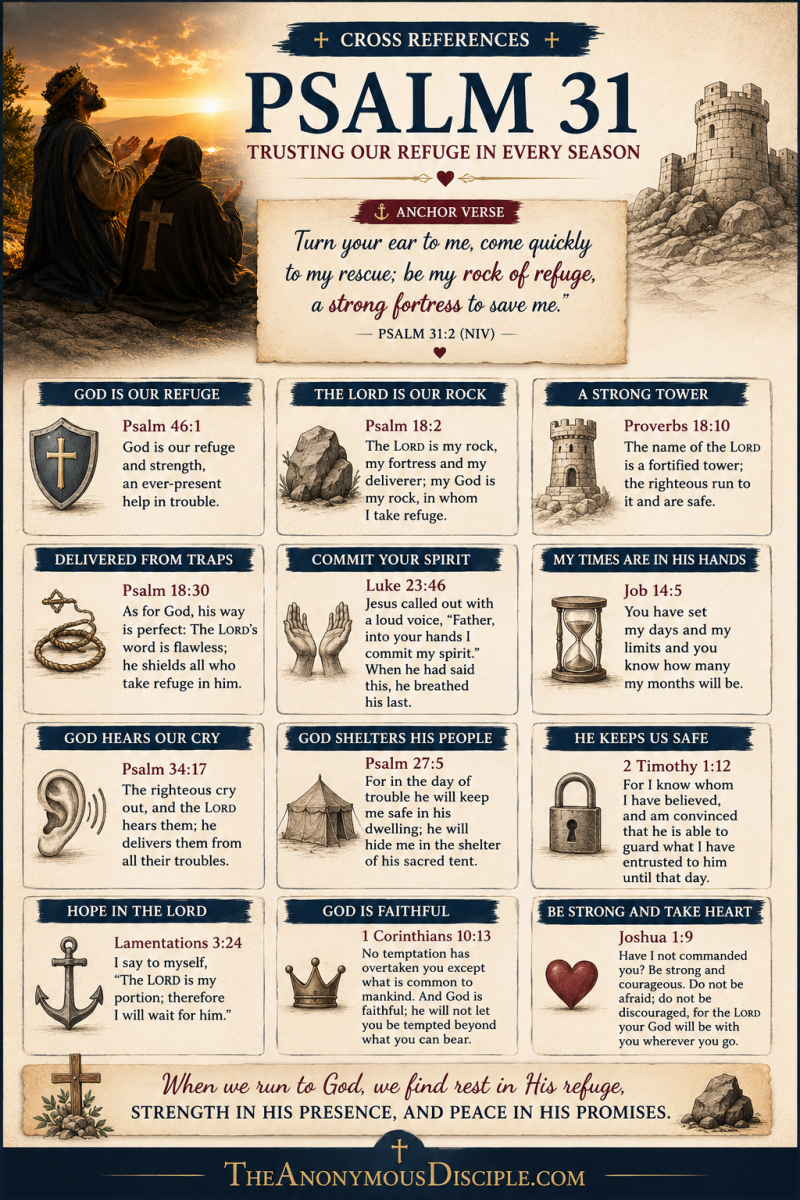
Psalm 18:2 (NIV)
“The LORD is my rock, my fortress and my deliverer…”
Psalm 46:1 (NIV)
“God is our refuge and strength, an ever-present help in trouble.”
Psalm 61:2–3 (NIV)
“…lead me to the rock that is higher than I. For you have been my refuge, a strong tower against the foe.”
Proverbs 18:10 (NIV)
“The name of the LORD is a fortified tower; the righteous run to it and are safe.”
Nahum 1:7 (NIV)
“The LORD is good, a refuge in times of trouble. He cares for those who trust in him.”
And there's our pattern again:
🪨 Run to the Rock.
🏰 Enter the Fortress.
👐 Put yourself in His hands.
❤️ Trust the One who already holds your times.
“Lord, lean in and listen carefully to me. Don’t take Your time—I need You right now. Be the solid rock I can hide behind and the strong fortress that keeps me safe.”
That picture of God as a rock and a fortress runs through the whole psalm. David is not pretending everything is fine. He admits he is exhausted, lonely, and scared. But instead of looking for safety in people or his own strength, he keeps turning to the Lord as his only real place of safety.
Notice how the psalm unfolds around that cry:
- Verses 1–8 – David starts by declaring his trust and asking God to rescue him, just as verse 2 does. He hands his life over to God (“Into your hands I commit my spirit” – the very words Jesus later spoke on the cross).
- Verses 9–13 – Then he pours out how bad things really are. His eyes are worn out from crying, his body is weak, friends avoid him, and enemies plot against him.
- Verses 14–18 – Even in the middle of that darkness he says again, “But I trust in you, Lord… My times are in your hands.”
- Verses 19–24 – Finally he praises God for the goodness and protection He gives to those who take refuge in Him, and he encourages every believer to be strong and take heart while they wait for the Lord.
The heart of the psalm is this: when life feels like it is falling apart and danger is all around, we can still cry out the same simple prayer David prayed in verse 2. We ask God to listen, to come quickly, and to be our rock and fortress. And because He is faithful, that prayer is never wasted.
That’s the plain, honest truth of Psalm 31.
Add comment
Comments