

When life feels bitter and your soul is downcast, the way forward is not to pretend the pain isn’t there. It is to deliberately remember that the Lord’s love and mercy are still new every morning. Because He is your portion, you can wait. And verse 25 promises: The Lord is good to the one who hopes in Him and seeks Him.
That goodness isn’t always the removal of the trouble right away. Sometimes it is the quiet strength to keep seeking Him in the middle of it, knowing His faithfulness will not fail.
Jeremiah (the writer) is in deep pain. Jerusalem has been destroyed. Everything feels ruined. He is honest about how low he feels… and then he deliberately turns his mind toward God. That’s the big movement of these verses.
Verse-by-Verse Walk-Through
Verses 19–20 “I remember my affliction and my wandering, the bitterness and the gall. I well remember them, and my soul is downcast within me.”
He is not pretending. He looks straight at the pain — the bitterness, the wandering, the heavy heart — and admits, “My soul is downcast.” He’s not in denial. He’s just being real with God and with himself.
Verse 21 “Yet this I call to mind and therefore I have hope:”
This is the turning point. He chooses to call something to mind. He doesn’t wait until he feels better. He deliberately remembers a truth that lifts his hope.
Verses 22–23 “Because of the Lord’s great love we are not consumed, for his compassions never fail. They are new every morning; great is your faithfulness.”
Even in the middle of the disaster, God’s love and mercy have not run out. His compassions are brand new every single morning. Great is His faithfulness — not ours, His.
Verse 24 “I say to myself, ‘The Lord is my portion; therefore I will wait for him.’”
He talks to his own soul: “The Lord Himself is my portion — my share, my inheritance, my enough.” Because of that, he chooses to wait.
Verse 25 (the anchor) “The Lord is good to those whose hope is in him, to the one who seeks him.”
This is the heart of the passage. God is not just good in a general way. He is good toward the person who puts their hope in Him and actively seeks Him. Waiting and seeking are not passive. They are trust in action — leaning on Him, looking for Him, refusing to give up on Him even when the feelings are dark.
Verse 26 “It is good to wait quietly for the salvation of the Lord.”
There’s a quiet strength in waiting. Not frantic waiting, not demanding waiting — quiet, steady trust that the Lord’s rescue (His salvation) will come in His time.
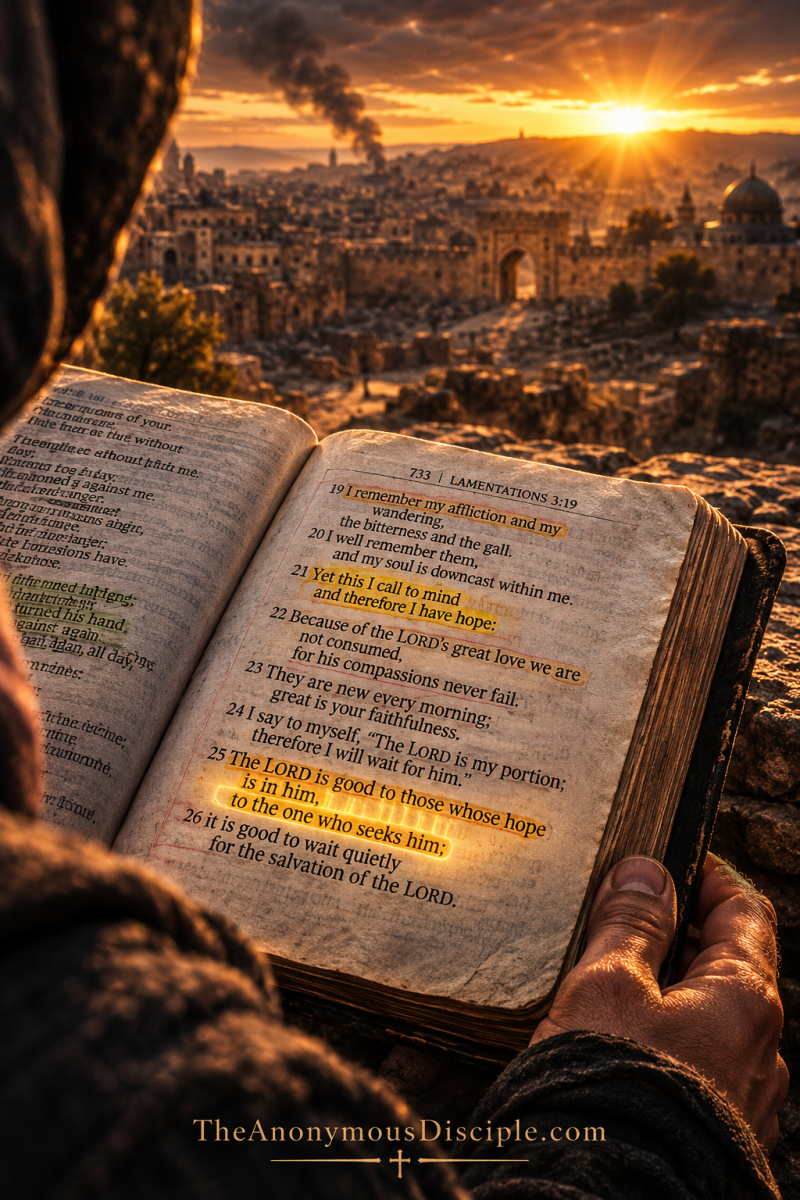


Here’s how Lamentations 3:19–26, especially verse 25, can speak into everyday struggles in simple, practical ways.
When your heart feels heavy and downcast
You wake up already tired, or something hard sits on your chest all day. Jeremiah didn’t pretend it wasn’t there. He named the bitterness. Then he chose to call something else to mind.
Practical step: When the heaviness hits, pause and say out loud (or write it down): “My soul is downcast… yet this I call to mind: the Lord’s compassions are new this morning. Great is His faithfulness.” You’re not denying the feeling. You’re choosing not to let the feeling have the last word.
When you’re waiting for something that feels slow
A hard situation that doesn’t change, a prayer that seems unanswered, a season that just keeps going. Verse 25 says the Lord is good to those who hope in Him and seek Him. Verse 26 adds that it is good to wait quietly.
Practical step: Instead of only asking “When will this end?”, also ask, “Lord, how can I seek You in this?” That might look like a short prayer while doing the dishes, reading one verse slowly, or simply telling Him, “I’m still waiting, and I’m still looking for You.” Waiting becomes less empty when it is directed toward Him.
When you feel like you’ve used up all your strength
You think, “I don’t have anything left.” Jeremiah’s hope didn’t come from feeling strong. It came from remembering that God’s love and mercy had not run out.
Practical step: On the days you feel empty, stop trying to dig deeper into yourself. Look outward and upward instead. Say something simple like: “Lord, You are my portion today. I don’t have much, but I still have You. Help me wait.” His faithfulness is the supply, not your emotional energy.
When guilt or past failure keeps replaying
The bitterness and gall can include regret. Even then, the writer turns to the Lord’s great love that keeps us from being completely consumed.
Practical step: When the old tape starts playing, answer it with verse 22–23: “Because of the Lord’s great love I am not consumed. His compassions never fail. They are new this morning.” You don’t have to earn a fresh start. His mercy already is one.
When life just feels ordinary and gray
Not a big crisis, just the daily grind. Verse 25 is for those days too. Seeking Him doesn’t always look dramatic.
Practical step: Build one small “seeking” habit into the ordinary. Maybe it’s thanking Him for one specific kindness before your feet hit the floor, or whispering “You are my portion” while you make coffee. Small, quiet seeking still counts. The promise is still true: the Lord is good to the one who seeks Him.
The heart of it stays the same: The Lord is good to those whose hope is in Him, to the one who seeks Him.
You don’t have to feel hopeful first. You just keep turning toward Him—honest about the pain, yet deliberately remembering His faithfulness. That is how hope grows, even on the hard days.
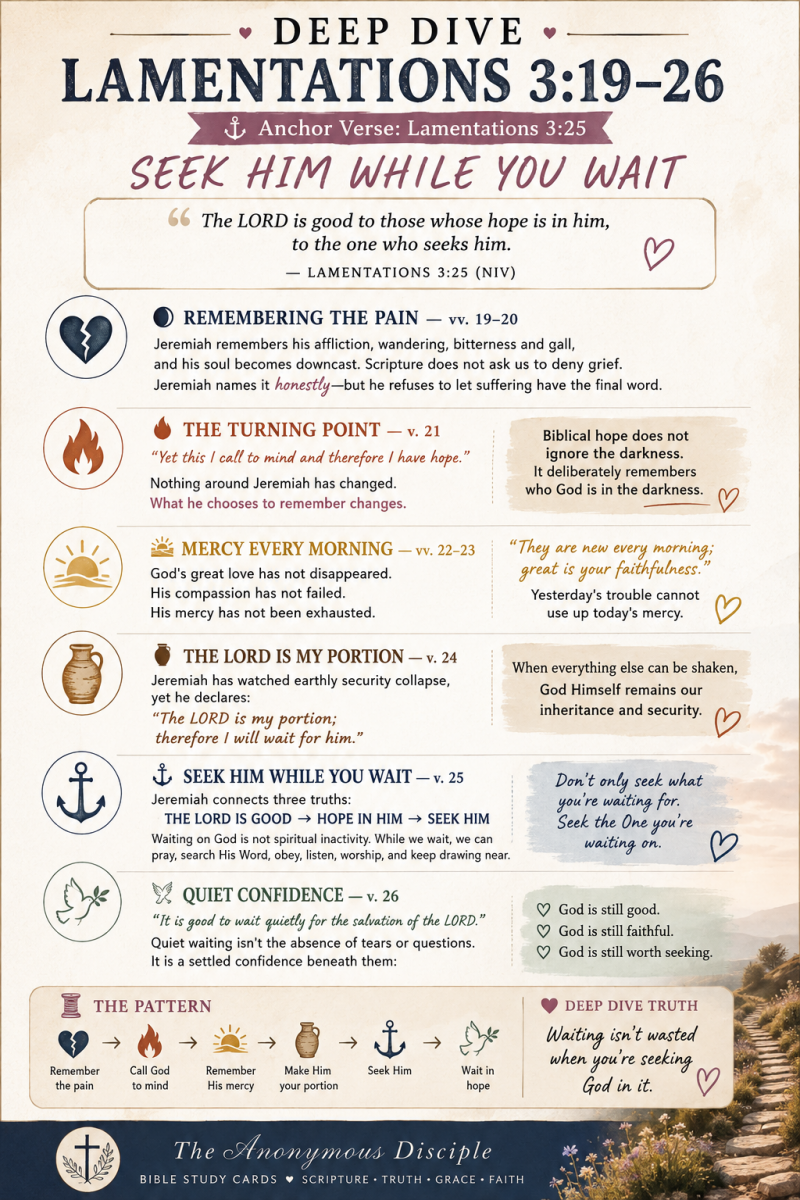


study notes
📖 Deep Dive: Lamentations 3:19–26
⚓ Anchor: Lamentations 3:25
Theme: Seek Him While You Wait
Lamentations 3:25 (NIV)
“The LORD is good to those whose hope is in him, to the one who seeks him.”
Before we even get into the individual verses, look at the movement of this passage:
Affliction → remembrance → hope → mercy → waiting → seeking → salvation.
Jeremiah doesn't get a change of circumstances in these verses.
He gets a change of focus. ❤️
🌑 Lamentations 3:19–20 — He Doesn't Pretend It Doesn't Hurt
Lamentations 3:19–20 (NIV)
“I remember my affliction and my wandering, the bitterness and the gall.
I well remember them, and my soul is downcast within me.”
Jeremiah isn't minimizing his suffering.
Jerusalem has been devastated. The people have experienced the consequences of rebellion and judgment. Jeremiah has witnessed terrible things.
And notice his words:
“I remember…”
“I well remember…”
His mind keeps returning to the pain.
And the result?
“My soul is downcast within me.”
There's an important spiritual truth here:
What we continually bring to mind affects the direction of our soul.
Jeremiah remembers the bitterness—and sinks.
But then comes verse 21.
🔥 Lamentations 3:21 — The Pivot
Lamentations 3:21 (NIV)
“Yet this I call to mind and therefore I have hope:”
I LOVE this verse. ❤️
Nothing outside Jeremiah has changed.
Jerusalem is still devastated.
The suffering is still real.
The loss hasn't disappeared.
But Jeremiah deliberately calls something else to mind.
“Yet…”
That tiny word changes the entire passage.
I remember the pain... YET.
I see the devastation... YET.
My soul is downcast... YET.
He essentially says:
There is something else I know to be true.
And that is where hope begins.
Biblical hope isn't pretending darkness isn't dark.
It's remembering who God is while standing in it.
🌅 Lamentations 3:22–23 — What Jeremiah Remembers
Lamentations 3:22–23 (NIV)
“Because of the LORD’s great love we are not consumed, for his compassions never fail.
They are new every morning; great is your faithfulness.”
There it is.
Jeremiah doesn't anchor his hope in:
Things will improve soon.
He anchors it in:
God has not changed.
❤️ “The LORD's great love”
The Hebrew idea here is tied to God's steadfast covenant love—His loyal, faithful love.
🕊️ “His compassions never fail”
God's compassion hasn't run dry because yesterday was difficult.
🌅 “They are new every morning”
Yesterday's mercy wasn't God's last supply.
Morning arrives...
and mercy is already there.
👑 “Great is Your faithfulness”
Notice the shift.
Jeremiah began with:
“I remember my affliction…”
Now he's remembering:
God's faithfulness.
Same man.
Same circumstances.
Different remembrance.
🏺 Lamentations 3:24 — “The LORD Is My Portion”
Lamentations 3:24 (NIV)
“I say to myself, ‘The LORD is my portion; therefore I will wait for him.’”
This is huge.
A person's portion was their share—the thing allotted to them, their inheritance.
Jeremiah has watched earthly security collapse.
Jerusalem.
Homes.
Possessions.
National stability.
Everything people thought they could depend upon had been shaken.
And Jeremiah essentially says:
“If everything else disappears, I still have God.”
That's why he can wait.
Not because waiting is comfortable.
But because the One he's waiting for is enough.
And then we arrive at our anchor. ⚓️
⚓ Lamentations 3:25 — “The LORD Is Good”
Lamentations 3:25 (NIV)
“The LORD is good to those whose hope is in him, to the one who seeks him.”
Look carefully at the three ideas packed into this verse:
God is good.
Hope in Him.
Seek Him.
Jeremiah doesn't say:
The LORD is good to those who understand what He's doing.
Or:
The LORD is good when circumstances prove it.
Or:
The LORD is good once the waiting ends.
He simply declares:
The LORD is good.
His goodness is His character.
Our circumstances don't determine whether God is good.
🔎 “To the one who seeks Him”
This is what really grabs me about your anchor verse.
Waiting on God isn't necessarily passive.
Jeremiah doesn't describe someone sitting around saying:
"Well... I guess I'll see what God does."
The person waiting is also seeking.
📖 Opening His Word.
🙏 Praying.
🕊️ Listening.
❤️ Trusting.
👣 Obeying what they already know.
👀 Watching for God's hand.
Waiting on God and seeking God belong together.
And that changes the question.
Instead of only asking:
“God, when are You going to change this?”
we begin asking:
“God, what can I learn about You while I'm here?”
That's a completely different posture.
🤫 Lamentations 3:26 — Quiet Waiting
Lamentations 3:26 (NIV)
“It is good to wait quietly for the salvation of the LORD.”
There's that word again:
good.
Verse 25:
The LORD is good.
Verse 26:
It is good to wait.
Why can the waiting be called good?
Because of who we're waiting for.
Quiet waiting doesn't mean we never cry, question, grieve, or pray desperately. Jeremiah has already done all of those things!
It means beneath all of that emotion there can still be a settled confidence:
God will be faithful.
🧵 Look at the Pattern
This passage forms such a beautiful progression:
v.19 — I remember my suffering.
⬇️
v.20 — My soul becomes downcast.
⬇️
v.21 — YET I deliberately remember something else.
⬇️
vv.22–23 — I remember God's mercy and faithfulness.
⬇️
v.24 — God Himself becomes my portion.
⬇️
v.25 — Therefore I hope in Him and seek Him.
⬇️
v.26 — And I can wait for Him.
That's powerful, Sherri.
Because Jeremiah doesn't get from despair to hope by denying reality.
He gets there by bringing God into his remembrance.
🔗 Scripture Echoes
This idea runs all through Scripture:
Psalm 27:14 (NIV) - “Wait for the LORD; be strong and take heart and wait for the LORD.”
Isaiah 40:31 (NIV) - “But those who hope in the LORD will renew their strength.”
Psalm 34:10 (NIV) - “Those who seek the LORD lack no good thing.”
Psalm 130:5 (NIV) - “I wait for the LORD, my whole being waits, and in his word I put my hope.”
Hebrews 11:6 (NIV) - “...he rewards those who earnestly seek him.”
There's that same combination:
Trust Him. Seek Him. Wait for Him.
❤️ The Heart of the Passage
Don't only seek what you're waiting for.
Seek the One you're waiting on.
Sometimes our prayers become entirely centered around the outcome:
When will this happen?
When will this change?
When will You answer?
When will this season end?
Lamentations 3 redirects us.
While you're waiting for God's hand, seek God's face.
Because sometimes the greatest thing God gives us during the waiting isn't immediately the thing we've asked for.
It's more of Himself. ❤️
⚓ Anchor Truth — Lamentations 3:25
“The LORD is good to those whose hope is in him, to the one who seeks him.”
So if I were boiling today's study down to one sentence, it would be:
Add comment
Comments