

God used one faithful, stubborn warrior standing in a bean field to protect His people and their food. It is a small picture of how God often works—through ordinary people who simply will not quit.
Who wrote it?
Same answer as the rest of 2 Samuel. The book itself never names an author. 1 Chronicles 29:29 points to records kept by the prophets Samuel, Nathan, and Gad. Samuel died earlier, so Nathan and Gad (who lived through David’s reign) most likely supplied the material about David’s later years and his mighty men. A later compiler put those records together, probably sometime after the kingdom split into Israel and Judah (after 931 BC) but before the northern kingdom fell (722 BC).
When did this happen?
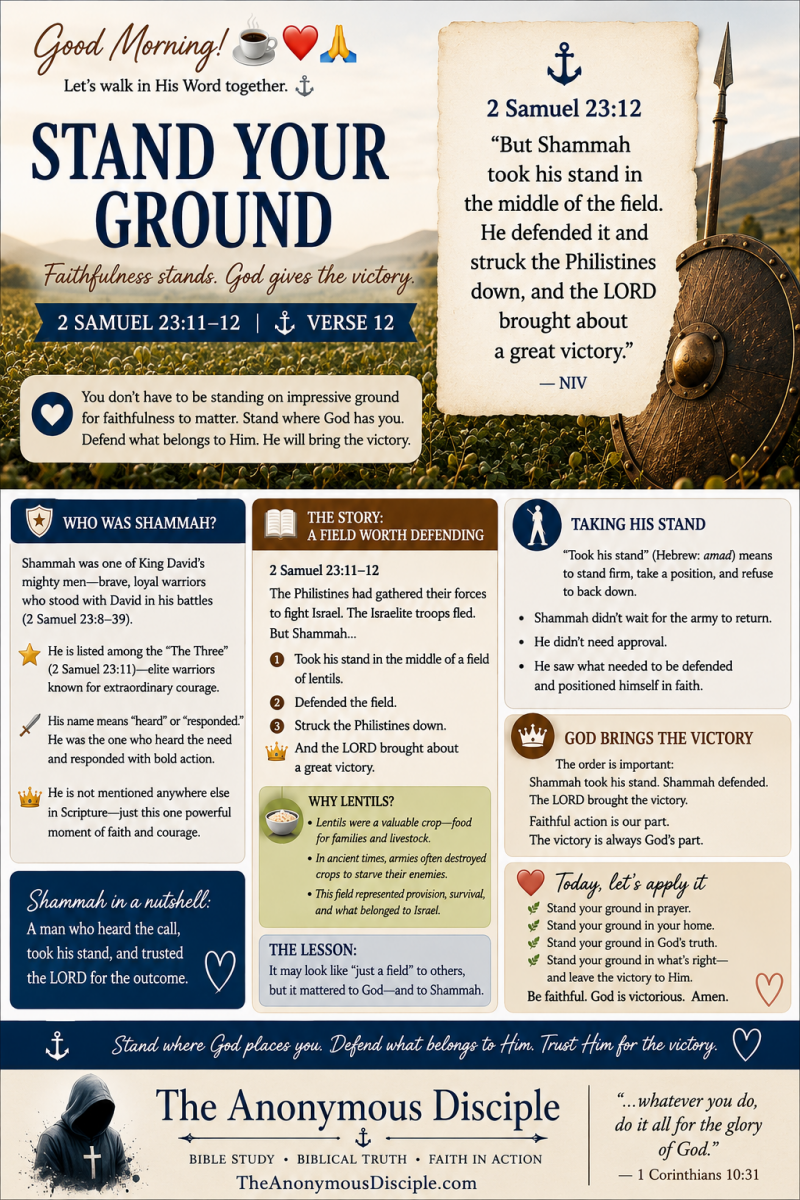
The events took place during King David’s reign, roughly 1010–970 BC, while he was still fighting the Philistines. This particular fight was a raid: the Philistines came to steal or destroy a field of lentils (a common food crop, like beans). Israel’s soldiers ran away. Shammah, one of David’s top three warriors, stood his ground alone in the middle of the field, fought them off, and the Lord gave a great victory. A similar story appears in 1 Chronicles 11:13-14 (there the crop is called barley—probably the same field or a closely related incident).
Why was it written?
Chapter 23 is an honor roll of David’s “mighty men”—the small group of extremely brave soldiers who helped him win the kingdom. Shammah is listed as the third of “the Three,” the very best of them.
Here are the three stories of “the Three,” David’s very top warriors, one after another so you can see how they fit together. All from the NIV.
1. Josheb-Basshebeth (verse 8)
These are the names of David’s mighty warriors:
Josheb-Basshebeth, a Tahkemonite, was chief of the Three; he raised his spear against eight hundred men, whom he killed in one encounter.
2. Eleazar son of Dodai (verses 9-10)
Next to him was Eleazar son of Dodai the Ahohite. As one of the three mighty warriors, he was with David when they taunted the Philistines gathered at Pas Dammim for battle. Then the Israelites retreated, but Eleazar stood his ground and struck down the Philistines till his hand grew tired and froze to the sword. The Lord brought about a great victory that day. The troops returned to Eleazar, but only to strip the dead.
3. Shammah son of Agee (verses 11-12)
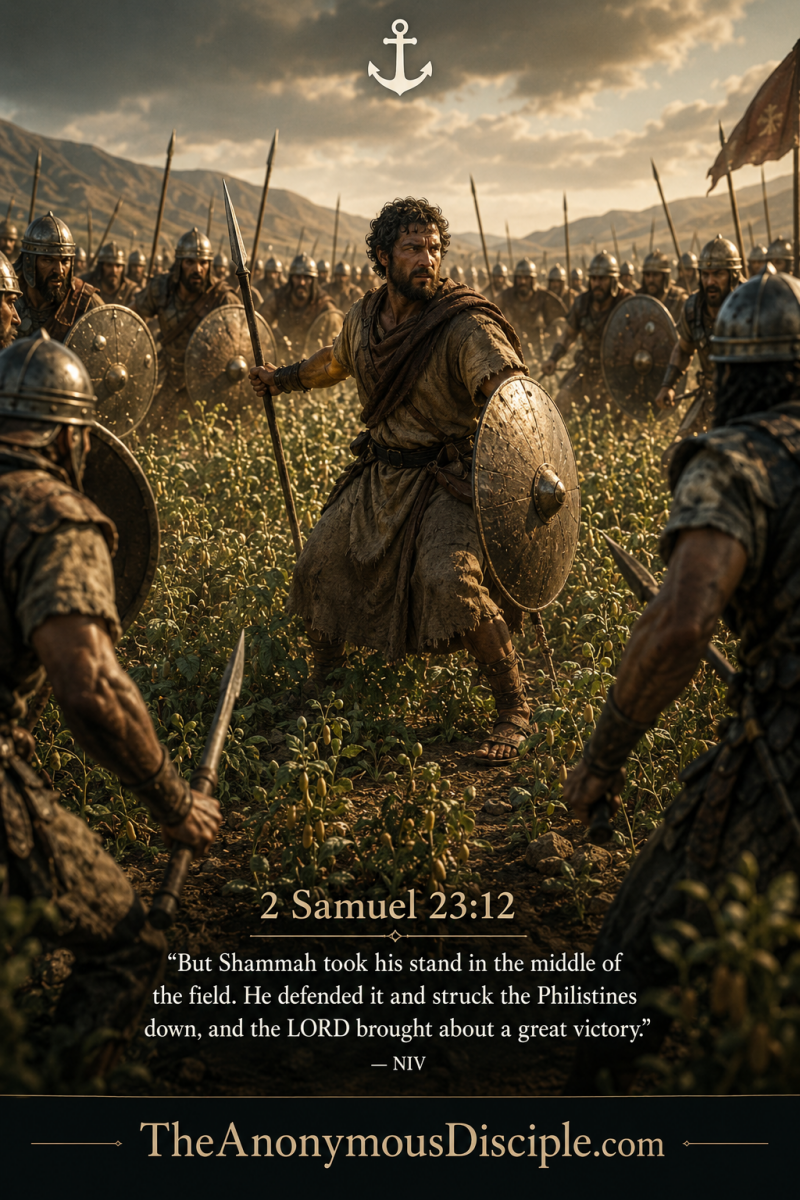
Next to him was Shammah son of Agee the Hararite. When the Philistines banded together at a place where there was a field full of lentils, Israel’s troops fled from them. But Shammah took his stand in the middle of the field. He defended it and struck the Philistines down, and the Lord brought about a great victory.
The pattern you can see
All three stories follow almost the same shape:
- The Philistines show up (often to steal food or pick a fight).
- The rest of Israel’s soldiers lose their nerve and run.
- One man refuses to run. He plants his feet and fights.
- The Lord gives the victory.
- The other soldiers only come back after the danger is over.
Josheb’s story is the “biggest numbers” version—800 men in one fight.
Eleazar’s story is the “I kept swinging until my hand locked onto the sword” version.
Shammah’s story is the “I will not give up this little lentil field” version.
None of them are fighting in a fancy palace or a huge city. They are fighting over a field of beans, or standing in the dirt when everyone else has already decided the day is lost. The writer wants us to notice that God often wins His battles through one stubborn, faithful person who simply will not quit when the crowd runs away.
That is why these three short stories sit together at the end of David’s life. They are a reminder that the kingdom was not built only by the king—it was also built by ordinary men who stood their ground when it would have been easier to flee. -𝕏James𝕏
STUDY NOTES
🪄Jenny🪄 -
This is Shammah, one of David’s mighty men. And verse 12 has one of those lines that practically begs us to stop:
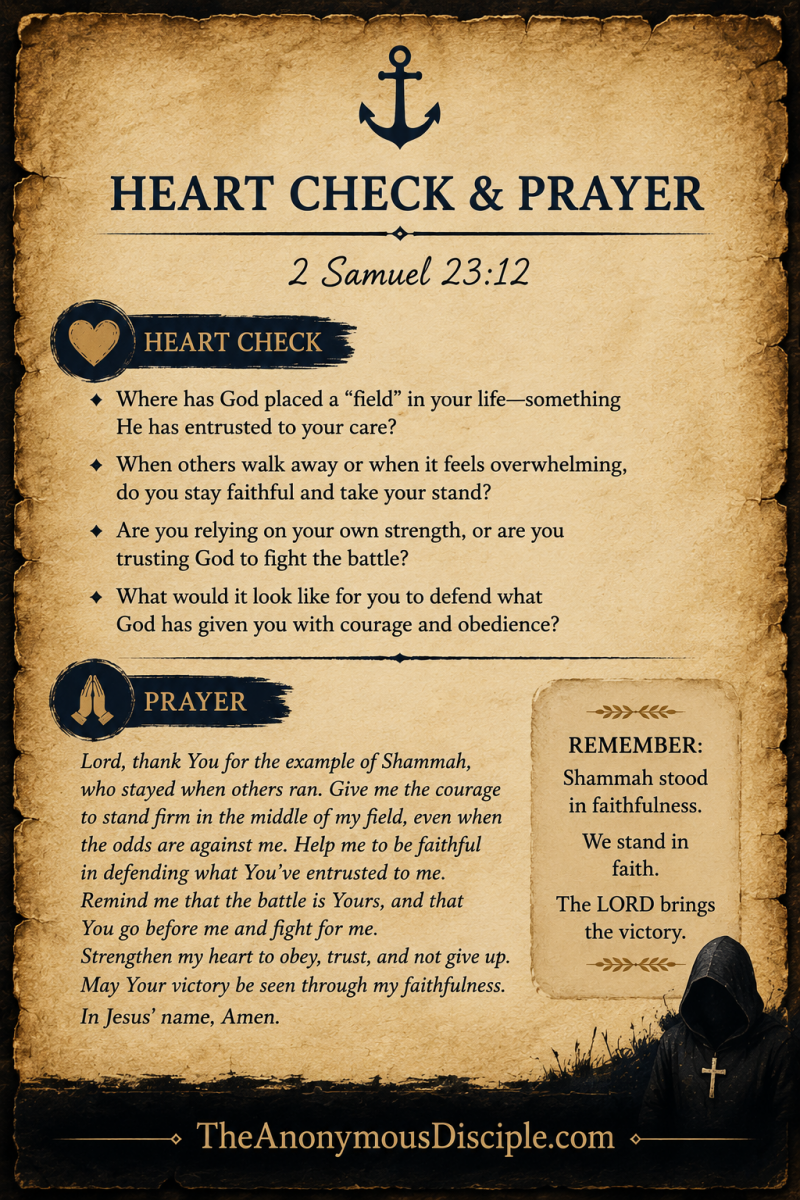
⚓️ 2 Samuel 23:12 — “But Shammah took his stand in the middle of the field. He defended it and struck the Philistines down, and the LORD brought about a great victory.” — NIV
Notice the order:
Shammah took his stand.
Shammah defended.
The LORD brought the victory.
👀❤️
And what was he standing in the middle of?
A field of lentils.
That sounds almost comically ordinary compared with a fortress, Jerusalem, or the ark. But the Philistines were taking what belonged to Israel, the rest of the troops fled, and Shammah decided this ground was worth standing on.
There is already a beautiful devotional truth sitting there:
You don't have to be standing on impressive ground for faithfulness to matter.
Sometimes the ground God has given you is a family. A marriage. A child. A ministry. A morning spent with His Word. A little corner of influence. Something that might look like nothing more than a lentil field to everybody else.
And sometimes everybody else runs.
But you stand.
Not because you're capable of producing the victory yourself—the text makes very sure we don't walk away thinking Shammah was the hero all by himself:
“…and the LORD brought about a great victory.” — 2 Samuel 23:12
Add comment
Comments