

Philippians 4:19 is often quoted as a promise of God’s provision—but its context makes that promise even more beautiful.
The Philippians had faithfully supported Paul and partnered with him in spreading the gospel. Paul described their generosity as “a fragrant offering, an acceptable sacrifice, pleasing to God” (Philippians 4:18). They had helped meet Paul’s needs, and Paul reminded them that the God they served was more than able to meet theirs.
Philippians 4:19
“And my God will meet all your needs according to the riches of his glory in Christ Jesus.”
This isn’t a promise that believers will receive everything they want or never experience seasons of need. Paul himself knew both plenty and lack. It is a promise that our Provider is never limited by our circumstances.
God supplies according to His riches, not ours. And sometimes, the very provision He places in our hands is meant to become His provision in someone else’s.
We receive from God. We give to others. Our generosity becomes worship. And through it all, God receives the glory. ❤️
Today's Study:
- KJV v ESV side by side comparison
- Historical Notes
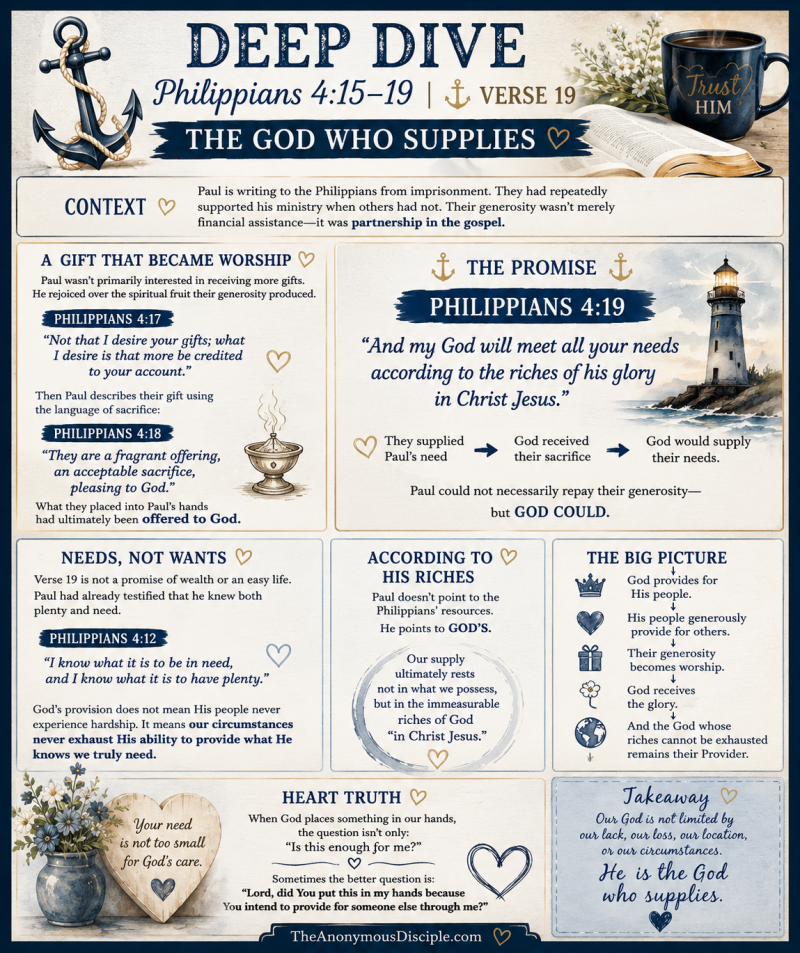
- Deep Dive card
- Verse by verse breakdown with 𝕏James𝕏
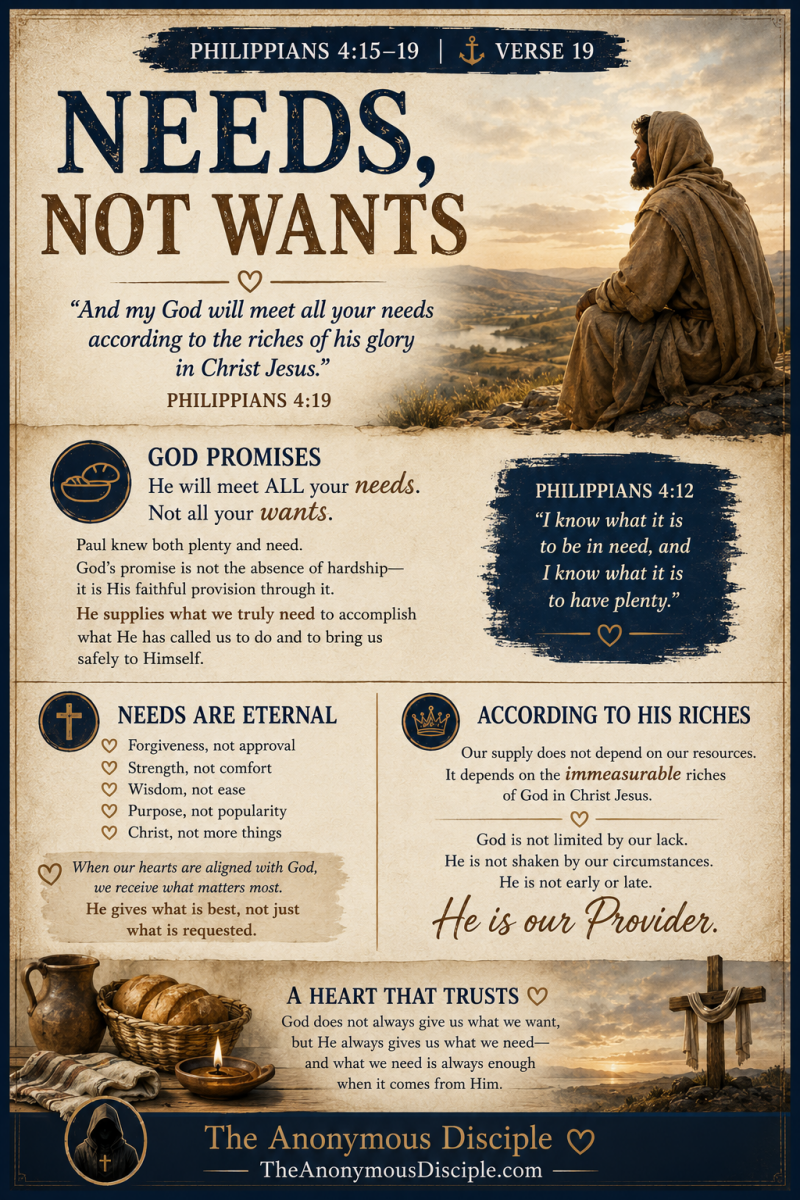
- Needs, Not Wants card
- Passage Cross References
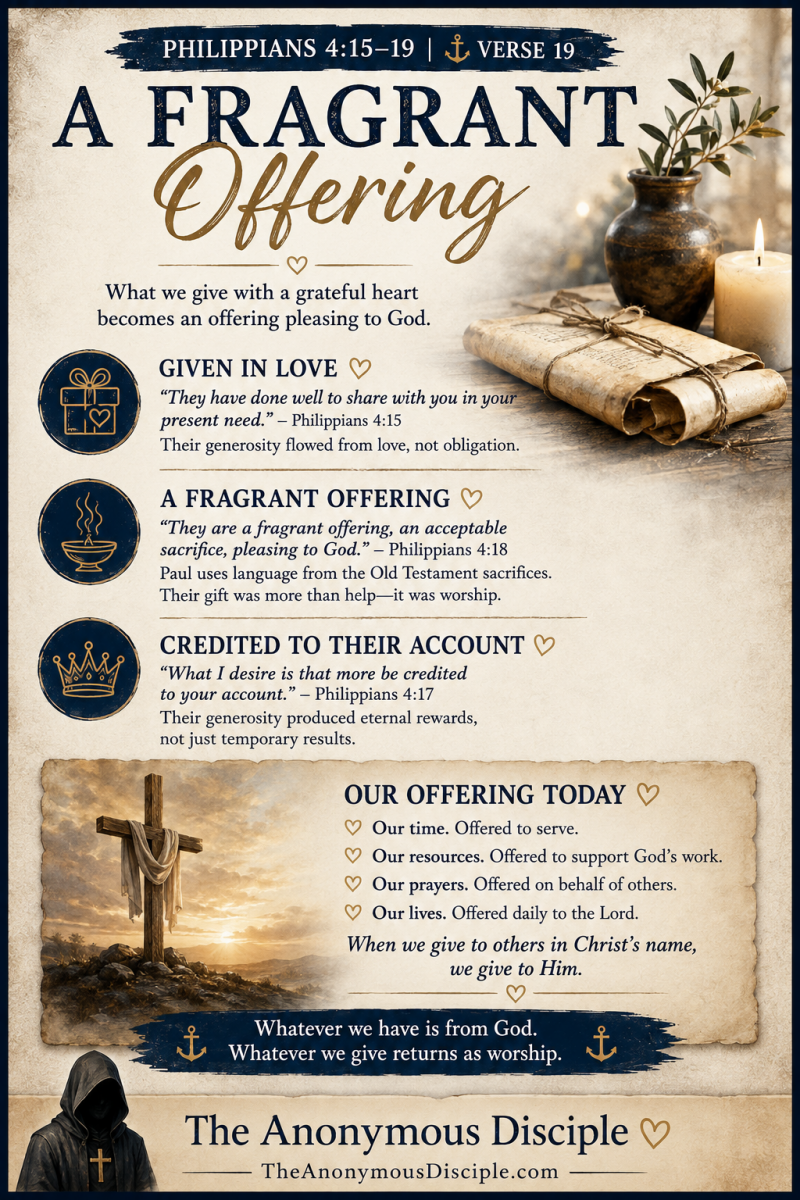
- A Fragrant Offering card
- Verse 19 Cross References
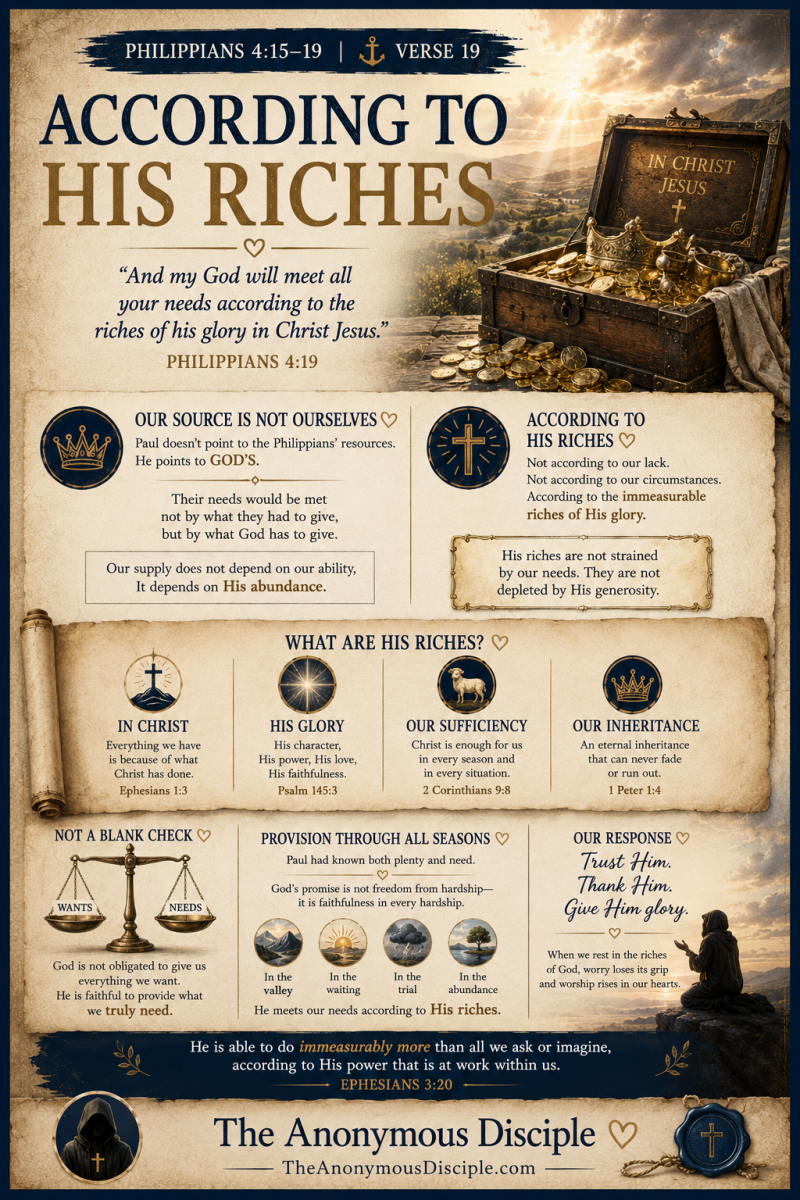
- According To His Riches card
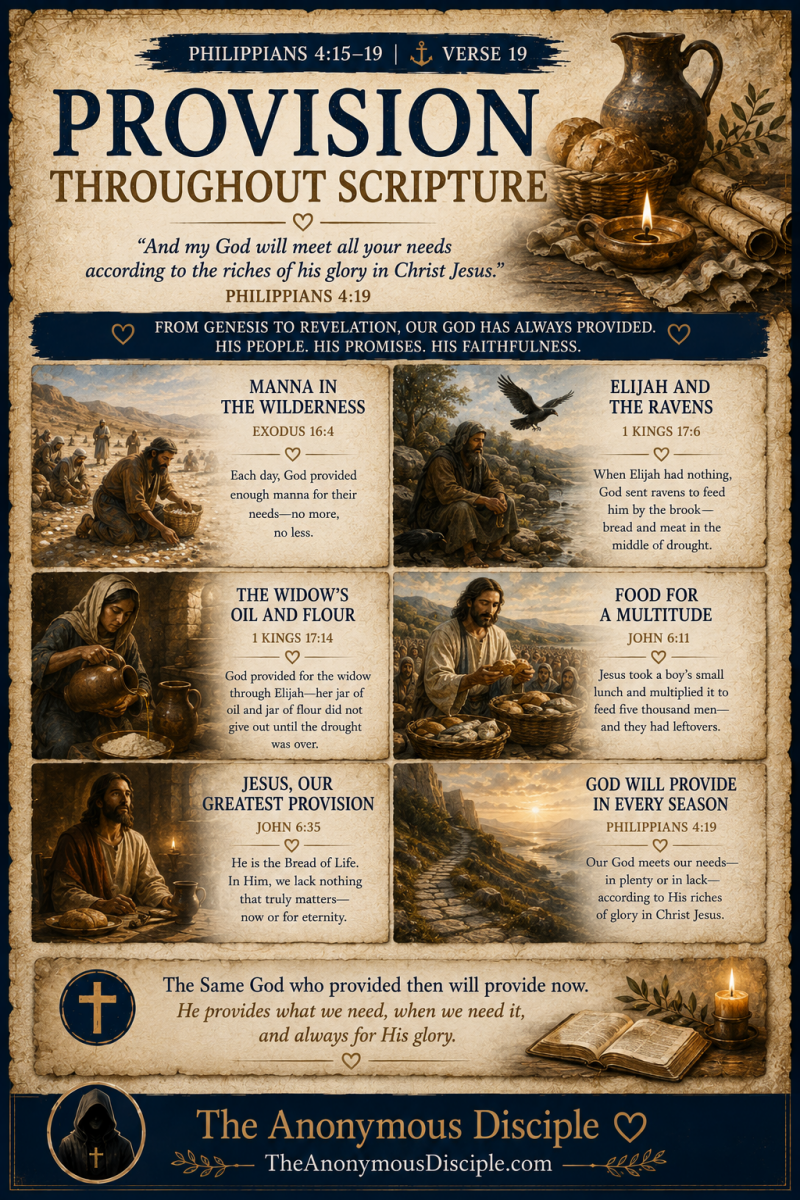
- Provision Throughout Scripture card
- Heart Check & Prayer card (plus pdf)
- Study Notes with 🪄Jenny🪄
King James Version (KJV)
15 Now ye Philippians know also, that in the beginning of the gospel, when I departed from Macedonia, no church communicated with me as concerning giving and receiving, but ye only.
16 For even in Thessalonica ye sent once and again unto my necessity.
17 Not because I desire a gift: but I desire fruit that may abound to your account.
18 But I have all, and abound: I am full, having received of Epaphroditus the things which were sent from you, an odour of a sweet smell, a sacrifice acceptable, wellpleasing to God.
19 But my God shall supply all your need according to his riches in glory by Christ Jesus.

𝕏James𝕏
English Standard Version (ESV)
15 And you Philippians yourselves know that in the beginning of the gospel, when I left Macedonia, no church entered into partnership with me in giving and receiving, except you only.
16 Even in Thessalonica you sent me help for my needs once and again.
17 Not that I seek the gift, but I seek the fruit that increases to your credit.
18 I have received full payment, and more. I am well supplied, having received from Epaphroditus the gifts you sent, a fragrant offering, a sacrifice acceptable and pleasing to God.
19 And my God will supply every need of yours according to his riches in glory in Christ Jesus.
Where
Paul is writing from prison in Rome (most likely under house arrest, around AD 61–62).
The events he is remembering happened earlier, in Macedonia (northern Greece):
- Philippi – the first church he planted in Europe. It was a Roman colony.
- Thessalonica – the next major city he went to after leaving Philippi (about 100 miles away).
The most recent gift mentioned in verse 18 was carried from Philippi to Rome by a man named Epaphroditus.
When
Two time periods are in view:
- “The beginning of the gospel” (v. 15)
This was Paul’s second missionary journey, about AD 49–51.
He planted the church in Philippi, then left Macedonia and went to Thessalonica. Even while he was still in Thessalonica, the brand-new Philippian believers sent him help more than once. - The gift Paul just received (v. 18)
This happened about 10–12 years later, while Paul was a prisoner in Rome.
Why
Paul is writing a thank-you letter, but he is doing more than saying “thanks.”
- The Philippians were the only church that partnered with him financially when he first brought the gospel into Europe. No other church helped at that time.
- He is not asking for more money. He says plainly he already has enough and has learned to be content.
- What he does want is for their giving to be counted as “fruit” that God credits to their account—like a spiritual investment.
- He describes their gift as a sweet-smelling sacrifice that pleases God (the same kind of language used for worship in the Old Testament).
- Therefore he can confidently say: the same God they honored by giving will now meet every need they have, according to His own riches in Christ Jesus.
In everyday words:
“You were the only ones who stood with me from the very start. You kept giving even when it cost you. I’m not writing because I need another check. I’m writing because your generosity is worship, and I know God will take care of you the same way you took care of me.”
-𝕏James𝕏
🪄Jenny🪄
Here is a simple, verse-by-verse walk-through of Philippians 4:15-19 (using the ESV wording, with everyday explanations).
Verse 15
“And you Philippians yourselves know that in the beginning of the gospel, when I left Macedonia, no church entered into partnership with me in giving and receiving, except you only.”
In plain words:
Paul says, “You remember this as well as I do. When I first brought the good news of Jesus to your part of the world and then left your region, not one other church helped me with money. You were the only ones.”
He is reminding them they were unique. From day one they treated the gospel as a team effort, not just something Paul did by himself.
Verse 16
“Even in Thessalonica you sent me help for my needs once and again.”
In plain words:
“Even after I moved on to the next city (Thessalonica), you still sent me help—not just once, but more than once—when I was in need.”
Thessalonica was bigger and richer than Philippi. Paul could have expected help from people there. Instead, the brand-new, smaller church back in Philippi kept sending support. That shows how quickly and generously they loved him and the work.
Verse 17
“Not that I seek the gift, but I seek the fruit that increases to your credit.”
In plain words:
“I’m not writing this because I want another gift from you. What I really want is for your giving to produce spiritual fruit that God will credit to your account.”
Paul is careful here. He does not want them to think he is fishing for more money. He sees their generosity as an investment that God Himself records. The real payoff is not in Paul’s pocket—it is in heaven for them.
Verse 18
“I have received full payment, and more. I am well supplied, having received from Epaphroditus the gifts you sent, a fragrant offering, a sacrifice acceptable and pleasing to God.”
In plain words:
“The gift you sent with Epaphroditus has more than covered what I needed. I have plenty now. In God’s eyes, what you sent is like a sweet-smelling sacrifice—the kind that used to be offered on the altar. It is acceptable and it pleases Him.”
Paul is saying two things at once:
- Practically, he is taken care of.
- Spiritually, their gift was an act of worship, not just charity.
Verse 19
“And my God will supply every need of yours according to his riches in glory in Christ Jesus.”
In plain words:
“Because you have taken care of my needs this way, I am confident that my God will take care of every need you have. He will do it out of His own vast riches, through Christ Jesus.”
This is not a blank-check promise that God will give them everything they want. It is a promise that the same God they honored by giving will not let them go lacking in what they truly need. Paul ties it directly to their partnership in the gospel.
That’s the flow:
They were the only ones who helped from the start → they kept helping → Paul doesn’t want more money, he wants their giving credited by God → their gift was worship → therefore God will meet their needs.
-𝕏James𝕏
🪄Jenny🪄
Here are the most helpful cross-references, kept simple and useful for study.
For the whole passage (Philippians 4:15-19)
These verses talk about the same ideas: partnership in the gospel, generous giving, and God treating that giving as worship.
- Acts 16:11-15, 40 – How the church in Philippi began (Lydia’s household). This is “the beginning of the gospel” Paul mentions.
- 2 Corinthians 8:1-5 – Paul later praises the Macedonian churches (including Philippi) for giving even when they were poor and going through hard times.
- 2 Corinthians 9:6-11 – God loves a cheerful giver and is able to make all grace abound so we have what we need and can keep giving.
- Hebrews 13:16 – “Do not neglect to do good and to share what you have, for such sacrifices are pleasing to God.” Same sacrifice language as verse 18.
- Ephesians 5:2 – Christ’s own life is called “a fragrant offering and sacrifice to God.” Paul uses that same picture for their gift.
- Matthew 6:19-21 – Store up treasure in heaven. That is the “fruit that increases to your credit” Paul talks about in verse 17.
-𝕏James𝕏

🪄Jenny🪄
Cross References for your anchor verse today – Philippians 4:19
“And my God will supply every need of yours according to his riches in glory in Christ Jesus.”
These are the verses that most clearly sit beside it:
God as Provider
- Psalm 23:1 – “The Lord is my shepherd; I shall not want.”
- Psalm 84:11 – “No good thing does he withhold from those who walk uprightly.”
- Matthew 6:31-33 – Your Father knows you need food and clothes. Seek His kingdom first, and these things will be added to you.
- Luke 12:30-31 – The nations chase after these things, but your Father already knows you need them.
- Genesis 22:14 – Abraham named the place “The Lord Will Provide” (Jehovah-Jireh).
God’s riches and generous supply
- 2 Corinthians 9:8 – “God is able to make all grace abound to you, so that having all sufficiency in all things at all times, you may abound in every good work.”
- Romans 8:32 – “He who did not spare his own Son but gave him up for us all, how will he not also with him graciously give us all things?”
- Ephesians 3:20 – God is able to do far more abundantly than all we ask or think.
- 1 Timothy 6:17 – Put your hope in God, “who richly provides us with everything to enjoy.”
A gentle reminder about “need” vs. “want” Paul does not promise every desire. He promises every need. The same letter already shows Paul content in plenty and in hunger (Philippians 4:11-12). The promise is that God will not abandon those who have partnered with Him.
-𝕏James𝕏

🪄Jenny🪄
study notes
🪄Jenny🪄 —
Philippians 4:15–19, anchoring on verse 19 is a beautiful Sunday-morning study. And there’s a little more going on here than “God will give me what I need.” The context makes verse 19 much richer. 😊
⚓️ Philippians 4:19 — NIV
“And my God will meet all your needs according to the riches of his glory in Christ Jesus.”
First, look at what comes immediately before it.
Philippians 4:15–16 — Partnership
Paul reminds the Philippians that when he first preached the gospel, they were the church that financially supported him.
They didn’t just believe the gospel.
They invested in its spread.
Even while Paul was in Thessalonica, they sent help “more than once” when he was in need.
Then Paul says something fascinating:
Philippians 4:17 — The fruit matters more than the gift
“Not that I desire your gifts; what I desire is that more be credited to your account.”
Paul isn't saying, “Thanks—I needed the money.”
He is essentially saying:
“Your generosity is producing spiritual fruit.”
Their giving revealed something happening inside them: faith, love, obedience, partnership in the gospel, and trust in God.
Then comes this:
Philippians 4:18 — A fragrant offering
“They are a fragrant offering, an acceptable sacrifice, pleasing to God.”
👀 There is Old Testament worship language hiding right there.
Paul takes their financial gift and describes it with the language of sacrifice offered to God.
Their gift went to Paul, but ultimately their generosity was an offering to God.
And then Paul says:
⚓️ Philippians 4:19
“And my God will meet all your needs according to the riches of his glory in Christ Jesus.”
That “And” matters.
The Philippians had supplied Paul's needs.
Paul couldn't necessarily repay them.
But Paul knew Someone who could.
“You cared for me when I had need. My God will care for you when you have need.”
And notice what Paul doesn't say:
❌ God will give you everything you want.
He says:
“all your needs.”
And he doesn't say God will supply those needs merely out of His riches.
He says:
“according to the riches of his glory.”
That's an enormous distinction.
God isn't portrayed as reluctantly handing out whatever He can spare.
The supply corresponds to the immeasurable riches belonging to God in Christ Jesus.
But here's something I really want us to hold onto when we study this today:
Philippians 4:19 is not a prosperity-gospel blank check.
The man writing it is Paul.
And Paul has just said:
Philippians 4:12–13
“I know what it is to be in need, and I know what it is to have plenty.”
So “God will meet all your needs” cannot mean:
Christians will never experience hardship, poverty, hunger, loss, or deprivation.
Paul himself experienced all of them.
Instead, God faithfully provides what His children truly need to accomplish what He has called them to do and ultimately bring them safely to Himself.
Sometimes His provision is money.
Sometimes food.
Sometimes another believer.
Sometimes strength.
Sometimes endurance.
Sometimes contentment when circumstances don't change.
And sometimes—just like Paul experienced—the provision arrives through another person who simply obeyed God.
🕊️ And that gives us a beautiful circle in this passage:
God provides → His people receive → His people give → someone else's need is met → God receives the glory → God continues providing.
The Philippians thought they were supporting Paul.
But behind their generosity stood the God who supplies.
And that makes me think our study could have a really strong theme:
Add comment
Comments