

Acts 2 takes us to one of the great turning points in Scripture: Pentecost and the birth of the Church. The promised Holy Spirit comes with the sound of wind and what appeared to be tongues of fire; people from many nations hear the wonders of God proclaimed in their own languages; and Peter boldly announces that the crucified and risen Jesus is both Lord and Messiah.
Then comes the response that stopped us this morning:
Acts 2:37:
“Now when they heard this, they were pricked in their heart…” — KJV
The NASB renders it:
“Now when they heard this, they were pierced to the heart…”
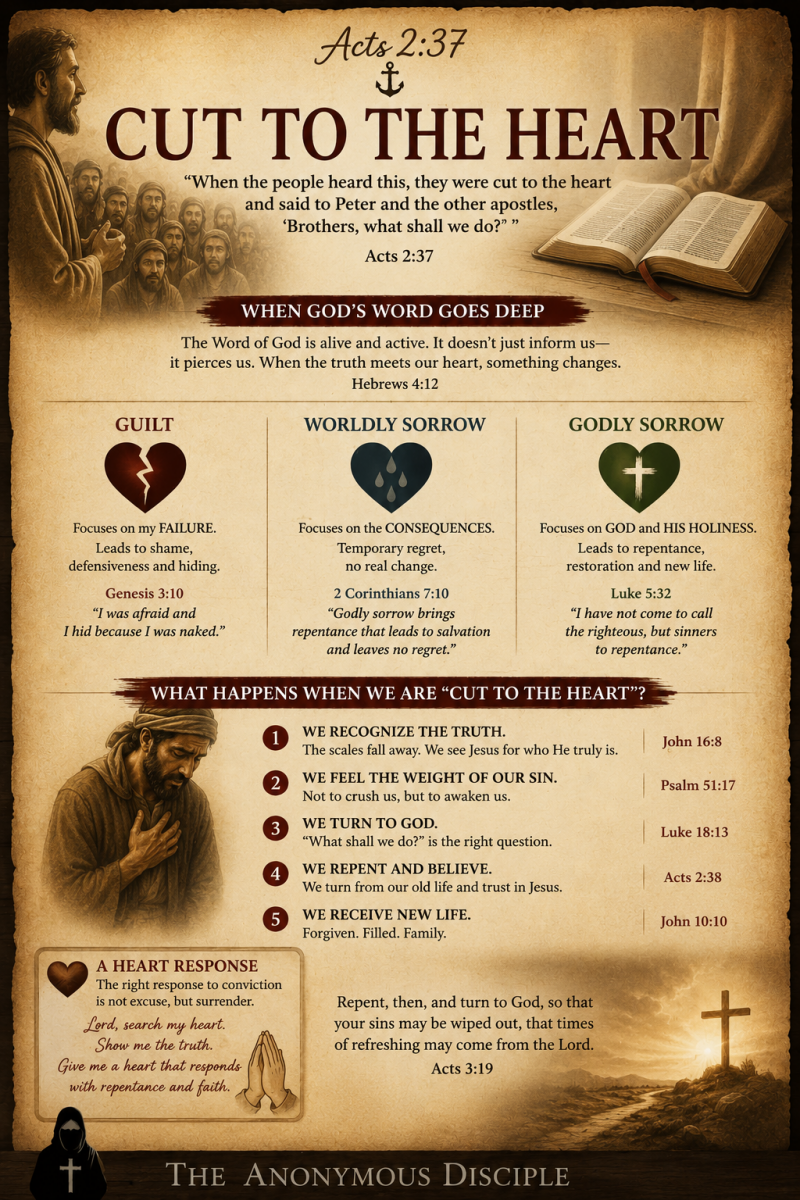
They heard the truth—and it went deeper than their ears. It reached the heart. Their question became, “What are we to do?”
And after repentance, baptism, and about three thousand people receiving the message, Luke gives us a beautiful picture of what their new life in Christ looked like:
Acts 2:42:
“They were continually devoting themselves to the apostles’ teaching and to fellowship, to the breaking of bread and to prayer.” — NASB
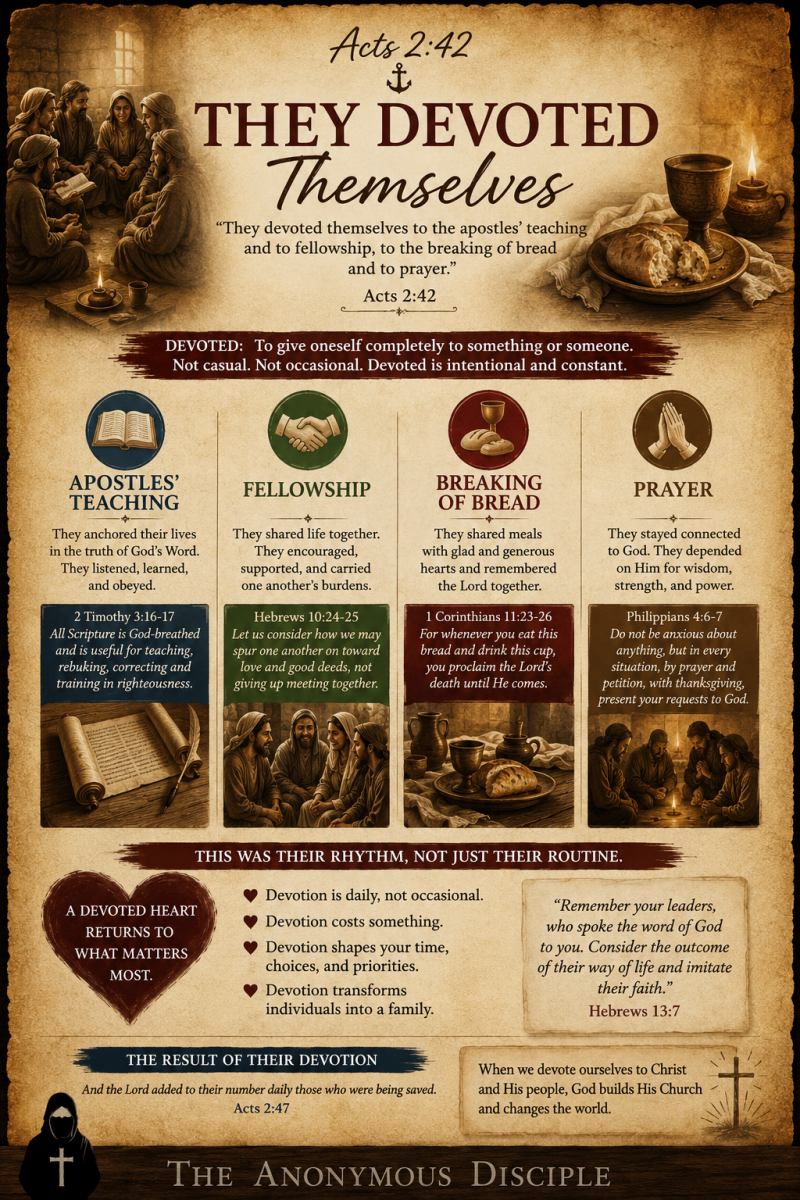
That word devoting became the heartbeat of our study. These believers weren't merely interested in Jesus. Their new faith began reshaping how they learned, how they lived together, how they remembered Christ, and how they prayed.
Today we're digging into that story from several directions: comparing the KJV and NASB translations, looking at the historical setting of Pentecost, walking through the passage verse by verse, exploring what it means to be Cut to the Heart, following important cross-references, and examining the four practices of those who Devoted Themselves.
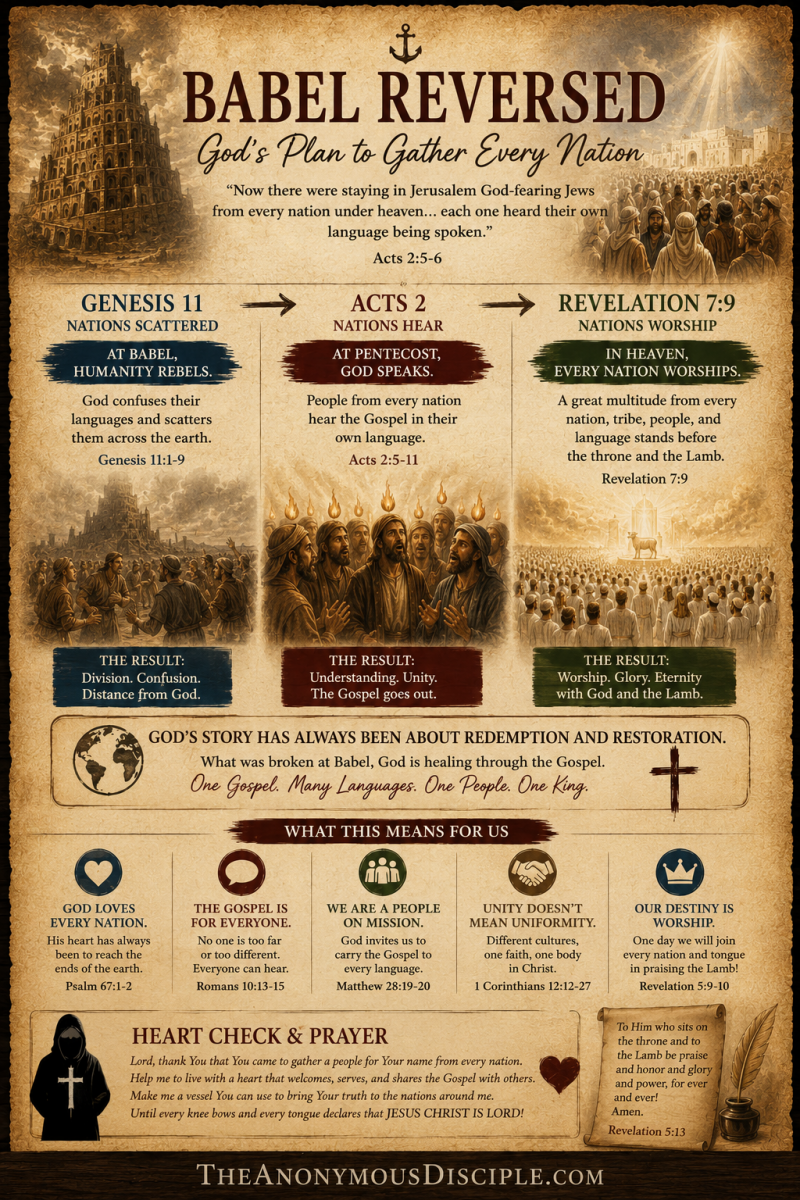
We'll also step back and follow an incredible thread across the whole Bible in Babel Reversed:
Genesis 11 — the nations scattered.
Acts 2 — the nations hear.
Revelation 7:9 — the nations worship.
One Gospel. Many languages. One redeemed people. One King. ❤️
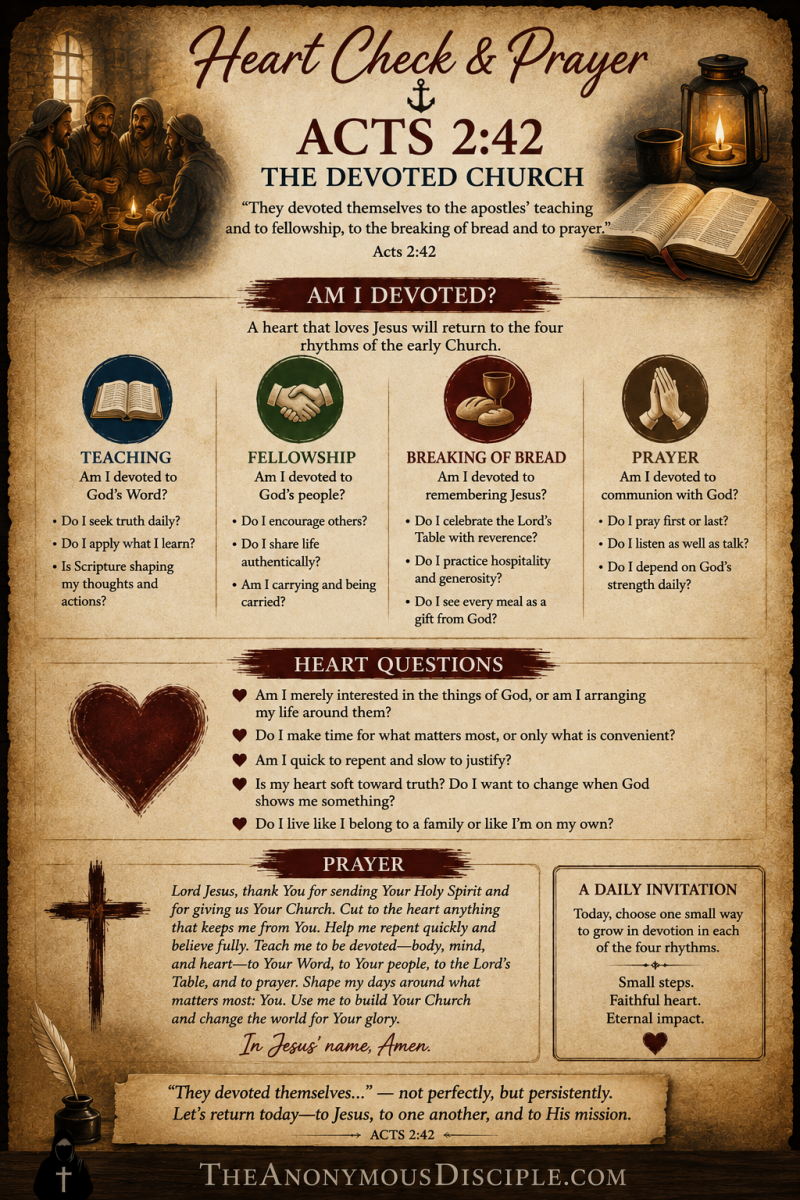
Finally, we'll bring everything home with our Heart Check & Prayer and deeper study notes.
Our question for today is simple, but it reaches pretty deep:
Am I merely interested in the things of God—or am I arranging my life around them?
⚓️ Acts 2:42 — They devoted themselves.
KJV - Acts 2:1-6
1 And when the day of Pentecost was fully come, they were all with one accord in one place.
2 And suddenly there came a sound from heaven as of a rushing mighty wind, and it filled all the house where they were sitting.
3 And there appeared unto them cloven tongues like as of fire, and it sat upon each of them.
4 And they were all filled with the Holy Ghost, and began to speak with other tongues, as the Spirit gave them utterance.
5 And there were dwelling at Jerusalem Jews, devout men, out of every nation under heaven.
6 Now when this was noised abroad, the multitude came together, and were confounded, because that every man heard them speak in his own language.
-----------------------------------------
Acts 2:36-37
36 Therefore let all the house of Israel know assuredly, that God hath made that same Jesus, whom ye have crucified, both Lord and Christ.
37 Now when they heard this, they were pricked in their heart, and said unto Peter and to the rest of the apostles, Men and brethren, what shall we do?
⚓️ Acts 2:42
KJV
And they continued stedfastly in the apostles' doctrine and fellowship, and in breaking of bread, and in prayers.
NASB
They were continually devoting themselves to the apostles’ teaching and to fellowship, to the breaking of bread and to prayer.
NASB - Acts 2:1-6
1 When the day of Pentecost had come, they were all together in one place.
2 And suddenly there came from heaven a noise like a violent rushing wind, and it filled the whole house where they were sitting.
3 And there appeared to them tongues as of fire distributing themselves, and they rested on each one of them.
4 And they were all filled with the Holy Spirit and began to speak with other tongues, as the Spirit was giving them utterance.
5 Now there were Jews living in Jerusalem, devout men from every nation under heaven.
6 And when this sound occurred, the crowd came together, and were bewildered because each one of them was hearing them speak in his own language.
------------------------------------------
Acts 2:36-37
36 Therefore let all the house of Israel know for certain that God has made Him both Lord and Christ—this Jesus whom you crucified.
37 Now when they heard this, they were pierced to the heart, and said to Peter and the rest of the apostles, “Brethren, what shall we do?”

Why it was written
- To give an orderly, trustworthy account of what Jesus continued to do after He went back to heaven — now through the Holy Spirit and His people.
- To show how the gospel moved from Jerusalem to the rest of the world (Acts 1:8).
- So Theophilus (and every reader) could be certain of the things they had been taught.
- To record the birth of the church and how God opened the door to the Gentiles.
- To show that the Christian faith was not a threat to Rome.
In short: Luke wrote Acts as “volume 2” of the story that began in his Gospel — Jesus is still at work, the Spirit has come, and the good news is going out to the whole world.
Who wrote it
Luke — the same Luke who wrote the Gospel of Luke. He was a physician and a close companion of the apostle Paul. He does not name himself in the book, but the early church, the matching style with Luke’s Gospel, and the “we” sections (where the writer is traveling with Paul) all point to him.
When it was written
Most conservative Bible teachers date it around AD 62–64 (early 60s). The book ends with Paul still alive under house arrest in Rome and does not mention Paul’s later death, Nero’s persecution of Christians, or the destruction of Jerusalem in AD 70. Some scholars date it later (80s), but the early date fits the ending of the story well.
Where it was written
The Bible does not say for sure. The most common view is that Luke wrote it in Rome while he was with Paul during those two years of house arrest (Acts 28:30–31).
To whom it was written
It is addressed to Theophilus — the same person Luke wrote his Gospel to (Luke 1:3; Acts 1:1). The name means “lover of God” or “friend of God.” The title “most excellent Theophilus” suggests he may have been a real person of some rank, possibly a Roman official. Luke also wrote for the wider church, especially Gentile believers who needed a clear record of how the church began.
Today's Study:
- KJV v NASB translation comparison
- Historical Notes
- Deep Dive study card
- Layman's Verse by Verse Breakdown
- Cut To The Heart card
- Cross References
- They Devoted Themselves card
- Babel Reversed card
- Heart Check & Prayer card (plus pdf)
- Deep Study Notes
Acts 2:1 - Layman's Verse by Verse Breakdown:
“When the day of Pentecost came, they were all together in one place.”
Pentecost was a Jewish feast that came 50 days after Passover. The believers (about 120 of them, including the apostles) were waiting together in Jerusalem just like Jesus had told them to. They were in one room, unified and ready.
Acts 2:2
“Suddenly a sound like the blowing of a violent wind came from heaven and filled the whole house where they were sitting.”
Out of nowhere a loud sound like a strong, rushing wind filled the whole house. It wasn’t just a breeze — it was a powerful sign from God that something big was happening.
Acts 2:3
“They saw what seemed to be tongues of fire that separated and came to rest on each of them.”
They saw what looked like flames of fire that split apart and sat on every person there. Fire in the Bible often shows God’s presence and power. This was God marking each believer with His Spirit.
Acts 2:4
“All of them were filled with the Holy Spirit and began to speak in other tongues as the Spirit enabled them.”
The Holy Spirit filled every one of them. Then they started speaking in languages they had never learned. The Spirit Himself gave them the words. This was the moment the church was born and given power.
Acts 2:5
“Now there were staying in Jerusalem God-fearing Jews from every nation under heaven.”
Jerusalem was packed with Jewish people who had come from all over the known world for the feast. They were devout — they loved God and had traveled a long way to worship.
Acts 2:6
“When they heard this sound, a crowd came together in bewilderment, because each one heard their own language being spoken.”
The noise drew a huge crowd. People were stunned because they heard the believers speaking in their own native languages. God was making sure everyone could understand the message in their heart language.
Acts 2:36
“Therefore let all Israel be assured of this: God has made this Jesus, whom you crucified, both Lord and Messiah.”
Peter finishes his sermon with a strong, clear statement: The same Jesus you crucified is the One God has made both Lord (the One in charge) and Messiah (the promised Savior). There is no middle ground.
Acts 2:37
“When the people heard this, they were cut to the heart and said to Peter and the other apostles, ‘Brothers, what shall we do?’”
The truth hit them hard. They felt deep conviction — like their hearts had been pierced. They didn’t argue. They asked the most important question: “What do we do now?”
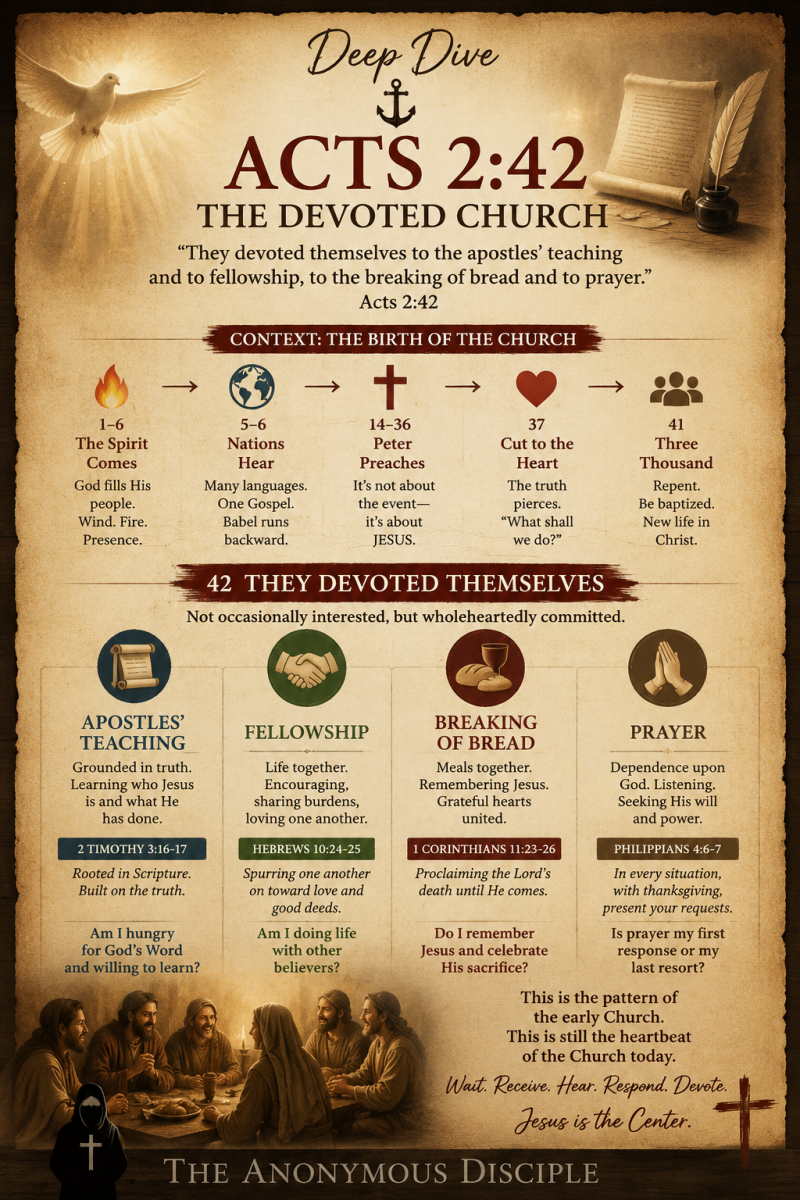
Acts 2:42
“They devoted themselves to the apostles’ teaching and to fellowship, to the breaking of bread and to prayer.”
After they believed and were baptized, they didn’t go back to life as usual. They stuck close to four things:
- Learning from the apostles
- Sharing life with other believers
- Remembering Jesus in the Lord’s Supper and meals together
- Praying
This became the daily pattern of the first church.
That’s the flow in plain words: God sent His Spirit, the message went out in every language, people were convicted of who Jesus really is, and the new believers immediately started living a new kind of life together.
-𝕏James𝕏
Here are helpful cross references for the verses we’ve been looking at. I kept the list focused so it doesn’t feel like too much at once. These are verses that shine extra light on the same truths.
Acts 2:1
They were all together waiting on the day of Pentecost.
- Acts 1:4–5, 14 — Jesus told them to wait in Jerusalem for the gift the Father promised. They were praying together.
- Leviticus 23:15–16 — Pentecost (the Feast of Weeks) was already on God’s calendar, 50 days after Passover.
- Luke 24:49 — Jesus said, “I am going to send you what my Father has promised; but stay in the city until you have been clothed with power from on high.”
Acts 2:2–3
The sound of a mighty wind and tongues of fire.
- Exodus 19:16–18 — When God came down on Mount Sinai there was thunder, a loud sound, and fire.
- 1 Kings 19:11–12 — The Lord was not in the wind or the fire, but He often uses those signs when He shows up.
- John 3:8 — Jesus said the Spirit is like the wind: you hear it but you cannot control it.
- Ezekiel 37:9–10 — God told Ezekiel to call the breath (or wind) to bring life to the dry bones.
Acts 2:4
Filled with the Holy Spirit and speaking in other languages.
- Joel 2:28–32 — Peter quotes this next. God promised to pour out His Spirit on all people.
- Acts 1:8 — “You will receive power when the Holy Spirit comes on you; and you will be my witnesses…”
- John 14:16–17, 26 — Jesus promised the Spirit would come and teach them.
- 1 Corinthians 12:13 — We are all baptized by one Spirit into one body.
Acts 2:5–6
Jews from every nation heard the message in their own language.
- Genesis 12:3 — God promised Abraham that all nations would be blessed through him.
- Isaiah 2:2–3 — People from all nations would come to learn the Lord’s ways.
- Matthew 28:19 — Jesus said, “Go and make disciples of all nations.”
Acts 2:36
God has made this Jesus both Lord and Messiah.
- Psalm 110:1 — “The Lord says to my Lord: ‘Sit at my right hand…’” (Peter just quoted this.)
- Luke 2:11 — The angel said a Savior has been born who is Messiah and Lord.
- Philippians 2:9–11 — God exalted Jesus and gave Him the name above every name so that every tongue will confess that Jesus Christ is Lord.
- Romans 10:9 — If you declare with your mouth, “Jesus is Lord,” and believe in your heart that God raised Him from the dead, you will be saved.
- Matthew 28:18 — “All authority in heaven and on earth has been given to me.”
Acts 2:37
They were cut to the heart and asked, “What shall we do?”
- John 16:8 — The Holy Spirit convicts the world of sin, righteousness, and judgment.
- Hebrews 4:12 — The word of God is living and active… it judges the thoughts and attitudes of the heart.
- Acts 16:30 — The jailer asked the same question: “Sirs, what must I do to be saved?”
Acts 2:42
They devoted themselves to the apostles’ teaching, fellowship, breaking of bread, and prayer.
- Acts 1:14 — They were already devoted to prayer before Pentecost.
- John 8:31 — “If you hold to my teaching, you are really my disciples.”
- 1 John 1:3, 7 — We have fellowship with the Father and with one another.
- Luke 22:19 and 1 Corinthians 11:23–26 — Jesus said, “Do this in remembrance of me” when He broke the bread.
- Acts 20:7 — The church gathered on the first day of the week to break bread.
- Hebrews 10:25 — Let us not give up meeting together… but encourage one another.
These verses help us see that what happened on Pentecost was not a surprise to God. He had been pointing to it all along — in the feasts, in the prophets, in Jesus’ promises, and then in the everyday life of the first believers.
Deep Study Notes
🪄Jenny🪄 -
Acts 2:1–6, 36–37 shows the birth of the Church, while Acts 2:42 shows what that newborn Church actually did once people believed.
Acts 2:1–6 — God comes to dwell in His people
Acts 2:1 (NIV):
“When the day of Pentecost came, they were all together in one place.”
That little phrase matters: “all together.”
Jesus had told them not to run off and begin ministry on their own. They were to wait for the promised Holy Spirit.
Acts 1:4–5:
“Do not leave Jerusalem, but wait for the gift my Father promised… For John baptized with water, but in a few days you will be baptized with the Holy Spirit.”
So Acts 2 begins with obedient waiting.
They weren’t manufacturing revival.
They weren’t developing a church-growth strategy.
They were simply where Jesus told them to be.
And then God moved.
Acts 2:2–4 — Wind. Fire. Spirit.
Acts 2:2–4:
“Suddenly a sound like the blowing of a violent wind came from heaven and filled the whole house where they were sitting. They saw what seemed to be tongues of fire… All of them were filled with the Holy Spirit…”
Notice Luke’s careful wording.
It was “like” wind.
It was “what seemed to be” fire.
Luke is describing something supernatural using physical language.
And both images are deeply biblical.
Wind / breath often accompanies the Spirit of God.
Genesis 2:7: God breathes life into Adam.
Ezekiel 37:9–10: breath enters the dry bones and they live.
Even the biblical words for Spirit carry that idea:
Hebrew: ruach — spirit, wind, breath.
Greek: pneuma — spirit, wind, breath.
That connection is beautiful after our Genesis 2 study the other day. ❤️
God breathed life into humanity at creation.
Now, at Pentecost, God breathes life into His Church.
And then there is fire.
Throughout Scripture, fire often accompanies God's presence.
Exodus 3:2: the burning bush.
Exodus 13:21: the pillar of fire.
Exodus 19:18: Sinai covered with smoke because the LORD descended in fire.
But now something has changed.
The fire does not descend on a mountain.
It rests on people.
That is enormous.
God’s presence is no longer represented primarily by a tabernacle or temple.
God is dwelling in His people.
Paul later says:
1 Corinthians 3:16:
“Don’t you know that you yourselves are God’s temple and that God’s Spirit dwells in your midst?”
🔥 Pentecost is temple imagery becoming personal.
Acts 2:5–6 — Babel begins to run backward
Then something fascinating happens.
Acts 2:5–6:
“Now there were staying in Jerusalem God-fearing Jews from every nation under heaven… each one heard their own language being spoken.”
Think about Genesis 11.
At Babel, humanity rebels against God.
God confuses their languages.
People scatter among the nations.
But Acts 2 begins with people from the nations gathered in Jerusalem…
…and suddenly they hear one Gospel in many languages.
The languages are not erased.
Instead, God speaks through them.
That is almost like a preview of the final redeemed multitude.
Revelation 7:9:
“There before me was a great multitude… from every nation, tribe, people and language, standing before the throne and before the Lamb.”
Genesis 11: nations scattered.
Acts 2: nations hear.
Revelation 7: nations worship.
That is one gorgeous biblical storyline. ❤️
Then Peter preaches Jesus
Most of Acts 2 is Peter explaining what just happened.
And look at the man delivering the sermon.
Weeks earlier Peter had denied Jesus three times.
Now the Holy Spirit fills him…
…and the frightened fisherman stands publicly in Jerusalem and proclaims Christ.
The center of his message is not Pentecost itself.
It is Jesus.
That matters.
The Holy Spirit’s ministry points people toward Christ.
Peter finally reaches his conclusion:
Acts 2:36:
“Therefore let all Israel be assured of this: God has made this Jesus, whom you crucified, both Lord and Messiah.”
That is the hammer blow of the sermon.
Jesus is Lord.
Jesus is Messiah.
Jesus was crucified.
Jesus was raised.
And then comes the verse I would probably put a giant circle around this morning.
Acts 2:37 — “Cut to the heart”
Acts 2:37:
“When the people heard this, they were cut to the heart and said to Peter and the other apostles, ‘Brothers, what shall we do?’”
Ohhhh...
There is our meditation verse. ❤️
“They were cut to the heart.”
The Greek idea here carries the sense of being pierced deeply inwardly.
They didn’t merely say:
“That was an interesting sermon.”
They realized:
This is true.
And truth demanded a response.
That is what Scripture is supposed to do.
Hebrews 4:12:
“For the word of God is alive and active. Sharper than any double-edged sword…”
God’s Word doesn’t simply inform us.
Sometimes it wounds us before it heals us.
It exposes.
It convicts.
It dismantles excuses.
And when the Holy Spirit uses the Word that way, the correct response isn’t:
“What do they need to change?”
It is exactly what these people asked:
“What shall we do?”
That is a phenomenal Bible-study prayer, actually.
Whenever we open Scripture:
Lord, what are You showing me—and what should I do with it?
❤️
And that brings us directly to your devotional verse
After Peter tells them to repent and be baptized, about three thousand people believe.
Then Luke tells us how these brand-new Christians lived.
Acts 2:42:
“They devoted themselves to the apostles’ teaching and to fellowship, to the breaking of bread and to prayer.”
And the word that jumps out at me is:
DEVOTED.
Not occasionally interested.
Not “when life wasn’t busy.”
Not “when the sermon was entertaining.”
Devoted.
The early Christians organized their lives around four things:
- Apostles’ teaching — learning the truth about Christ.
- Fellowship — sharing life with other believers.
- Breaking of bread — meals together and likely remembrance of Jesus in communion.
- Prayer — dependence upon God.
And notice something.
Christianity immediately became communal.
They didn’t hear Peter preach and say:
“Great. I have Jesus now. I don’t need anybody else.”
They joined a people.
They learned together.
They ate together.
They prayed together.
They worshiped together.
They carried one another.
That is why the New Testament describes Christians as a body, not merely a collection of isolated believers.
1 Corinthians 12:27:
“Now you are the body of Christ, and each one of you is a part of it.”
Here is what I think Acts 2 is asking us this morning
Pentecost begins with believers waiting on God.
The Spirit comes.
The Gospel is proclaimed.
People are cut to the heart.
They respond.
Then they devote themselves to a life centered on Christ.
And that gives us a beautiful progression:
Wait → Receive → Hear → Be convicted → Respond → Devote yourself.
🔥
But I think there’s another quieter challenge hiding in Acts 2:42.
We live in a Christianity where it is very easy to consume biblical content.
Listen to sermons.
Watch Bible videos.
Read devotionals.
Save Scripture posts.
Study prophecy.
Learn theology.
And those things can be wonderful.
But Acts 2 describes something deeper.
They devoted themselves.
The Word was not merely something they learned.
It became the structure of their lives.
So my heart-check question this morning would be:
Am I merely interested in the things of God—or am I arranging my life around them?
And I don't hear that as condemnation.
I hear it as an invitation.
Because devotion isn't perfection.
Devotion means:
“This is where my heart keeps returning.”
Add comment
Comments