

Paul does not pretend the Christian life is easy. We are jars of clay—fragile, limited, and sometimes hard pressed, perplexed, persecuted, and struck down. Yet within these ordinary vessels God has placed an extraordinary treasure: the gospel of Jesus Christ and the power of God at work in us.
That is why Paul can say, “Therefore we do not lose heart” (2 Corinthians 4:16). Our outward circumstances may weaken us, but God is renewing us inwardly day by day. What hurts now is real, but it is temporary; what God has promised is eternal. Our suffering is not the end of the story—resurrection and glory are coming.
Today we’ll look beyond the fragile jar to the treasure within, beyond what is seen to what is unseen, and beyond present trouble to the eternal glory awaiting those who belong to Christ.
The jar is fragile. The treasure is priceless. The suffering is temporary. The glory is eternal. Therefore, we do not lose heart. ❤️🕊️
I pray Our Infinitely Faithful & Wonderful Savior, Lord Jesus, blesses & keeps you today and always!

Today's Study:
- Historical Notes
- KJV v NIV translations for comparison
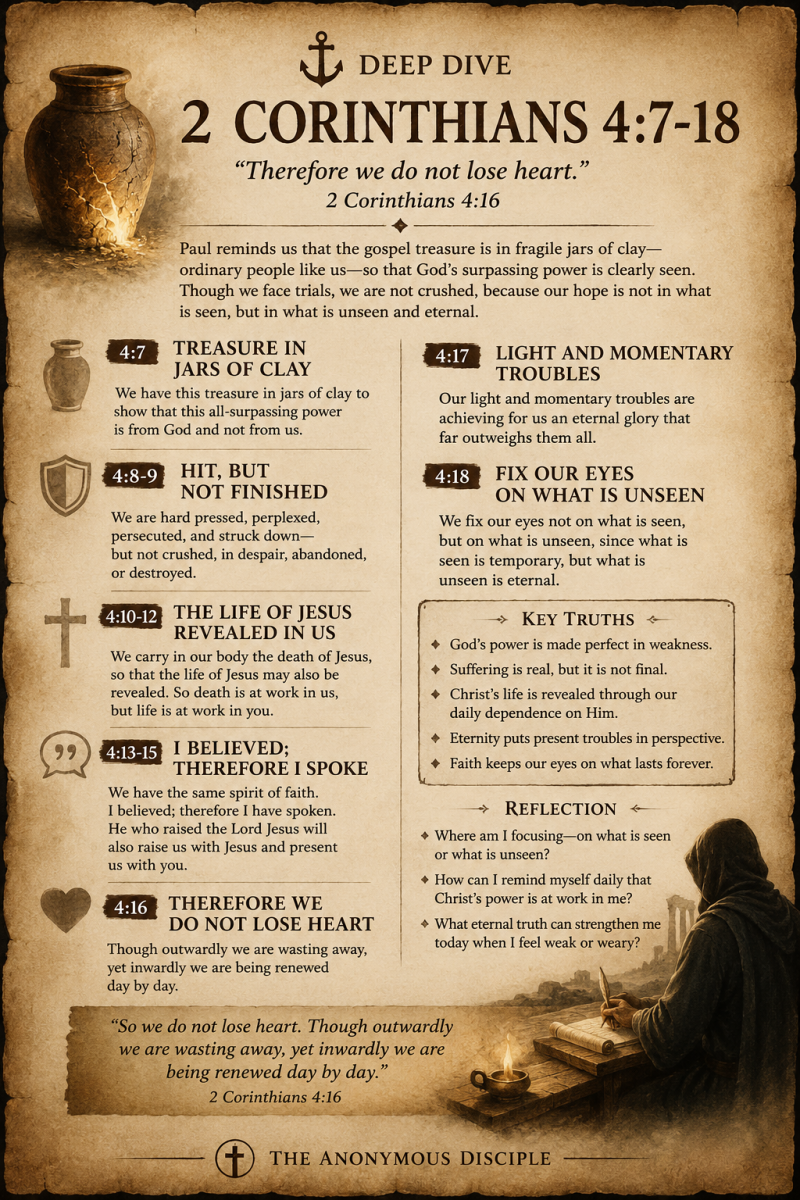
- Deep Dive Study card
- Layman's verse by verse breakdown
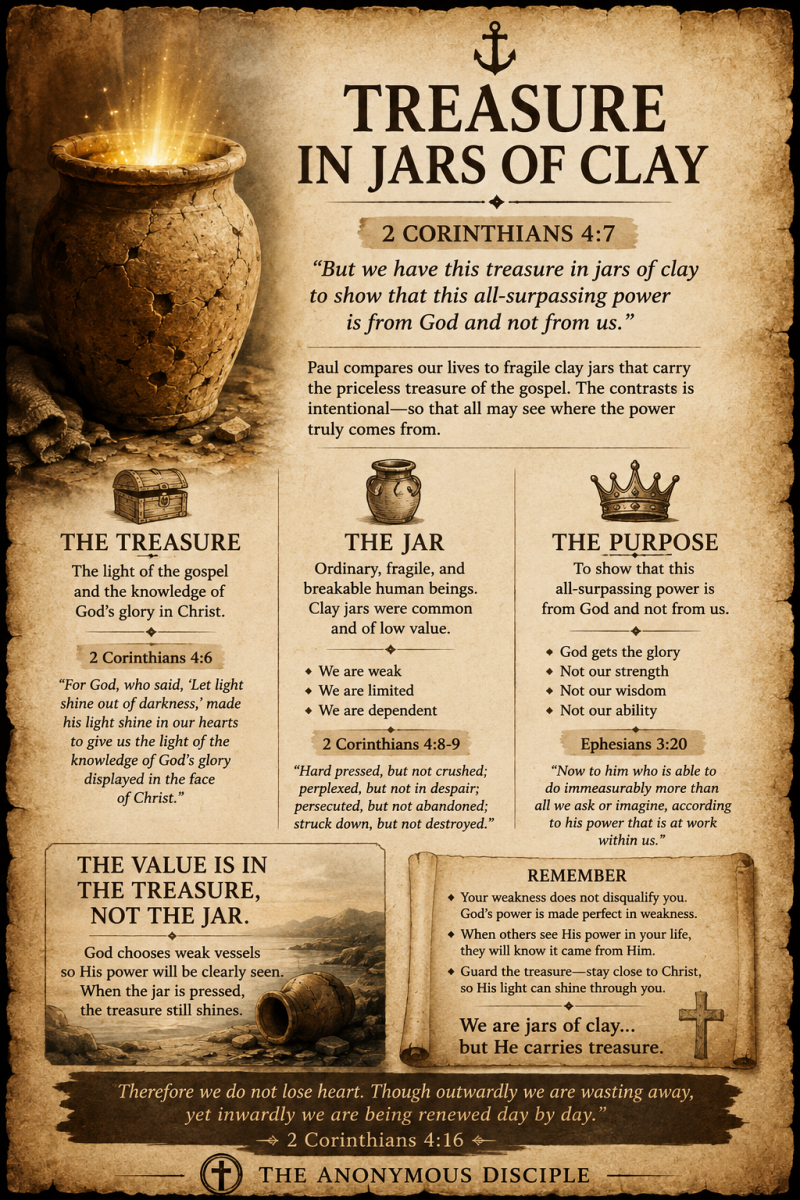
- Treasure In Jars of Clay card
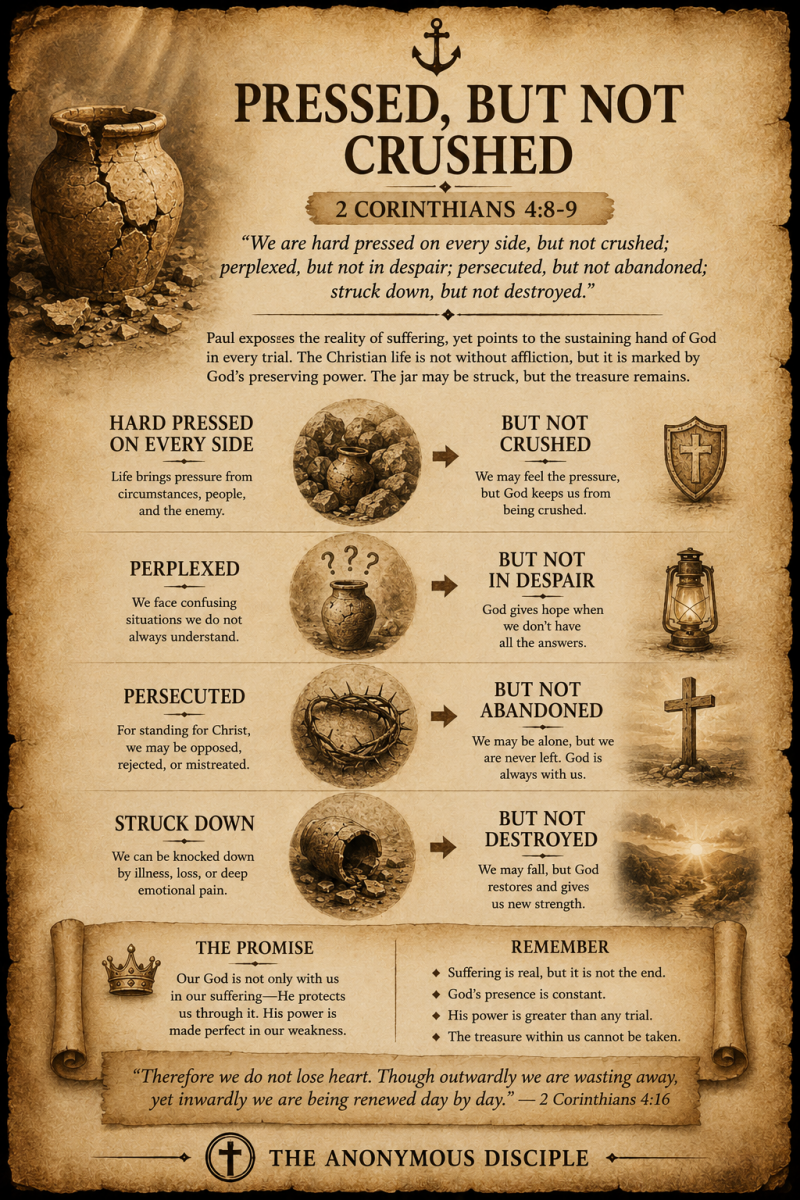
- Pressed, But Not Crushed card
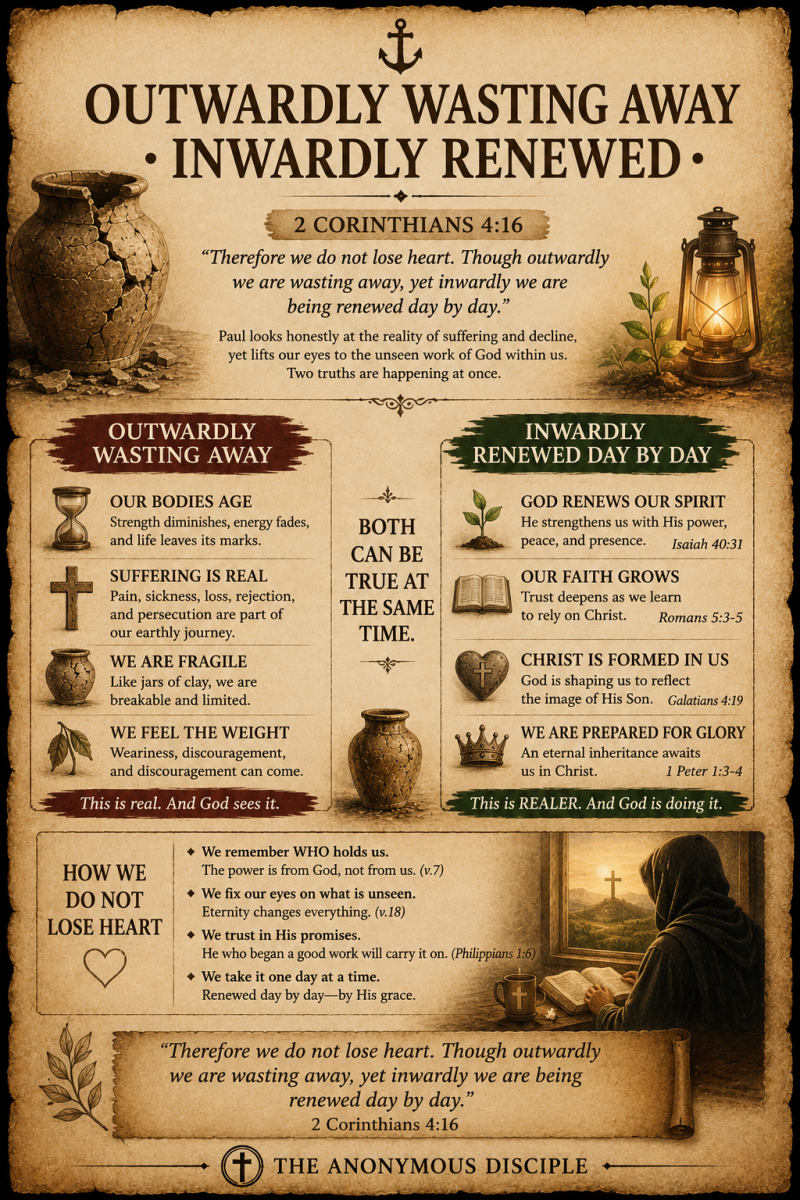
- Outwardly Wasting Away-Inwardly Renewed card
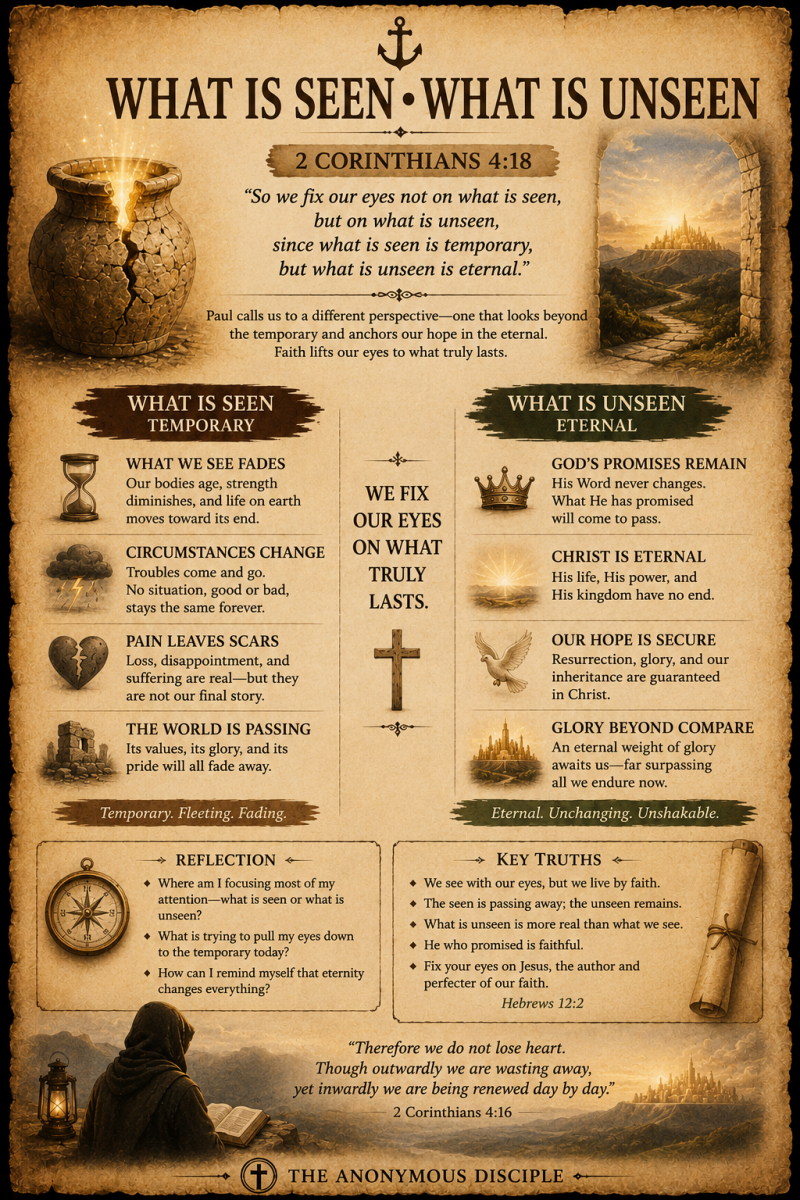
- What Is Seen-What Is Unseen card
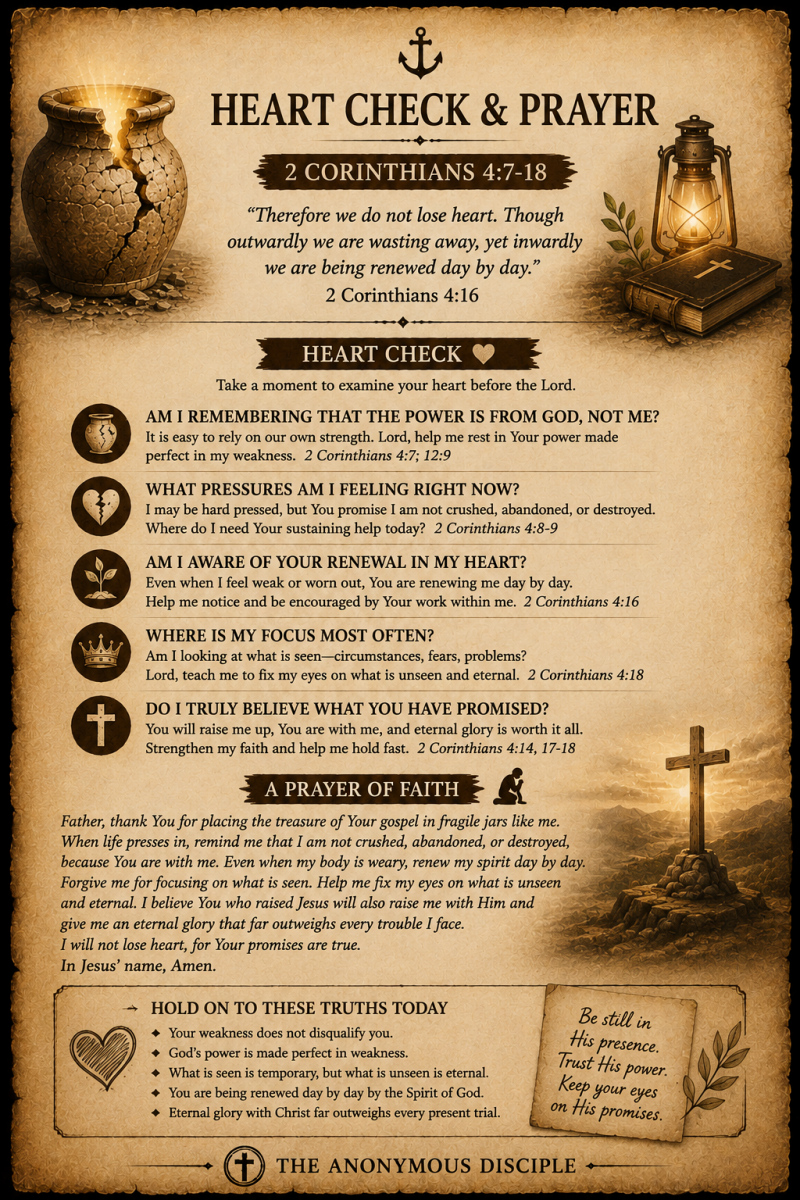
- Heart Check & Prayer card (plus pdf)
Who wrote it
The apostle Paul. Almost no serious scholar doubts this. The letter is too personal and specific (his sufferings, his tears, his defense of his own ministry) to be a fake.
When
About A.D. 55–56, roughly a year after he wrote 1 Corinthians. That is about 22–25 years after Jesus’ death and resurrection.
Where
From Macedonia (northern Greece). Paul had left Ephesus, was traveling through Macedonia, and met Titus there. Titus brought good news that most of the Corinthian church had come around. Paul likely wrote from Philippi or another city in that region.
To whom
The church in Corinth (a busy, wealthy, morally loose port city in southern Greece) and the believers in the surrounding region of Achaia (2 Corinthians 1:1).
Why it was written
Paul had already founded the church, written them at least one earlier letter we no longer have, written 1 Corinthians, then made a short “painful visit” that did not go well. After that he sent a severe “letter of tears.”
Most of the church then repented and wanted to be right with Paul again. But some still questioned him. False teachers (sometimes called “super-apostles”) had come in, looking more impressive than Paul—better speakers, stronger-looking, less battered. They attacked his authority.
So Paul wrote 2 Corinthians to:
- restore the relationship and comfort the repentant
- defend his apostleship (not by looking impressive, but by pointing to Christ’s power in weakness)
- explain what real gospel ministry looks like (treasure in jars of clay, dying so Jesus’ life can be seen)
- prepare them for his third visit
- keep them moving forward in the collection for the poor believers in Jerusalem
How chapter 4 fits
Paul is in the middle of explaining his ministry. He is saying, in effect: “Yes, I look weak and worn out. That is the point. The treasure is Jesus, not the clay jar. That is why we do not lose heart. The outer person is wasting away, but the inner person is being renewed every day.”
That is the setting for the verses you read this morning.
King James Version (KJV)
7 But we have this treasure in earthen vessels, that the excellency of the power may be of God, and not of us.
8 We are troubled on every side, yet not distressed; we are perplexed, but not in despair;
9 Persecuted, but not forsaken; cast down, but not destroyed;
10 Always bearing about in the body the dying of the Lord Jesus, that the life also of Jesus might be made manifest in our body.
11 For we which live are alway delivered unto death for Jesus’ sake, that the life also of Jesus might be made manifest in our mortal flesh.
12 So then death worketh in us, but life in you.
13 We having the same spirit of faith, according as it is written, I believed, and therefore have I spoken; we also believe, and therefore speak;
14 Knowing that he which raised up the Lord Jesus shall raise up us also by Jesus, and shall present us with you.
15 For all things are for your sakes, that the abundant grace might through the thanksgiving of many redound to the glory of God.
16 For which cause we faint not; but though our outward man perish, yet the inward man is renewed day by day.
17 For our light affliction, which is but for a moment, worketh for us a far more exceeding and eternal weight of glory;
18 While we look not at the things which are seen, but at the things which are not seen: for the things which are seen are temporal; but the things which are not seen are eternal.
Simple comparison of the ⚓️ key verse they highlighted (v. 16):
- KJV: “we faint not” / “outward man perish” / “inward man is renewed”
- NIV: “we do not lose heart” / “outwardly we are wasting away” / “inwardly we are being renewed”
Same truth, just different wording. Paul is saying: our bodies get older and weaker, life can press us hard, but God is quietly making the inside of us new every day. So we don’t give up.
The whole passage is Paul reminding the church that the real treasure is Jesus in us, not how strong or pretty the “jar” (our body) looks. Hard days are real, but they are short compared with the glory that is coming.
New International Version (NIV)
7 But we have this treasure in jars of clay to show that this all-surpassing power is from God and not from us.
8 We are hard pressed on every side, but not crushed; perplexed, but not in despair;
9 persecuted, but not abandoned; struck down, but not destroyed.
10 We always carry around in our body the death of Jesus, so that the life of Jesus may also be revealed in our body.
11 For we who are alive are always being given over to death for Jesus’ sake, so that his life may also be revealed in our mortal body.
12 So then, death is at work in us, but life is at work in you.
13 It is written: “I believed; therefore I have spoken.” Since we have that same spirit of faith, we also believe and therefore speak,
14 because we know that the one who raised the Lord Jesus from the dead will also raise us with Jesus and present us with you to himself.
15 All this is for your benefit, so that the grace that is reaching more and more people may cause thanksgiving to overflow to the glory of God.
16 Therefore we do not lose heart. Though outwardly we are wasting away, yet inwardly we are being renewed day by day.
17 For our light and momentary troubles are achieving for us an eternal glory that far outweighs them all.
18 So we fix our eyes not on what is seen, but on what is unseen, since what is seen is temporary, but what is unseen is eternal.
Here is a simple, verse-by-verse walk-through of 2 Corinthians 4:7–18 (NIV wording, explained in everyday language).
Verse 7
“But we have this treasure in jars of clay to show that this all-surpassing power is from God and not from us.”
The “treasure” is the gospel—Jesus Himself living in us.
The “jar of clay” is us: ordinary, breakable people.
God put His greatest treasure in weak containers on purpose, so everyone can see the power is His, not ours.
Verses 8–9
“We are hard pressed on every side, but not crushed; perplexed, but not in despair; persecuted, but not abandoned; struck down, but not destroyed.”
Paul lists four hard realities, then immediately limits each one:
- Pressed hard — but not smashed flat
- Confused — but not hopeless
- Hunted — but not left alone by God
- Knocked down — but not finished
Trouble is real. Defeat is not the last word.
Verses 10–11
“We always carry around in our body the death of Jesus, so that the life of Jesus may also be revealed in our body. For we who are alive are always being given over to death for Jesus’ sake, so that his life may also be revealed in our mortal body.”
Paul’s body shows the marks of following Jesus—weariness, danger, suffering.
That same body is also the place where Jesus’ life shows up.
In other words: the dying is visible, and so is the living. Both happen in the same person.
Verse 12
“So then, death is at work in us, but life is at work in you.”
Paul is willing to be worn down so that life can flow to the Corinthians.
A pastor’s (or any servant’s) cost becomes another person’s blessing.
Verses 13–14
“It is written: ‘I believed; therefore I have spoken.’ Since we have that same spirit of faith, we also believe and therefore speak, because we know that the one who raised the Lord Jesus from the dead will also raise us with Jesus and present us with you to himself.”
Paul quotes Psalm 116:10. Faith talks.
He keeps speaking because he knows the same God who raised Jesus will raise him—and them—too. Resurrection is not a maybe.
Verse 15
“All this is for your benefit, so that the grace that is reaching more and more people may cause thanksgiving to overflow to the glory of God.”
None of the hardship is wasted.
Grace spreads, more people give thanks, and God gets the glory. That is the point of the whole messy journey.
Verse 16 ⚓️
“Therefore we do not lose heart. Though outwardly we are wasting away, yet inwardly we are being renewed day by day.”
“Therefore” looks back at everything he just said.
Because the treasure is real, because God is at work, because resurrection is coming—we do not give up.
The outside (body, circumstances) is wearing out.
The inside is being made new today, not only someday.
Verse 17
“For our light and momentary troubles are achieving for us an eternal glory that far outweighs them all.”
Paul is not saying the pain feels light. He is comparing weights.
Today’s trouble is short and relatively light next to the glory that lasts forever and is far heavier in the best sense.
Verse 18
“So we fix our eyes not on what is seen, but on what is unseen, since what is seen is temporary, but what is unseen is eternal.”
We choose where we look.
What we can see with our eyes—aging, hardship, disappointment—is real, but it will not last.
What we cannot see yet—Christ’s life in us, the coming glory, God’s daily inner renewal—is what lasts.
The whole passage in one sentence:
God put His treasure in ordinary, cracking jars so His power would be obvious; therefore we do not lose heart while the outside wears down, because He is renewing the inside every day and a far greater glory is coming.
Here are the most helpful cross-references, grouped so they are easy to use.
For the whole passage (2 Corinthians 4:7–18)
Treasure in jars of clay (v. 7)
- Lamentations 4:2 — God’s people compared to earthen jars
- 2 Timothy 2:20–21 — vessels of clay and vessels of honor
- 2 Corinthians 12:7–10 — God’s power made perfect in weakness
Pressed but not crushed (vv. 8–9)
- 2 Corinthians 6:4–10 — Paul’s longer list of hardships
- 2 Corinthians 11:23–28 — even more of what he endured
- Psalm 34:19 — “Many are the afflictions of the righteous, but the Lord delivers him out of them all.” (ESV)
Carrying Jesus’ death so His life is seen (vv. 10–12)
- Romans 6:3–11 — we died with Christ and now live with Him
- Galatians 2:20 — “I have been crucified with Christ…”
- Philippians 3:10 — knowing the power of His resurrection and sharing His sufferings
Same spirit of faith / “I believed, therefore I spoke” (v. 13)
- Psalm 116:10 — the verse Paul quotes
- Romans 10:9–10 — believing and speaking
God will raise us too (v. 14)
- 1 Corinthians 15:20–22, 51–57
- Romans 8:11
- 1 Thessalonians 4:14
Light, momentary trouble vs. eternal glory (vv. 17–18)
- Romans 8:18 — present sufferings not worth comparing with the glory to come
- 1 Peter 1:6–7 and 4:12–13
- Hebrews 12:2–3 — looking to Jesus
- Colossians 3:1–2 — set your minds on things above
- 2 Corinthians 5:7 — we walk by faith, not by sight
For the ⚓️ verse — 2 Corinthians 4:16
“Therefore we do not lose heart. Though outwardly we are wasting away, yet inwardly we are being renewed day by day.”
Do not lose heart / faint not
- 2 Corinthians 4:1 — Paul already said this at the start of the chapter
- Galatians 6:9 — “Let us not become weary in doing good…”
- Isaiah 40:29–31 — He gives strength to the weary; those who hope in the Lord renew their strength
- Hebrews 12:3 — consider Jesus so you will not grow weary and lose heart
- Psalm 27:13 — “I remain confident of this: I will see the goodness of the Lord…”
Outward wasting away, inward renewed
- Psalm 73:26 — “My flesh and my heart may fail, but God is the strength of my heart…”
- Job 19:26–27 — after my skin is destroyed, yet in my flesh I will see God
- Romans 7:22 — delight in God’s law in the inner man
- Ephesians 3:16 — strengthened with power through His Spirit in the inner being
- Colossians 3:10 — the new self is being renewed in knowledge
- Romans 12:2 — be transformed by the renewing of your mind
- 1 Peter 3:4 — the hidden person of the heart
Those last few are especially good companions to v. 16: the body is getting older and weaker, but God is quietly making the inside new every day.
Deep Dive Study Notes
🪄Jenny🪄 -
2 Corinthians 4:7–18 is LOADED.
And I really like your devotional’s anchor:
2 Corinthians 4:16 (NIV) — “Therefore we do not lose heart. Though outwardly we are wasting away, yet inwardly we are being renewed day by day.”
But here’s the first thing I want you to notice:
⚓️ “Therefore…”
You know what that means. 😂
Paul has already given us the reasons we don’t lose heart.
🏺 2 Corinthians 4:7 — Treasure in jars of clay
2 Corinthians 4:7 (NIV) — “But we have this treasure in jars of clay to show that this all-surpassing power is from God and not from us.”
The treasure is the gospel—the knowledge of Christ and His glory that Paul has just described in 2 Corinthians 4:6.
And where does God put this priceless treasure?
Not in gold containers.
Clay pots. Us. 😳
Ordinary. Fragile. Breakable.
That’s deliberate.
God doesn't need the container to look impressive because the power isn't supposed to be mistaken for ours.
That little phrase is enormous:
“…from God and not from us.”
That is going to explain everything that follows.
💥 2 Corinthians 4:8–9 — Hit, but not finished
2 Corinthians 4:8–9 (NIV) — “We are hard pressed on every side, but not crushed; perplexed, but not in despair; persecuted, but not abandoned; struck down, but not destroyed.”
Look at Paul's pattern:
Hard pressed → but not crushed.
Perplexed → but not despairing.
Persecuted → but not abandoned.
Struck down → but not destroyed.
Christian faith does not mean:
"Nothing terrible will happen to me."
It means:
"Nothing that happens to me can separate me from the sustaining power and presence of God."
The clay jar can take a beating.
The treasure remains.
❤️
✝️ 2 Corinthians 4:10–12 — The life of Jesus revealed through weakness
Paul says:
2 Corinthians 4:10 (NIV) — “We always carry around in our body the death of Jesus, so that the life of Jesus may also be revealed in our body.”
That's deeper than merely "suffering makes us stronger."
Paul's ministry actually resembles Christ's pattern:
suffering → death → life.
Paul's weakness becomes the stage upon which Christ's life and power become visible.
That connects beautifully with something we've studied before:
Galatians 2:20 (NIV) — “I have been crucified with Christ and I no longer live, but Christ lives in me…”
There it is again.
Not I, but Christ. ❤️
🗣️ 2 Corinthians 4:13–15 — “I believed; therefore I have spoken”
Paul quotes Psalm 116:10.
Despite suffering, he keeps preaching because he believes something bigger than his circumstances:
2 Corinthians 4:14 (NIV) — “because we know that the one who raised the Lord Jesus from the dead will also raise us with Jesus…”
There's Paul's secret.
Resurrection changes the calculation.
If death gets the final word, Paul's life makes no sense.
But if Christ rose—and those belonging to Christ will be raised—then suffering isn't the end of Paul's story.
And THAT brings us to your anchor.
⚓️ 2 Corinthians 4:16 — Therefore we do not lose heart
Now we understand the therefore.
Paul isn't saying:
"Don't get discouraged. Think positively."
He's saying:
We don't lose heart because resurrection is coming.
And then he makes this incredible contrast:
OUTWARDLY: wasting away.
INWARDLY: renewed day by day.
Paul doesn't deny physical deterioration.
He looks straight at it.
But he says something else is happening simultaneously that you cannot see from the outside.
God is renewing the believer day by day.
That's sanctification.
The body may be moving toward death while the believer is simultaneously being prepared for life everlasting.
That is such a Christian paradox.
The outside can be weakening while the inside is becoming stronger.
👑 2 Corinthians 4:17 — “Light and momentary troubles”
Now this one needs care:
2 Corinthians 4:17 (NIV) — “For our light and momentary troubles are achieving for us an eternal glory that far outweighs them all.”
Paul isn't calling suffering light because suffering doesn't hurt.
Look at what happened to this man!
Beatings. Imprisonment. Persecution. Rejection. Hunger. Danger.
He's comparing suffering to eternity.
Put suffering on one side of the scale.
Put eternal glory with Christ on the other.
The glory is so enormous that everything suffered here becomes comparatively light.
Paul isn't minimizing pain.
He's magnifying eternity.
And then comes the verse that ties the whole passage together.
👀 2 Corinthians 4:18 — Where are you looking?
2 Corinthians 4:18 (NIV) — “So we fix our eyes not on what is seen, but on what is unseen, since what is seen is temporary, but what is unseen is eternal.”
Oh, Sherri.
That's the heart of it.
The Christian lives surrounded by visible things:
pain
bodies that age
loss
trouble
fear
circumstances
death
But faith says:
That's not all there is.
Christ is unseen.
Resurrection is presently unseen.
Our eternal inheritance is unseen.
The glory awaiting God's children is unseen.
But unseen does not mean unreal.
Paul actually says the opposite:
What you're looking at right now?
Temporary.
What God has promised?
Eternal.
🕊️ The whole passage in one thought:
The jar is fragile.
The treasure is priceless.
The suffering is temporary.
The renewal is daily.
The resurrection is certain.
The glory is eternal.
Therefore...
Add comment
Comments