

Jesus’ baptism is not only an event to admire. It helps us understand who He is, why He came, and what our own baptism means in response to Him. ❤️
The Key Difference
Jesus’ baptism and ours are connected, but they are not identical.
Jesus was baptized in obedience, not repentance. He had no sin to confess.
⚓ 2 Corinthians 5:21
“God made him who had no sin to be sin for us, so that in him we might become the righteousness of God.”
Our baptism, however, is a public response of faith, repentance, identification, and surrender to the One who died and rose for us.
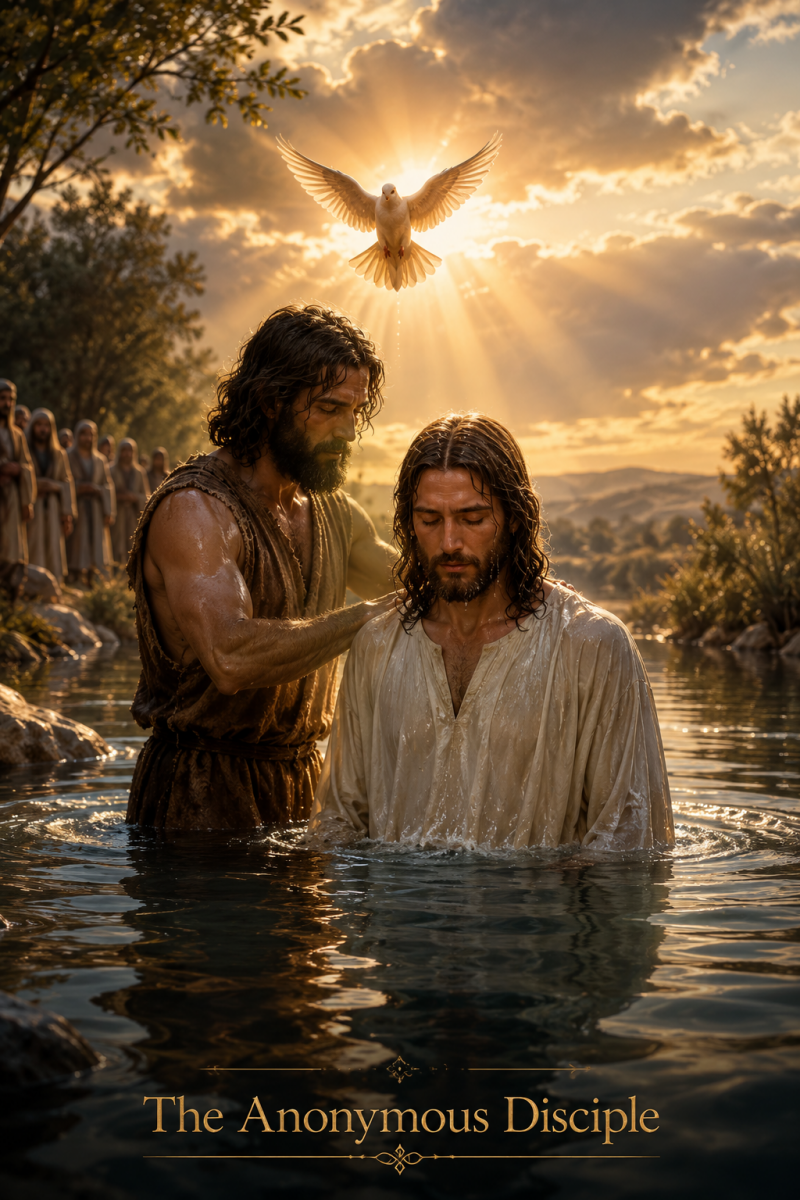
Jesus Went Into the Water for the Same Reason He Went to the Cross: Obedience, Identification, and Love
At the Jordan, Jesus stood among sinners.
At the cross, Jesus died for sinners.
At the resurrection, Jesus conquered what held sinners captive.
Our baptism then says:
I believe He stood in my place.
I believe He died for my sin.
I believe He rose again.
I belong to Him now.
By His grace, I will follow Him.
Why Was Jesus Baptized?
Jesus was not baptized because He needed forgiveness.
Instead, Scripture points to several reasons:
- ⚓ Matthew 3:15 — To fulfill all righteousness.
- To identify with sinful humanity.
- To publicly begin His earthly ministry.
- To affirm John's ministry.
- To reveal the Trinity.
- To foreshadow His death, burial, and resurrection.
Baptism Is Not Spiritual Magic
The physical act does not save apart from repentance, faith, and Christ’s finished work.
⚓ 1 Peter 3:21
“And this water symbolizes baptism that now saves you also—not the removal of dirt from the body but the pledge of a clear conscience toward God. It saves you by the resurrection of Jesus Christ.”
Peter immediately explains that baptism is not merely washing the body. Its meaning rests in Jesus’ resurrection and the believer’s appeal or pledge toward God.
The thief on the cross was saved through faith in Jesus without opportunity for baptism.
⚓ Luke 23:42–43
“Then he said, ‘Jesus, remember me when you come into your kingdom.’ Jesus answered him, ‘Truly I tell you, today you will be with me in paradise.’”
So baptism should never be dismissed as unimportant, but neither should the water replace the Savior.
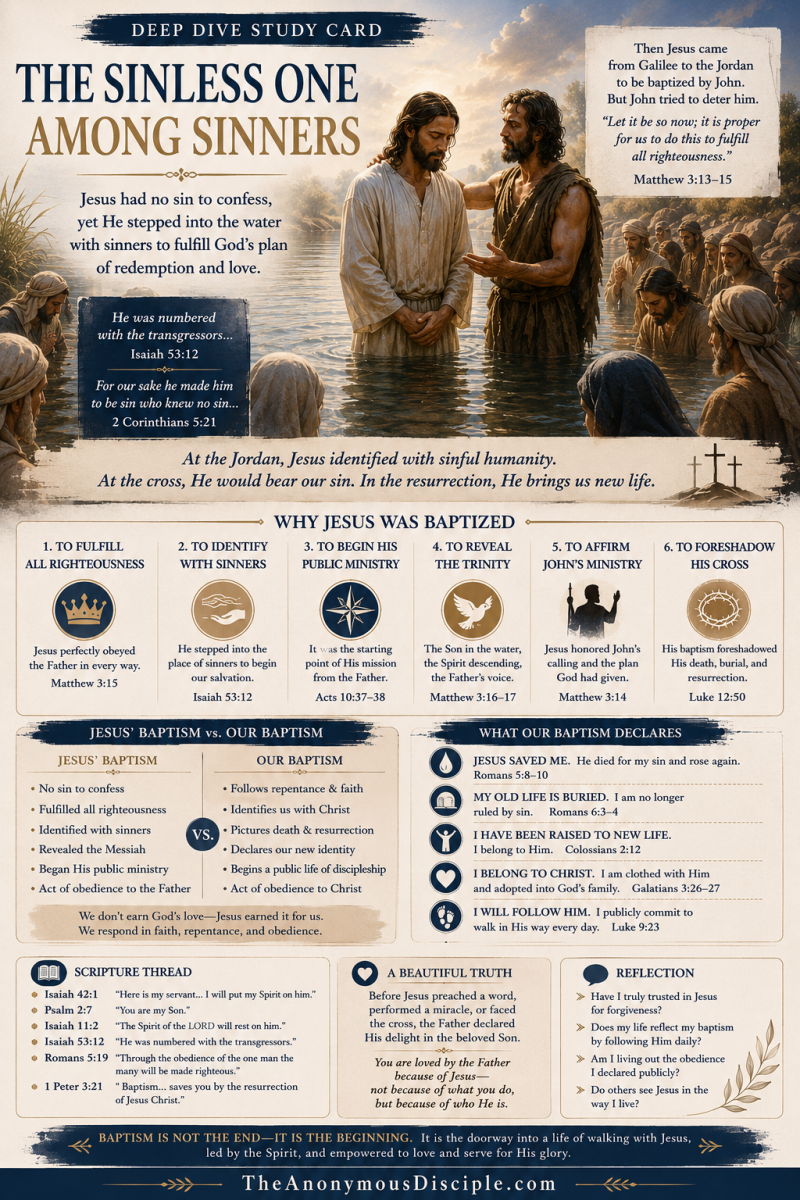
The Sinless One Among Sinners
Centered on Isaiah 53:12, Matthew 3:13–15, and 2 Corinthians 5:21.
Picture Jesus standing in the Jordan among people confessing their sins, though He had none—already revealing the heart of the gospel: the righteous One willingly stepping into the place of the guilty. ❤️
study notes
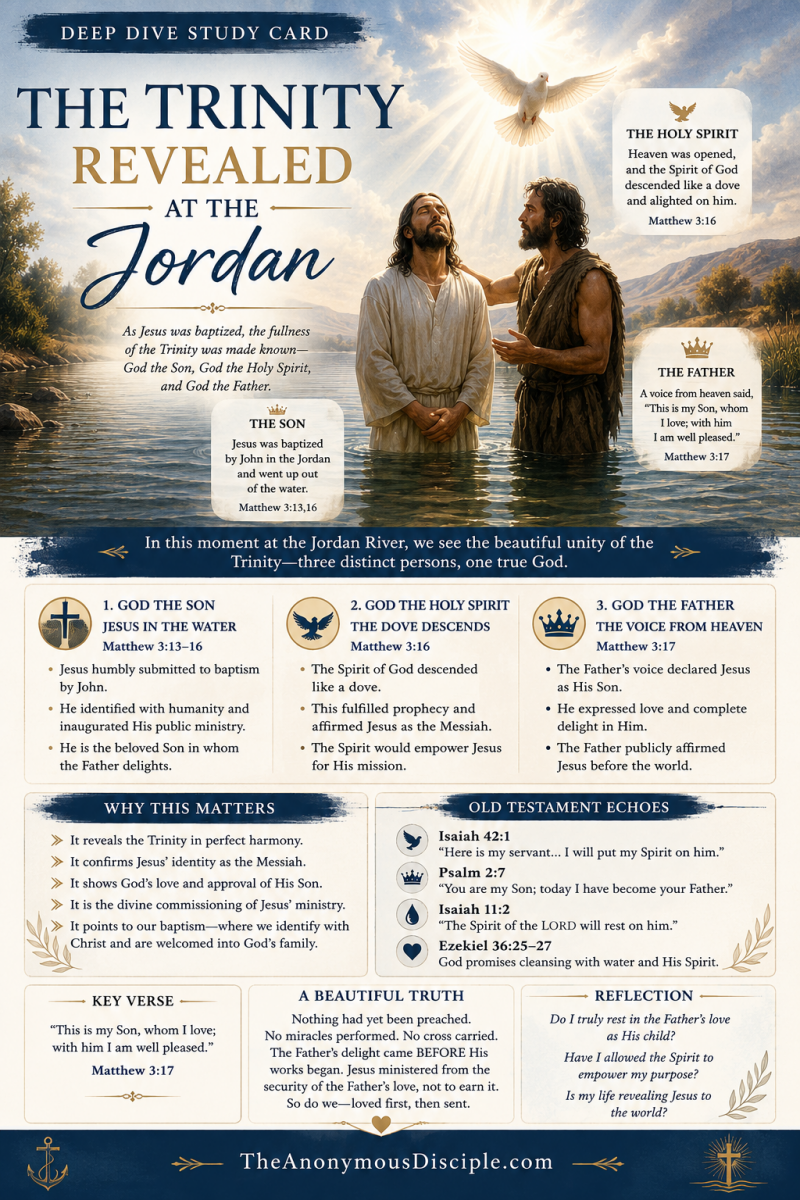
Jesus' baptism is recorded in all four Gospels, each emphasizing something a little different.
Primary Gospel Accounts
1. Jesus Is Baptized by John
⚓ Matthew 3:13–17 (NIV)
13 Then Jesus came from Galilee to the Jordan to be baptized by John.
14 But John tried to deter him, saying, "I need to be baptized by you, and do you come to me?"
15 Jesus replied, "Let it be so now; it is proper for us to do this to fulfill all righteousness." Then John consented.
16 As soon as Jesus was baptized, he went up out of the water. At that moment heaven was opened, and he saw the Spirit of God descending like a dove and alighting on him.
17 And a voice from heaven said, "This is my Son, whom I love; with him I am well pleased."
Highlights
- John recognizes Jesus' sinlessness.
- "Fulfill all righteousness."
- The Trinity is beautifully revealed:
- Jesus in the water
- Holy Spirit descending
- Father's voice from heaven
2. Mark's Account
⚓ Mark 1:9–11
A shorter account emphasizing the beginning of Jesus' public ministry.
Notice the wording:
"You are my Son, whom I love; with you I am well pleased."
Unlike Matthew, the Father's words are directed to Jesus.
3. Luke's Account
⚓ Luke 3:21–22
Luke uniquely notes that Jesus was praying when heaven opened.
"...and as he was praying, heaven was opened..."
Luke often emphasizes Jesus' prayer life.
4. John's Gospel
⚓ John 1:29–34
John does not actually describe Jesus entering the water.
Instead, John the Baptist gives his testimony afterward:
- "Behold, the Lamb of God..."
- He witnessed the Spirit descend.
- God had told him how he would recognize the Messiah.
This passage explains how John knew Jesus was the Christ.
John's Hesitation
⚓ Matthew 3:14
"I need to be baptized by you..."
John immediately understands Jesus is greater than himself.
Why Was Jesus Baptized?
Jesus was not baptized because He needed forgiveness.
Instead, Scripture points to several reasons:
- ⚓ Matthew 3:15 — To fulfill all righteousness.
- To identify with sinful humanity.
- To publicly begin His earthly ministry.
- To affirm John's ministry.
- To reveal the Trinity.
- To foreshadow His death, burial, and resurrection.
Old Testament Background
These aren't direct prophecies of the baptism itself but provide rich background:
- ⚓ Isaiah 42:1 — "Here is my servant... I will put my Spirit on him."
- ⚓ Psalm 2:7 — "You are my Son."
- ⚓ Isaiah 11:2 — The Spirit rests upon the Messiah.
- ⚓ Ezekiel 36:25–27 — Cleansing with water and God's Spirit.
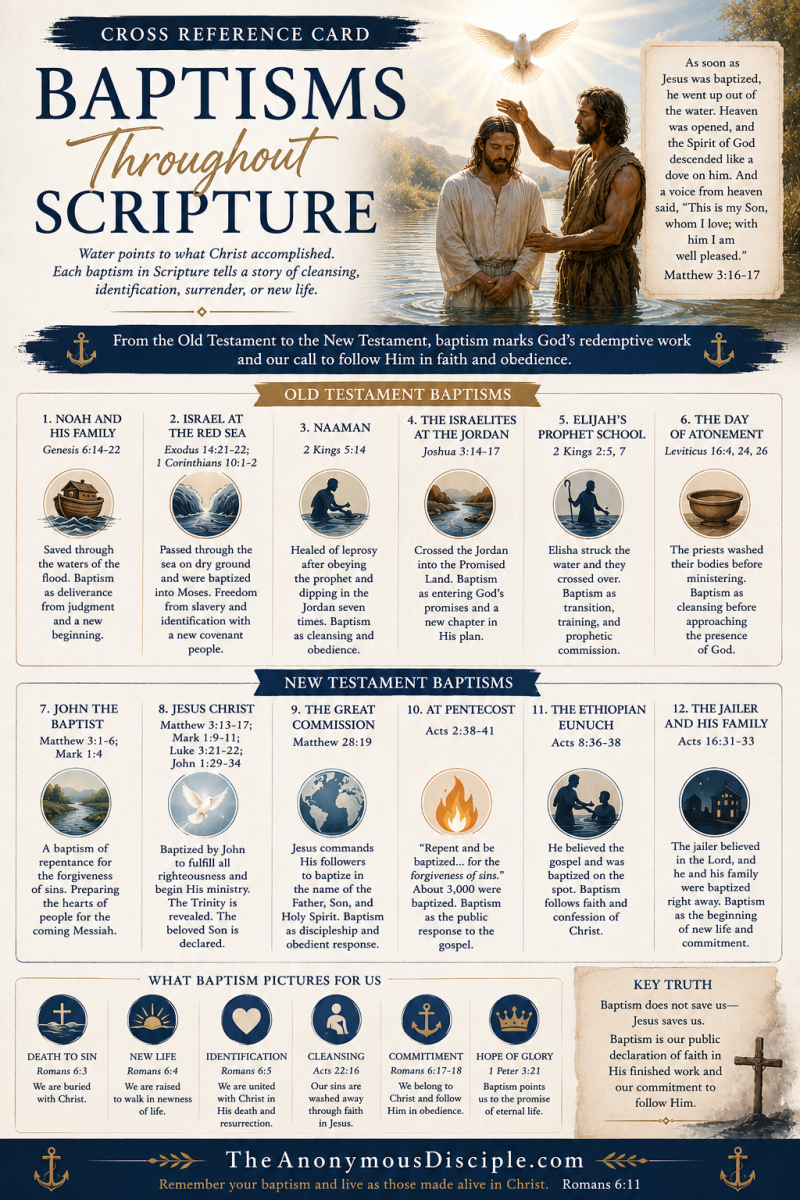
Cross References About Baptism
- ⚓ Acts 10:37–38 — Jesus' baptism marks the beginning of His ministry.
- ⚓ Romans 6:3–4 — Believers identify with Christ through baptism.
- ⚓ Colossians 2:12 — Buried and raised with Christ.
- ⚓ 1 Peter 3:21 — Baptism as the pledge of a good conscience toward God.
A Beautiful Observation ❤️
Jesus' public ministry begins with the Father saying,
"This is my Son, whom I love; with him I am well pleased."
(Matthew 3:17)
Nothing has yet been preached.
No miracles have been performed.
No crowds have been fed.
No cross has been carried.
The Father's delight comes before Jesus' public works. It's a powerful reminder that Jesus ministered from the security of the Father's love, not in order to earn it. As those who belong to Christ, we too serve God because we are loved, not to become loved.
Jesus’ baptism is not only an event to admire. It helps us understand who He is, why He came, and what our own baptism means in response to Him. ❤️
The Key Difference
Jesus’ baptism and ours are connected, but they are not identical.
Jesus was baptized in obedience, not repentance. He had no sin to confess.
⚓ 2 Corinthians 5:21
“God made him who had no sin to be sin for us, so that in him we might become the righteousness of God.”
Our baptism, however, is a public response of faith, repentance, identification, and surrender to the One who died and rose for us.
1. Jesus Stepped Into the Place of Sinners
John’s baptism was connected with repentance.
⚓ Mark 1:4–5
“And so John the Baptist appeared in the wilderness, preaching a baptism of repentance for the forgiveness of sins. The whole Judean countryside and all the people of Jerusalem went out to him. Confessing their sins, they were baptized by him in the Jordan River.”
Jesus had no sins to confess, yet He entered the same water.
That shows us something powerful: He did not remain distant from sinful humanity. He stepped into our place.
This anticipates the cross, where He would again stand where sinners deserved to stand.
⚓ Isaiah 53:12
“He was numbered with the transgressors.”
⚓ Luke 22:37
“And he was numbered with the transgressors.”
Jesus’ baptism visibly begins what the cross fully accomplishes: the sinless One identifying with sinners so that sinners could be reconciled to God.
2. Jesus Fulfilled Righteousness for Us
When John hesitated, Jesus answered:
⚓ Matthew 3:15
“Let it be so now; it is proper for us to do this to fulfill all righteousness.”
Jesus did not merely teach obedience. He lived perfect obedience.
From the Jordan to the wilderness, through His ministry, into Gethsemane, and all the way to the cross, Jesus obeyed the Father completely.
⚓ John 6:38
“For I have come down from heaven not to do my will but to do the will of him who sent me.”
⚓ Philippians 2:8
“And being found in appearance as a man, he humbled himself by becoming obedient to death—even death on a cross!”
Our salvation rests not only on Jesus dying for us, but on Jesus being the perfectly righteous Son we could never be.
⚓ Romans 5:19
“For just as through the disobedience of the one man the many were made sinners, so also through the obedience of the one man the many will be made righteous.”
That makes His baptism an early public declaration: the obedient Son has come to fulfill the Father’s saving plan.
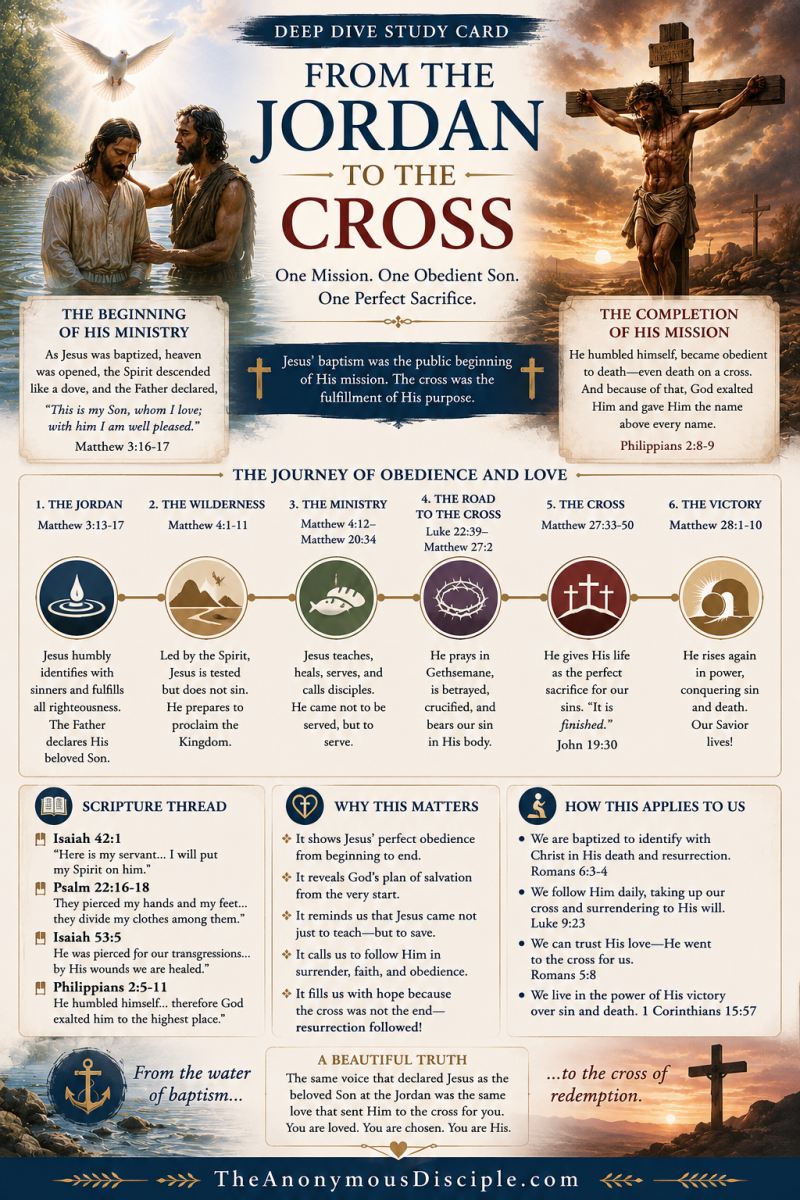
3. The Jordan Points Forward to the Cross
Jesus later described His suffering and death as a “baptism.”
⚓ Luke 12:50
“But I have a baptism to undergo, and what constraint I am under until it is completed!”
⚓ Mark 10:38
“Can you drink the cup I drink or be baptized with the baptism I am baptized with?”
At the Jordan, Jesus went down into the water and came back up.
At the cross, He would go down into death and rise again in victory.
The water itself did not cause His death and resurrection, but the action beautifully foreshadows the mission ahead.
Jordan: submission and identification.
Cross: sacrifice and substitution.
Empty tomb: resurrection and victory.
4. Our Baptism Identifies Us With His Death and Resurrection
This is one of the clearest connections between Jesus’ work and our baptism.
⚓ Romans 6:3–4
“Or don’t you know that all of us who were baptized into Christ Jesus were baptized into his death? We were therefore buried with him through baptism into death in order that, just as Christ was raised from the dead through the glory of the Father, we too may live a new life.”
Our baptism says:
- My old life no longer defines me.
- I belong to Jesus.
- His death was for my sin.
- His resurrection is the source of my new life.
- I am choosing to walk with Him.
⚓ Colossians 2:12
“Having been buried with him in baptism, in which you were also raised with him through your faith in the working of God, who raised him from the dead.”
The power is not in the water itself. The power is in Christ, received through faith.
5. Jesus’ Baptism Reveals His Identity; Ours Declares Ours
At Jesus’ baptism, the Father declared:
⚓ Matthew 3:17
“This is my Son, whom I love; with him I am well pleased.”
Jesus’ baptism revealed Him publicly as the beloved Son and promised Messiah.
Our baptism does not make us Jesus, of course, but it publicly declares that through faith in Him, we now belong to God’s family.
⚓ Galatians 3:26–27
“So in Christ Jesus you are all children of God through faith, for all of you who were baptized into Christ have clothed yourselves with Christ.”
That is beautiful language: clothed with Christ.
Our baptism declares a changed identity:
I am no longer living under my old name, shame, sin, or self-rule. I belong to Jesus.
6. Jesus Was Anointed for His Mission
At the Jordan, the Holy Spirit descended upon Jesus.
⚓ Luke 3:21–22
“And as he was praying, heaven was opened and the Holy Spirit descended on him in bodily form like a dove.”
This publicly marked and affirmed His messianic ministry.
⚓ Acts 10:37–38
“You know what has happened throughout the province of Judea, beginning in Galilee after the baptism that John preached—how God anointed Jesus of Nazareth with the Holy Spirit and power.”
Jesus’ baptism leads immediately into Spirit-led obedience.
⚓ Luke 4:1
“Jesus, full of the Holy Spirit, left the Jordan and was led by the Spirit into the wilderness.”
That gives us a strong application: baptism is not meant to be only a ceremony. It marks the beginning of a life of following, surrender, testing, obedience, and service.
7. Baptism Is Public Allegiance to Jesus
Before ascending, Jesus commanded His disciples:
⚓ Matthew 28:19–20
“Therefore go and make disciples of all nations, baptizing them in the name of the Father and of the Son and of the Holy Spirit, and teaching them to obey everything I have commanded you.”
Notice the order:
- Make disciples.
- Baptize them.
- Teach them to obey.
Baptism is not graduation from discipleship. It is an entrance into a publicly confessed life of discipleship.
It says:
Jesus is my Savior.
Jesus is my Lord.
Jesus’ people are now my people.
Jesus’ way is now my way.
8. Baptism Is Connected to Repentance and Faith
Peter’s message at Pentecost helps clarify our response.
⚓ Acts 2:38
“Repent and be baptized, every one of you, in the name of Jesus Christ for the forgiveness of your sins.”
Later, the Ethiopian official believed and then asked to be baptized.
⚓ Acts 8:36–38
“As they traveled along the road, they came to some water and the eunuch said, ‘Look, here is water. What can stand in the way of my being baptized?’ … Then both Philip and the eunuch went down into the water and Philip baptized him.”
In Acts, baptism closely follows believing the gospel. It is the outward confession of an inward response to Christ.
9. Baptism Is Not Spiritual Magic
The physical act does not save apart from repentance, faith, and Christ’s finished work.
⚓ 1 Peter 3:21
“And this water symbolizes baptism that now saves you also—not the removal of dirt from the body but the pledge of a clear conscience toward God. It saves you by the resurrection of Jesus Christ.”
Peter immediately explains that baptism is not merely washing the body. Its meaning rests in Jesus’ resurrection and the believer’s appeal or pledge toward God.
The thief on the cross was saved through faith in Jesus without opportunity for baptism.
⚓ Luke 23:42–43
“Then he said, ‘Jesus, remember me when you come into your kingdom.’ Jesus answered him, ‘Truly I tell you, today you will be with me in paradise.’”
So baptism should never be dismissed as unimportant, but neither should the water replace the Savior.
10. The Exodus and the Jordan Provide a Larger Biblical Picture
Scripture sometimes uses water crossings to picture deliverance and a new beginning.
Israel through the sea
⚓ 1 Corinthians 10:1–2
“Our ancestors were all under the cloud and that they all passed through the sea. They were all baptized into Moses in the cloud and in the sea.”
They left slavery behind and entered a new covenant identity.
Israel through the Jordan
⚓ Joshua 3:16–17
Israel crossed the Jordan to enter the land God had promised.
Jesus’ baptism in the Jordan carries echoes of deliverance, covenant, obedience, and new beginning. Jesus is the faithful Son who succeeds where Israel—and all humanity—failed.
How We Help Someone See Jesus in Baptism
The strongest message may be this:
Jesus Went Into the Water for the Same Reason He Went to the Cross: Obedience, Identification, and Love
At the Jordan, Jesus stood among sinners.
At the cross, Jesus died for sinners.
At the resurrection, Jesus conquered what held sinners captive.
Our baptism then says:
I believe He stood in my place.
I believe He died for my sin.
I believe He rose again.
I belong to Him now.
By His grace, I will follow Him.
Jesus’ Baptism and Ours
Two-column comparison:
Jesus’ baptism
- No repentance needed
- Fulfilled righteousness
- Identified with sinners
- Revealed the Messiah
- Began His public ministry
Our baptism
- Follows repentance and faith
- Identifies us with Christ
- Pictures death and resurrection
- Declares a new identity
- Begins a public life of discipleship
Buried and Raised With Christ
Centered on Romans 6:3–4 and Colossians 2:12.
What Does Baptism Declare?
- Jesus saved me.
- My old life is buried.
- I have been raised to new life.
- I belong to Christ.
- I will follow Him publicly.
From Water to Witness
Showing baptism as the beginning of visible discipleship, not the end goal.
Add comment
Comments