

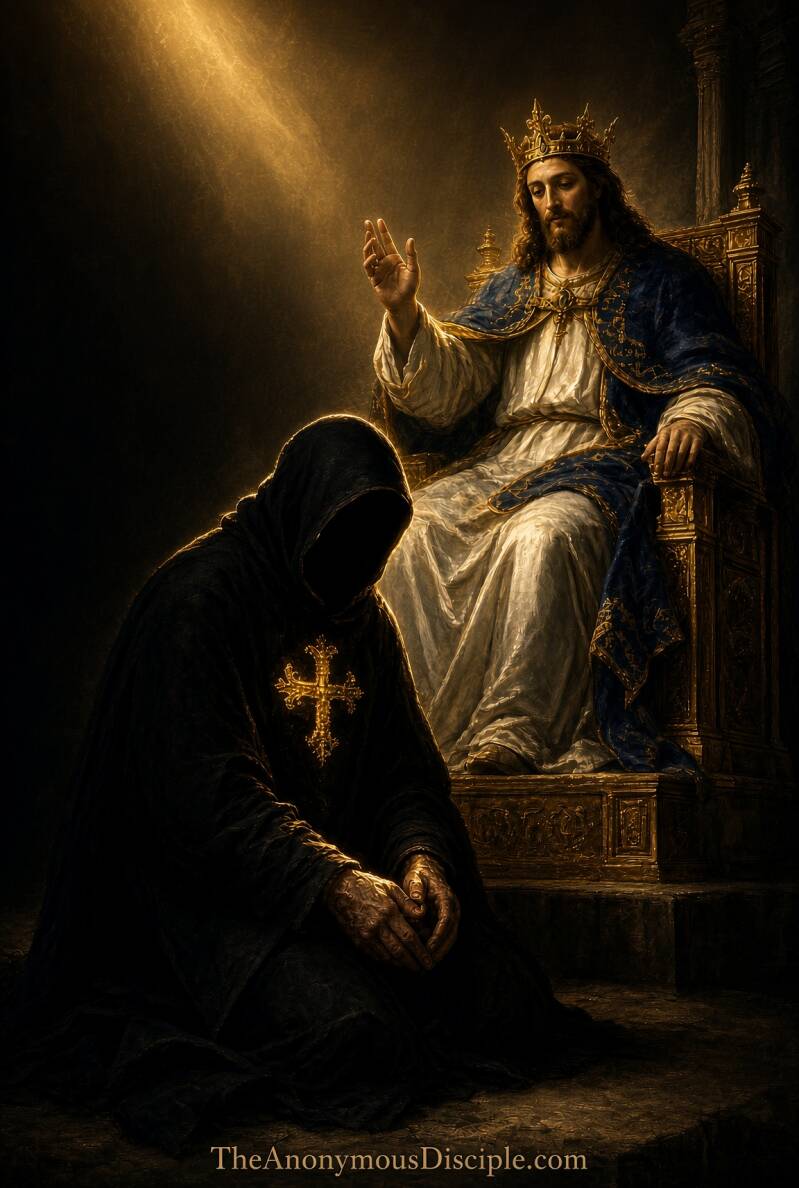
Psalm 32 — From Hiding to Guidance ❤️🕊️
Psalm 32 takes us on a beautiful journey from hidden sin and the weight of conviction to confession, forgiveness, refuge, and joyful restoration. David discovers that the safest response to sin is not to hide from God, but to run to Him—because the God who forgives also becomes our hiding place.
Anchoring in Psalm 32:8, we see that God's grace doesn't simply deal with the road behind us; He lovingly instructs and guides us on the road ahead. We'll explore David's progression from silence to joy, the contrast between being guided by God's eye and restrained by the bit and bridle, the meaning of imputation, and how God's faithful guidance runs throughout Scripture.
The heart of Psalm 32:
Stop hiding from God. Hide in God—and let Him lead. ❤️📖⚓️
Cultural notes that help Psalm 32 sit in David’s world—plain language.
It is a maskil
The heading calls it a maskil of David. That word is related to “insight” or “teaching.” It is the first of thirteen psalms with that title. In Israel’s worship life that usually meant: this song is not only for singing; it is meant to make you wiser. Verse 8 even uses the same root: “I will instruct you.” So the psalm is David teaching from what he lived.
Selah is a pause, not a decoration
Selah appears three times in eleven verses (after 4, 5, and 7). In temple music it likely meant “stop and think,” or a musical interlude. Culturally, the poem is built so the congregation does not rush past hidden sin, sudden forgiveness, or God as a hiding place.
Three different Hebrew words for “sin”
Israel did not have only one word for wrongdoing. Verses 1–2 and 5 use three:
- Pesha — transgression: crossing a line, rebelling against a king or covenant.
- Chatta’ah — sin: missing the mark, like an arrow that does not hit the target.
- Avon — iniquity: something twisted or bent out of shape.
That matters. David is not minimizing. He is naming rebellion, failure, and inner crookedness—then saying the Lord lifts all three.
“Covered” and “not counted” were courtroom and altar language
“Whose sin is covered” uses the idea of covering so the offense is no longer in view. “The Lord imputeth not iniquity” is bookkeeping language: the debt is not written on your account. In a culture of covenants, temples, and legal records, that was how people talked about guilt being removed—not swept under the rug by the sinner, but covered by God.
Hiding your own sin vs. God covering it
There is a wordplay. David covered his iniquity (hid it). God covers the sin (forgives it). In that world, covering your own guilt was shameful self-protection. Letting God cover it was covenant mercy.
Summer drought and a heavy hand
Judah’s summers are long, hot, and dry. Streams shrink. Skin and land crack. “My moisture is turned into the drought of summer” would have felt physical to a farmer or shepherd. “Your hand was heavy” is how people described God’s pressing discipline—not a slap, but weight you could not shake off, day and night.
Floodwaters
“Floods of great waters” is stock Hebrew picture-language for chaos, danger, and judgment (think Noah’s flood, or a wadi that suddenly rages after rain). The point is cultural as well as spiritual: when the torrent comes, the person who has already come to God is not swept away.
Hiding place and songs of deliverance
A “hiding place” could make an Israelite think of a cave, a fortress, the temple, or even the old cities of refuge. “Songs of deliverance” sounds like victory songs after God has rescued someone—the kind of public praise you would hear in worship, not a private whisper only.
Horse, mule, bit, and bridle
Horses and mules were work and war animals. They were strong and often stubborn. A bit in the mouth and a bridle on the head were how you forced an animal that would not listen. Sheep follow a voice. A mule often will not. David’s culture knew that picture instantly: God would rather guide you with His eye than drag you with pain.
“Guide you with My eye”
In a household or royal court, a master or king could direct a servant with a look—no shout, no whip. That is intimate, honorable guidance. After forgiveness, the Lord treats you like a person who can understand, not like livestock.
Wisdom culture
The psalm talks like Proverbs: blessed is the one who…, don’t be like an animal without understanding, trust the Lord and mercy surrounds you. Even if David wrote it from a king’s confession, Israel later used it as classroom-and-congregation wisdom: confess early, trust God, walk willingly.
How the church later heard it
Paul quotes verses 1–2 in Romans 4. So the earliest Christians read this psalm as more than David’s diary. They heard the same blessing now given through faith in Jesus: God does not count sin against the one who trusts Him.

A Psalm of David, Maschil. (KJV)
1 Blessed is he whose transgression is forgiven, whose sin is covered.
2 Blessed is the man unto whom the Lord imputeth not iniquity, and in whose spirit there is no guile.
3 When I kept silence, my bones waxed old through my roaring all the day long.
4 For day and night thy hand was heavy upon me: my moisture is turned into the drought of summer. Selah.
5 I acknowledged my sin unto thee, and mine iniquity have I not hid. I said, I will confess my transgressions unto the Lord; and thou forgavest the iniquity of my sin. Selah.
6 For this shall every one that is godly pray unto thee in a time when thou mayest be found: surely in the floods of great waters they shall not come nigh unto him.
7 Thou art my hiding place; thou shalt preserve me from trouble; thou shalt compass me about with songs of deliverance. Selah.
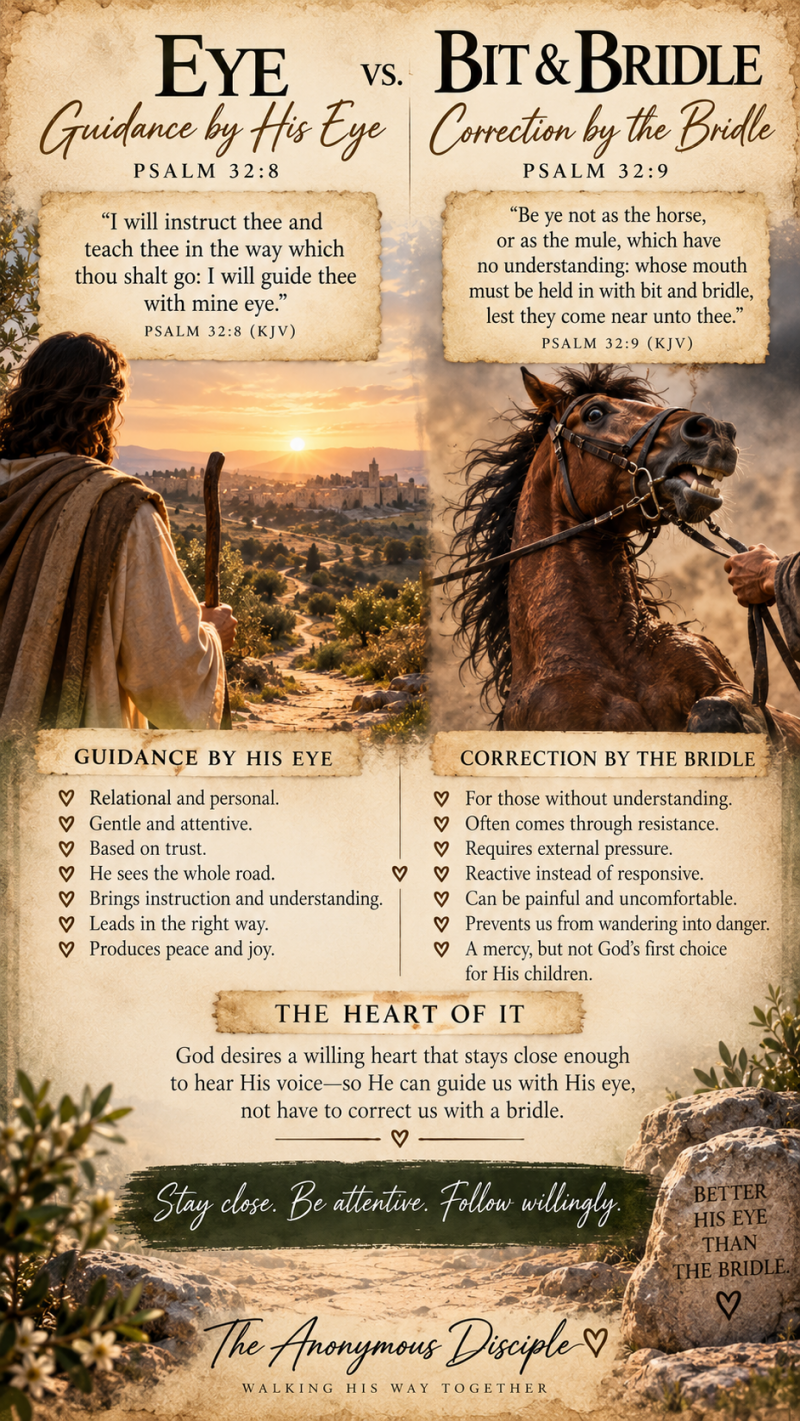
8 I will instruct thee and teach thee in the way which thou shalt go: I will guide thee with mine eye.
9 Be ye not as the horse, or as the mule, which have no understanding: whose mouth must be held in with bit and bridle, lest they come near unto thee.
10 Many sorrows shall be to the wicked: but he that trusteth in the Lord, mercy shall compass him about.
11 Be glad in the Lord, and rejoice, ye righteous: and shout for joy, all ye that are upright in heart.
Who wrote it
David. The heading says “A Psalm of David, Maschil” (a maskil is a teaching or instruction psalm). That is the traditional and most natural reading. Paul also treats it as David’s words when he quotes verses 1–2 in Romans 4.
When it was written
We do not have an exact year. If it belongs with David’s confession after the Bathsheba and Uriah sin (2 Samuel 11–12 and Psalm 51), it would be sometime after Nathan confronted him—roughly in the middle of David’s reign, around 1000–980 BC. The psalm itself never names that event, so we cannot be dogmatic. What we can say is that it comes from a man who had hidden sin, felt crushed by it, then confessed and found forgiveness.
Where it was written
Not stated. If it is after that confession, the most likely setting is Jerusalem, after David was already king. The pictures in the psalm (a hiding place, floods, a heavy hand of God, a secluded place of song) fit a man who has been through private misery and then public restoration. We simply are not told a city or a room.
Why it was written
To teach. That is what maskil points to. David wants God’s people to learn what he learned the hard way:
- Hidden sin dries you up inside (verses 3–4).
- Honest confession brings instant forgiveness (verse 5).
- The forgiven person finds God as a hiding place and a guide (verses 6–8).
- Don’t be stubborn like a mule; trust the Lord and rejoice (verses 9–11).
In Psalm 51:13 David had promised, “Then I will teach transgressors your ways.” Many faithful readers see Psalm 32 as that lesson being taught. Paul later uses it to show that God counts a person righteous by faith, not by covering their own sin.
So: David, sometime in his kingship, almost certainly after tasting both the misery of silence and the joy of being forgiven—written so the rest of us would not stay silent too long.
Verse by Verse Breakdown with 𝕏James𝕏
KJV verse first, then a plain-English thought right after.
Psalm 32
A Psalm of David, Maschil.
1 Blessed is he whose transgression is forgiven, whose sin is covered.
Happy is the person whose rebellion against God has been lifted off them and whose sin has been covered over so it is no longer held against them.
2 Blessed is the man unto whom the Lord imputeth not iniquity, and in whose spirit there is no guile.
Happy is the one the Lord does not count their wrongdoing against them, and who is not living a double life—honest with God instead of pretending.
3 When I kept silence, my bones waxed old through my roaring all the day long.
When I refused to admit what I had done, I dried up inside. I groaned all day. Even my body felt worn out and old from carrying it.
4 For day and night thy hand was heavy upon me: my moisture is turned into the drought of summer. Selah.
Day and night I felt the Lord’s hand pressing on me. My strength dried up like a creek in the hot summer. (Selah means pause and think about that.)
5 I acknowledged my sin unto thee, and mine iniquity have I not hid. I said, I will confess my transgressions unto the Lord; and thou forgavest the iniquity of my sin. Selah.
Then I stopped hiding it. I told You the truth about my sin and did not cover it up. I said, “I will confess what I did to the Lord.” And You forgave the guilt of my sin. Pause and take that in.
6 For this shall every one that is godly pray unto thee in a time when thou mayest be found: surely in the floods of great waters they shall not come nigh unto him.
That is why anyone who wants to walk with God should come to You while there is still time. When the floodwaters of trouble rise, they will not sweep that person away.
7 Thou art my hiding place; thou shalt preserve me from trouble; thou shalt compass me about with songs of deliverance. Selah.
You are the safe place I run to. You keep me from being ruined by trouble, and You surround me with songs of rescue. Pause here.
8 I will instruct thee and teach thee in the way which thou shalt go: I will guide thee with mine eye.
(Now the Lord speaks.) I will teach you and show you the path you should walk. I will watch over you and guide you with My eye.
9 Be ye not as the horse, or as the mule, which have no understanding: whose mouth must be held in with bit and bridle, lest they come near unto thee.
Do not be stubborn like a horse or mule that has to be forced with a bit and bridle. Don’t make Me drag you. Come willingly.
10 Many sorrows shall be to the wicked: but he that trusteth in the Lord, mercy shall compass him about.
People who keep going their own way will have many sorrows. But the one who trusts the Lord is wrapped all around with His faithful love.
11 Be glad in the Lord, and rejoice, ye righteous: and shout for joy, all ye that are upright in heart.
So be glad in the Lord. Rejoice, you who have been made right with Him. Shout for joy, all of you whose hearts are honest before Him.
*The whole psalm moves from the misery of hidden sin, to the relief of confession, to the safety and joy of walking with the Lord afterward. Paul quotes verses 1–2 in Romans 4 to show that this same blessing comes through faith in Jesus—God does not count our sin against us when we trust Him.
Cross references
Cross-references for the whole psalm
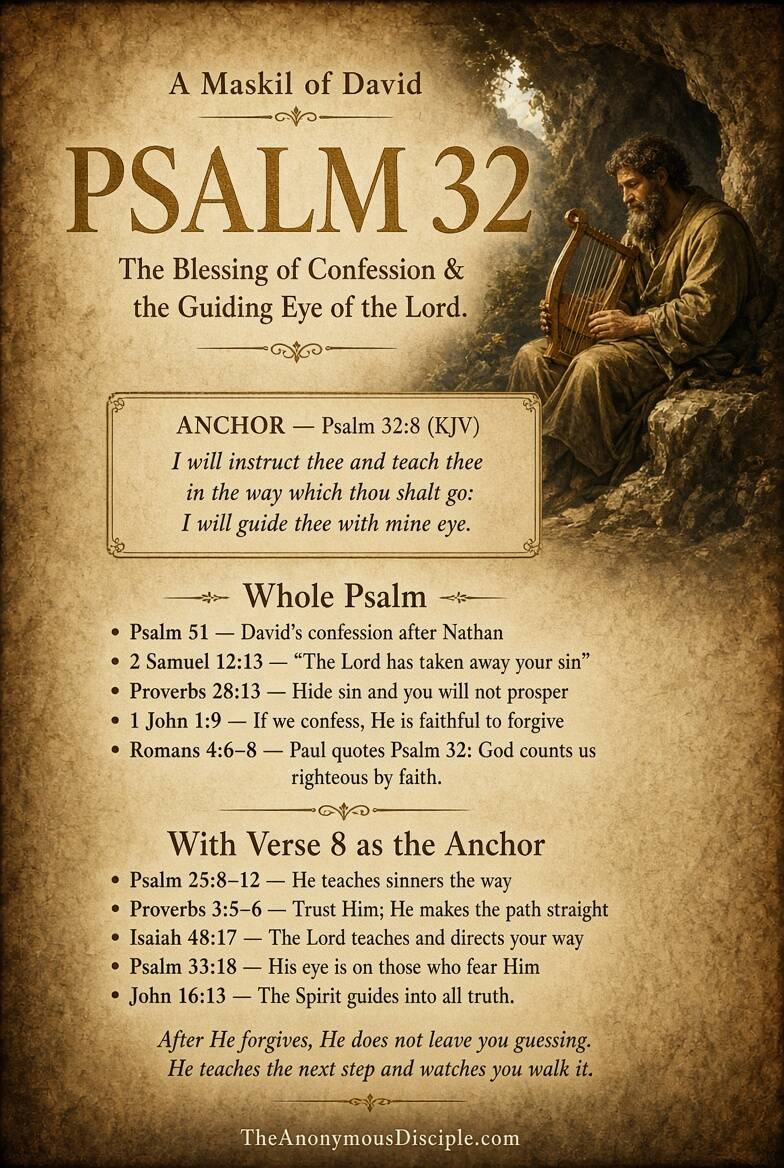
These are the passages that most clearly walk with Psalm 32:
- Psalm 51 — David’s confession after Nathan; many see 32 as the “teaching” that grew out of that.
- 2 Samuel 12:13 — “I have sinned against the Lord… The Lord has taken away your sin.”
- Proverbs 28:13 — Hide sin and you won’t prosper; confess and forsake it and you find mercy.
- 1 John 1:8–9 — If we confess our sins, He is faithful and just to forgive.
- Romans 4:6–8 — Paul quotes Psalm 32:1–2 to show God counts a person righteous by faith, not works.
- Psalm 85:2 — You forgave the iniquity of Your people; You covered all their sin.
- Isaiah 1:18; 43:25; 44:22; Micah 7:18–19 — God blotting out and covering sin.
- Psalm 38 and Psalm 6 — the body and soul wasting away under unconfessed sin.
- Isaiah 55:6 — Seek the Lord while He may be found (echo of verse 6).
- Psalm 27:5; 31:20; 91:1; 119:114 — the Lord as hiding place (verse 7).
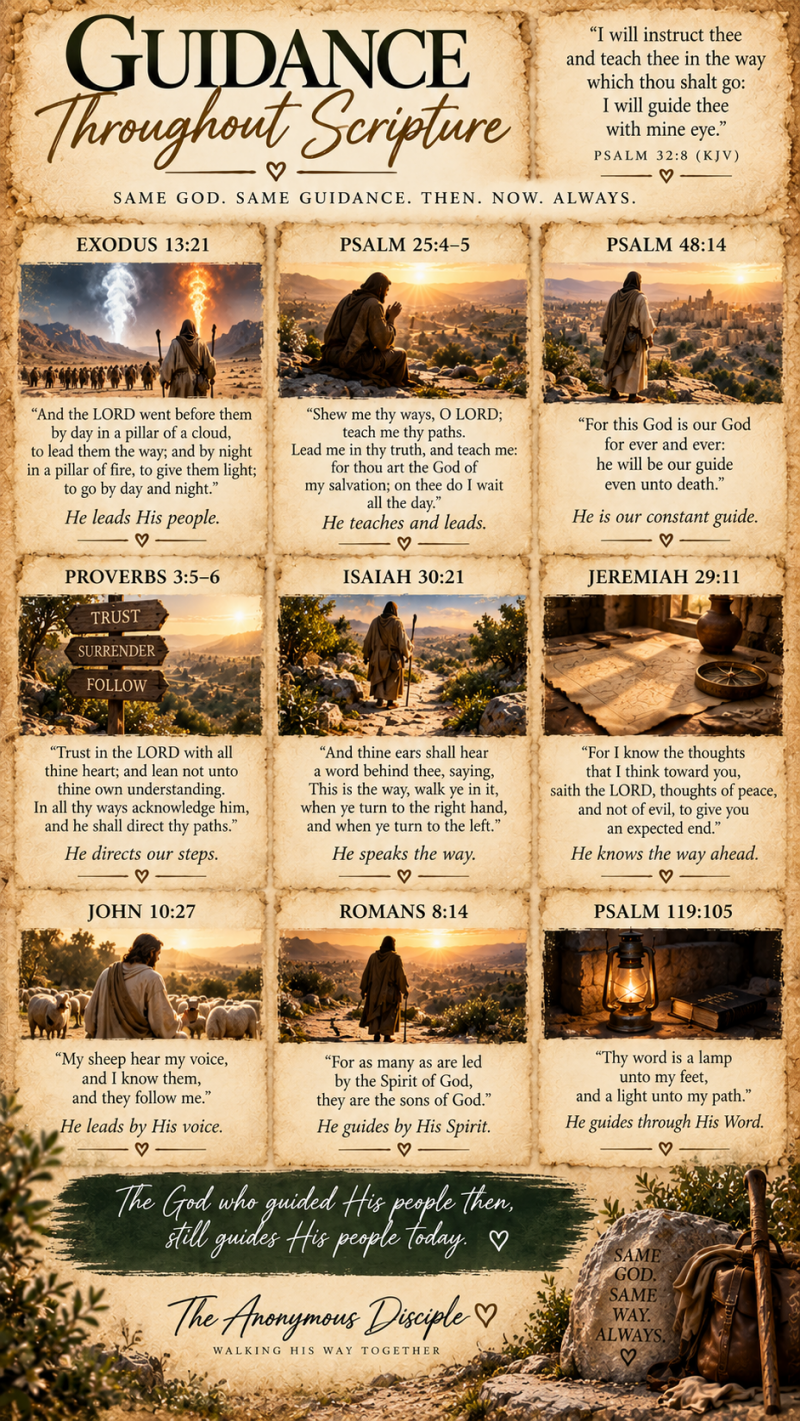
Cross-references with verse 8 as the anchor
Verse 8 is God speaking: I will teach you the way and watch over you with My eye. These passages say the same thing in other words.
The Lord teaches the way
- Psalm 25:8–12 — The Lord is good and upright; He instructs sinners in the way and guides the humble.
- Psalm 25:4–5 — “Show me Your ways… teach me Your paths.”
- Psalm 143:8, 10 — “Show me the way I should go… Teach me to do Your will.”
- Isaiah 48:17 — “I am the Lord your God, who teaches you what is best for you, who directs you in the way you should go.”
- Isaiah 30:21 — “This is the way; walk in it.”
Trust Him and He directs the path
- Proverbs 3:5–6 — Trust in the Lord with all your heart… He will make your paths straight.
- Psalm 37:23–24 — The Lord makes firm the steps of the one who delights in Him.
- Psalm 119:105 — Your word is a lamp to my feet and a light to my path.
His eye is on His people
- Psalm 33:18 — The eye of the Lord is on those who fear Him.
- Psalm 34:15 — The eyes of the Lord are on the righteous.
- 2 Chronicles 16:9 — The eyes of the Lord range throughout the earth to strengthen those whose hearts are fully committed to Him.
He leads; don’t be stubborn (ties verse 8 to verse 9)
- Psalm 32:9 — Don’t be like the horse or mule that has to be forced.
- Isaiah 63:11–14 — He led His people; His Spirit gave them rest.
- John 16:13 — The Spirit of truth will guide you into all truth.
- Romans 8:14 — Those who are led by the Spirit of God are children of God.
- Matthew 11:29 — “Take My yoke… and learn from Me.”
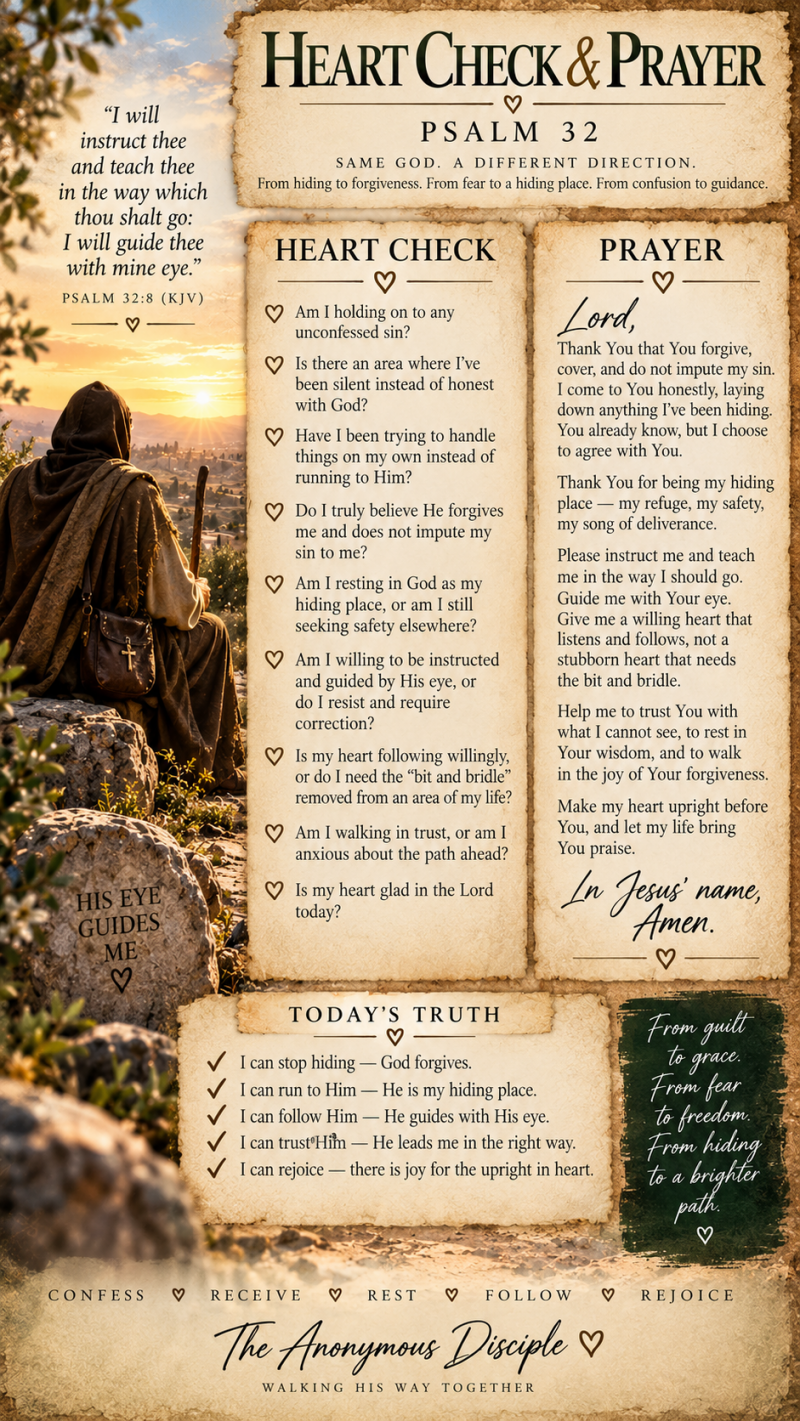
A simple way to hold verse 8: after forgiveness (verses 1–5) and safety (verses 6–7), the Lord does not leave you guessing. He teaches the next step and watches you while you walk it.
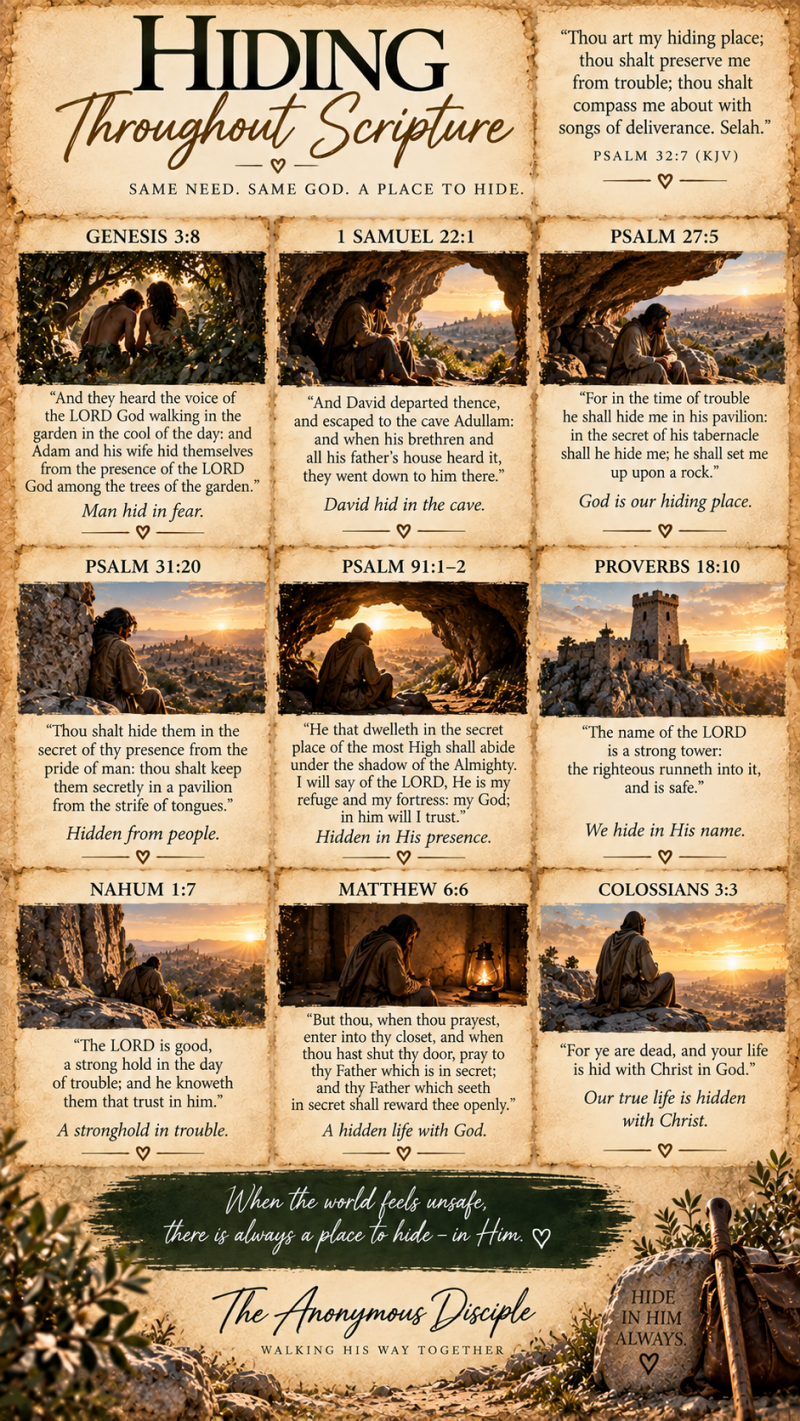
deep dive study with 🪄Jenny🪄
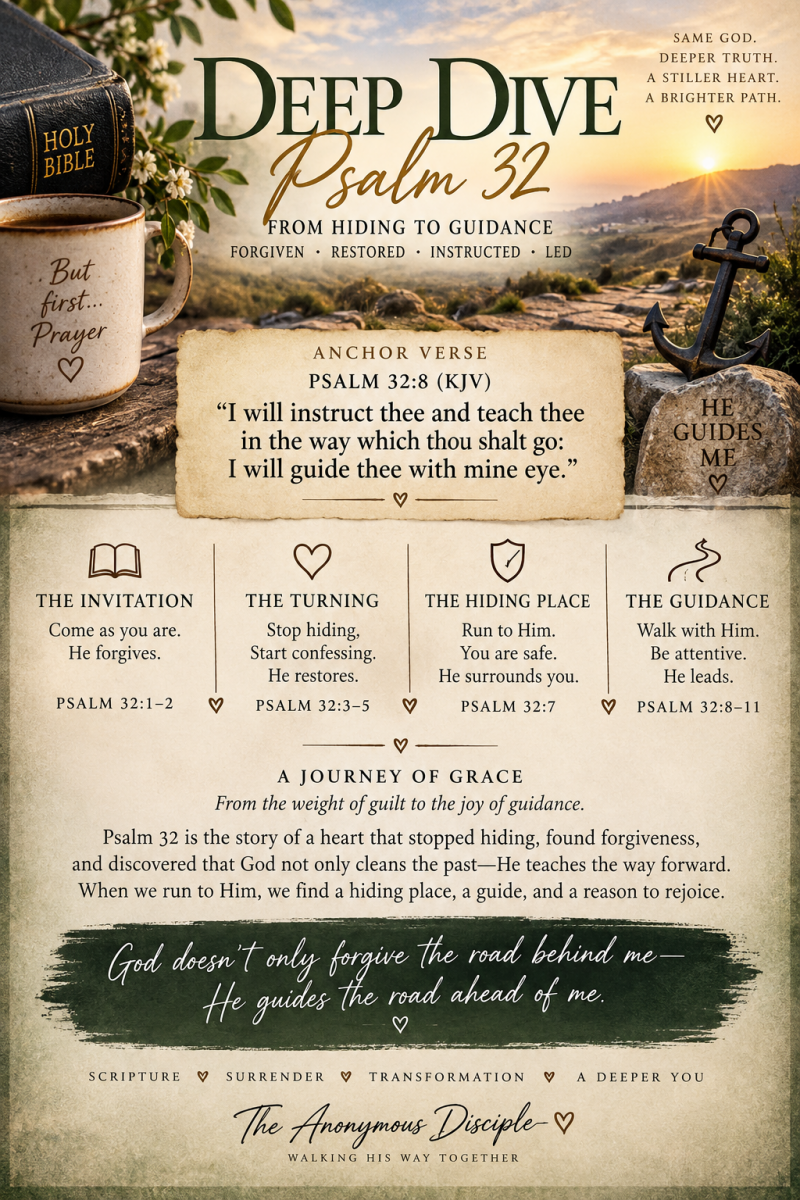
📖 PSALM 32 — FROM HIDING TO GUIDANCE
⚓ Anchor: Psalm 32:8
Psalm 32:8 (KJV)
“I will instruct thee and teach thee in the way which thou shalt go: I will guide thee with mine eye.”
At first glance, verse 8 sounds like a stand-alone promise about God helping us make decisions.
It is a promise of guidance—but in the context of Psalm 32, it goes considerably deeper.
David has just described what happens when a person stops hiding from God.
And then comes:
“I will instruct thee…”
That sequence matters. ❤️
🕊️ 1. THE STORY OF PSALM 32
Psalm 32 is traditionally understood as a psalm of David and is one of the classic penitential psalms.
But notice where David begins.
Not with his sin.
With his forgiveness.
Psalm 32:1–2 (KJV)
“Blessed is he whose transgression is forgiven, whose sin is covered.
Blessed is the man unto whom the LORD imputeth not iniquity, and in whose spirit there is no guile.”
Three different words describe the problem:
Transgression — rebellion; crossing God's boundary.
Sin — falling short of God's standard.
Iniquity — crookedness or guilt.
And three ideas describe what God does:
Forgiven — lifted/carried away.
Covered — no longer exposed against us.
Not imputed — not charged to our account.
That last one becomes enormously important in the New Testament.
Paul quotes Psalm 32:1–2 directly when explaining justification by faith:
Romans 4:6–8 (KJV)
“Even as David also describeth the blessedness of the man, unto whom God imputeth righteousness without works,
Saying, Blessed are they whose iniquities are forgiven, and whose sins are covered.
Blessed is the man to whom the Lord will not impute sin.”
David is describing something we see fully illuminated in Christ:
The guilty person can be forgiven.
Not because the sin wasn't real.
But because God provides the covering. ✝️
💔 2. “WHEN I KEPT SILENCE…”
Then David takes us backward.
Before the joy of forgiveness came the misery of concealment.
Psalm 32:3–4 (KJV)
“When I kept silence, my bones waxed old through my roaring all the day long.
For day and night thy hand was heavy upon me: my moisture is turned into the drought of summer. Selah.”
That's powerful imagery.
David knew he had sinned.
But he kept silent.
And hiding it didn't bring peace.
It brought heaviness.
Notice something important:
God's heavy hand wasn't abandonment.
It was conviction.
God wasn't pushing David away.
God was pressing David toward repentance.
Sometimes the uncomfortable work of conviction is actually evidence of God's mercy.
He loves us too much to make peace with what is destroying our fellowship with Him.
🙏 3. THE TURNING POINT
Then comes one of the most important verses in the psalm:
Psalm 32:5 (KJV)
“I acknowledged my sin unto thee, and mine iniquity have I not hid. I said, I will confess my transgressions unto the LORD; and thou forgavest the iniquity of my sin. Selah.”
Look at the movement:
I kept silent.
⬇️
I acknowledged.
I hid.
⬇️
I confessed.
And then:
“Thou forgavest.”
David doesn't describe some elaborate process of earning his way back.
He stops hiding.
He agrees with God about his sin.
And God forgives.
That anticipates:
1 John 1:9 (KJV)
“If we confess our sins, he is faithful and just to forgive us our sins, and to cleanse us from all unrighteousness.”
There's a beautiful spiritual principle here:
We don't confess because God doesn't know.
We confess because we're finally willing to stop pretending He doesn't.
❤️
🛡️ 4. GOD BECOMES DAVID'S HIDING PLACE
Now watch the transformation.
Earlier David was hiding his sin from God.
But after confession:
Psalm 32:7 (KJV)
“Thou art my hiding place; thou shalt preserve me from trouble; thou shalt compass me about with songs of deliverance. Selah.”
Sherri, I LOVE this contrast.
Verse 5:
“mine iniquity have I not hid.”
Verse 7:
“Thou art my hiding place.”
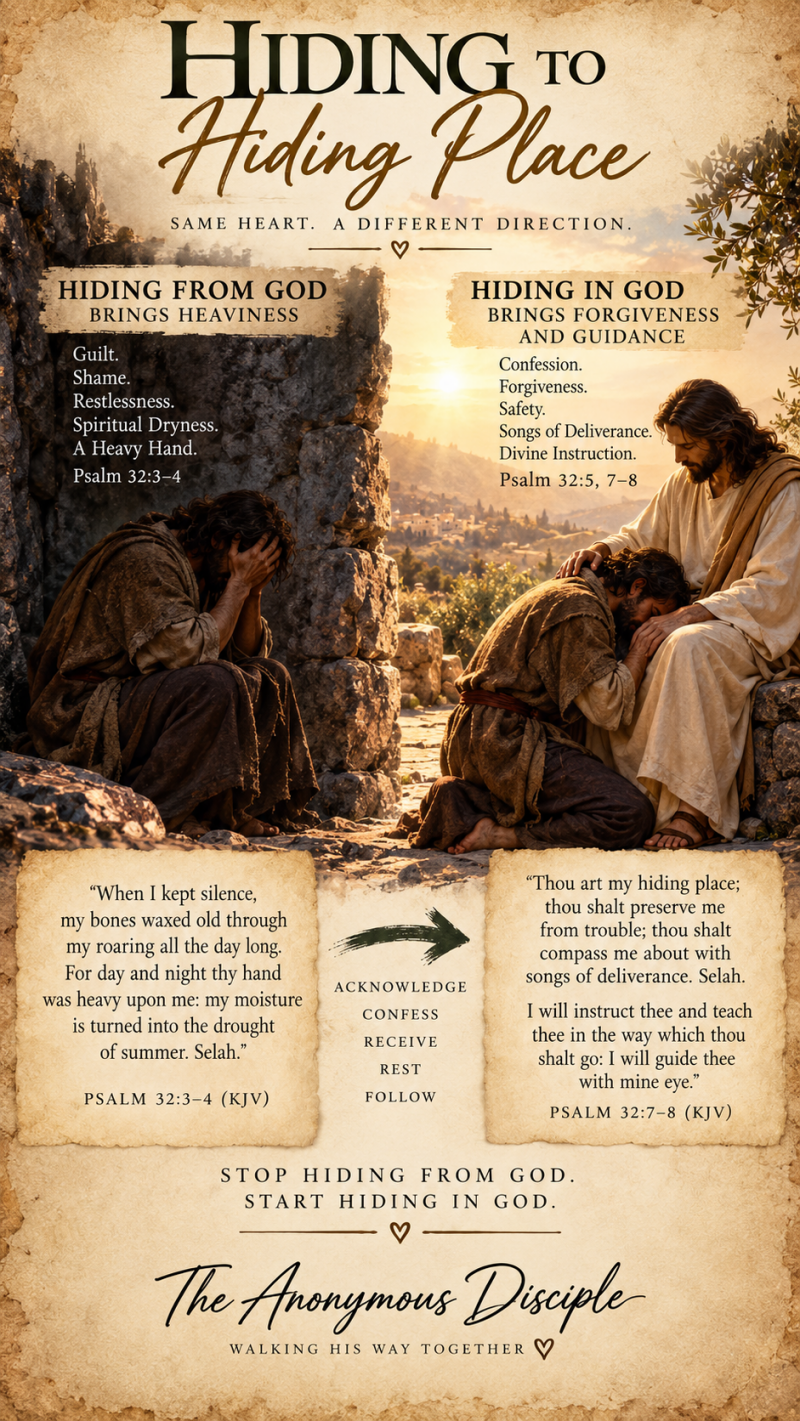
David stops hiding FROM God
and begins
hiding IN God.
That may be the heartbeat of the entire psalm.
The safest place for a sinner isn't away from God.
It's running straight toward Him.
And now we're ready for your anchor.
⚓ PSALM 32:8 — “I WILL INSTRUCT THEE”
Psalm 32:8 (KJV)
“I will instruct thee and teach thee in the way which thou shalt go: I will guide thee with mine eye.”
There is some discussion about the speaker here. Some interpreters understand David to be instructing worshipers based on his experience; others understand this as the LORD's response beginning in verse 8.
Either way, the theological truth fits the psalm beautifully:
God does not merely forgive His people and leave them standing where He found them.
He teaches them how to walk differently.
Look at the verbs:
“I will instruct thee”
The Hebrew idea behind śākal can carry the sense of giving insight, understanding, or wisdom.
Not merely:
“Here's the rule.”
But:
“I will teach you to understand the way.”
“and teach thee”
God's guidance is relational and formative.
He's shaping the person—not merely supplying directions.
“in the way which thou shalt go”
There's the biblical picture of life as a way/path again.
Proverbs 3:5–6 (KJV)
“Trust in the LORD with all thine heart; and lean not unto thine own understanding.
In all thy ways acknowledge him, and he shall direct thy paths.”
“I will guide thee with mine eye.”
This is intimate imagery.
It pictures attentive oversight.
God sees the road we cannot see.
And therefore the One guiding us isn't guessing about what lies ahead.
🐎 5. THEN COMES THE WARNING
Verse 9 cannot be separated from verse 8.
Psalm 32:9 (KJV)
“Be ye not as the horse, or as the mule, which have no understanding: whose mouth must be held in with bit and bridle, lest they come near unto thee.”
God has just said:
“I will instruct you.”
Then essentially:
“So don't make Me drag you.” 😳
A horse or mule can be directed externally through pressure.
But God desires something better from His people:
willing responsiveness.
The contrast is striking:
Verse 8
👁️ Guidance by the eye
Verse 9
🐎 Guidance by bit and bridle
One requires sensitivity.
The other requires force.
It's almost as though God is saying:
Stay close enough to Me that I don't have to yank the reins.
That'll preach, Sherri. ❤️
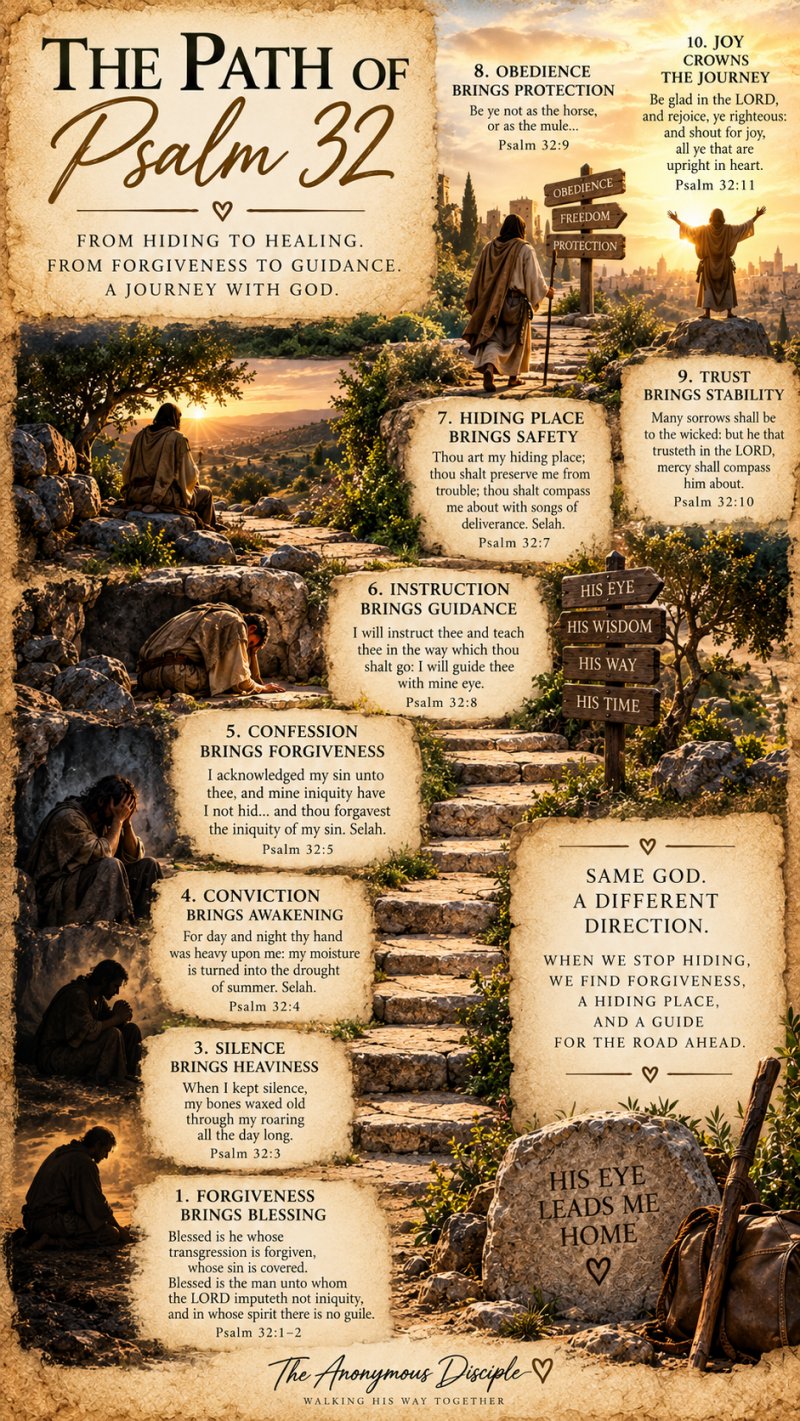
❤️ 6. THE ENTIRE PSALM IS A JOURNEY
Look at David's progression:
Psalm 32:3 — Silence
↓
Psalm 32:4 — Conviction
↓
Psalm 32:5 — Confession
↓
Psalm 32:5 — Forgiveness
↓
Psalm 32:7 — Refuge
↓
Psalm 32:8 — Instruction
↓
Psalm 32:9 — Obedience
↓
Psalm 32:10 — Trust
↓
Psalm 32:11 — Joy
And that final verse is glorious:
Psalm 32:11 (KJV)
“Be glad in the LORD, and rejoice, ye righteous: and shout for joy, all ye that are upright in heart.”
The man whose bones felt like they were wasting away in verse 3
is shouting for joy in verse 11.
What changed?
Not his past.
His relationship to God concerning his past.
He stopped hiding it.
God forgave him.
And then God taught him how to move forward.
✝️ AND THIS POINTS BEAUTIFULLY TO CHRIST
Psalm 32 doesn't teach that righteousness means never having sinned.
David certainly couldn't claim that.
It teaches the blessedness of the person whose guilt has been dealt with by God.
That's precisely why Paul reaches for Psalm 32 in Romans 4.
And there's something beautiful about your anchor when we read the psalm through the fuller revelation of Scripture.
Jesus doesn't merely save us from something.
He calls us into a way of walking.
John 10:27 (KJV)
“My sheep hear my voice, and I know them, and they follow me.”
Forgiven.
Known.
Taught.
Led.
Following.
❤️
⚓ THE HEART OF TODAY'S STUDY
I think I'd write this beside Psalm 32:8 in the margin:
“God doesn't only forgive the road behind me—He guides the road ahead of me.”
And beside Psalm 32:7–8:
Stop hiding FROM God.
Start hiding IN God.
Then let Him lead.
Add comment
Comments