


📜 Today’s Study — Exodus 2:23–25; 3:7–10
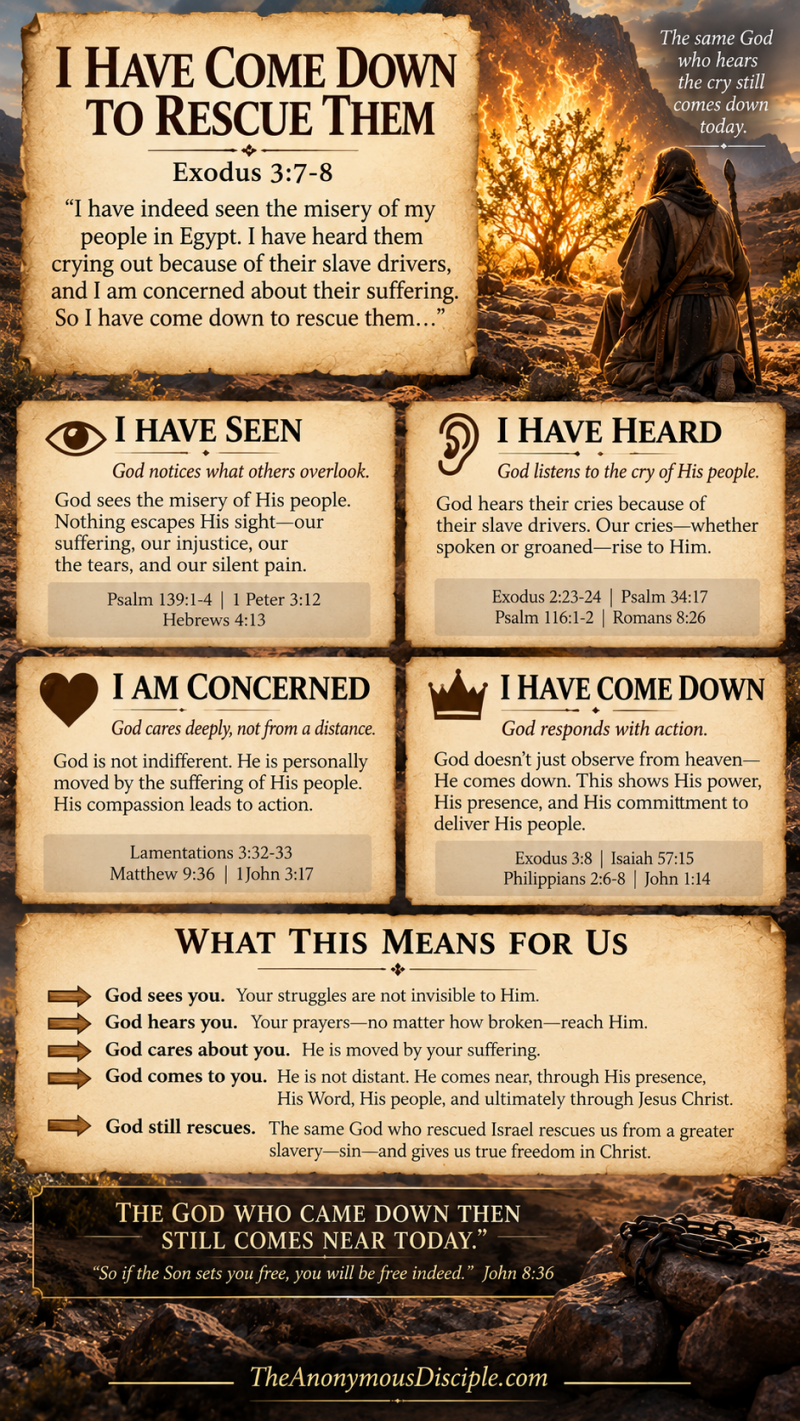
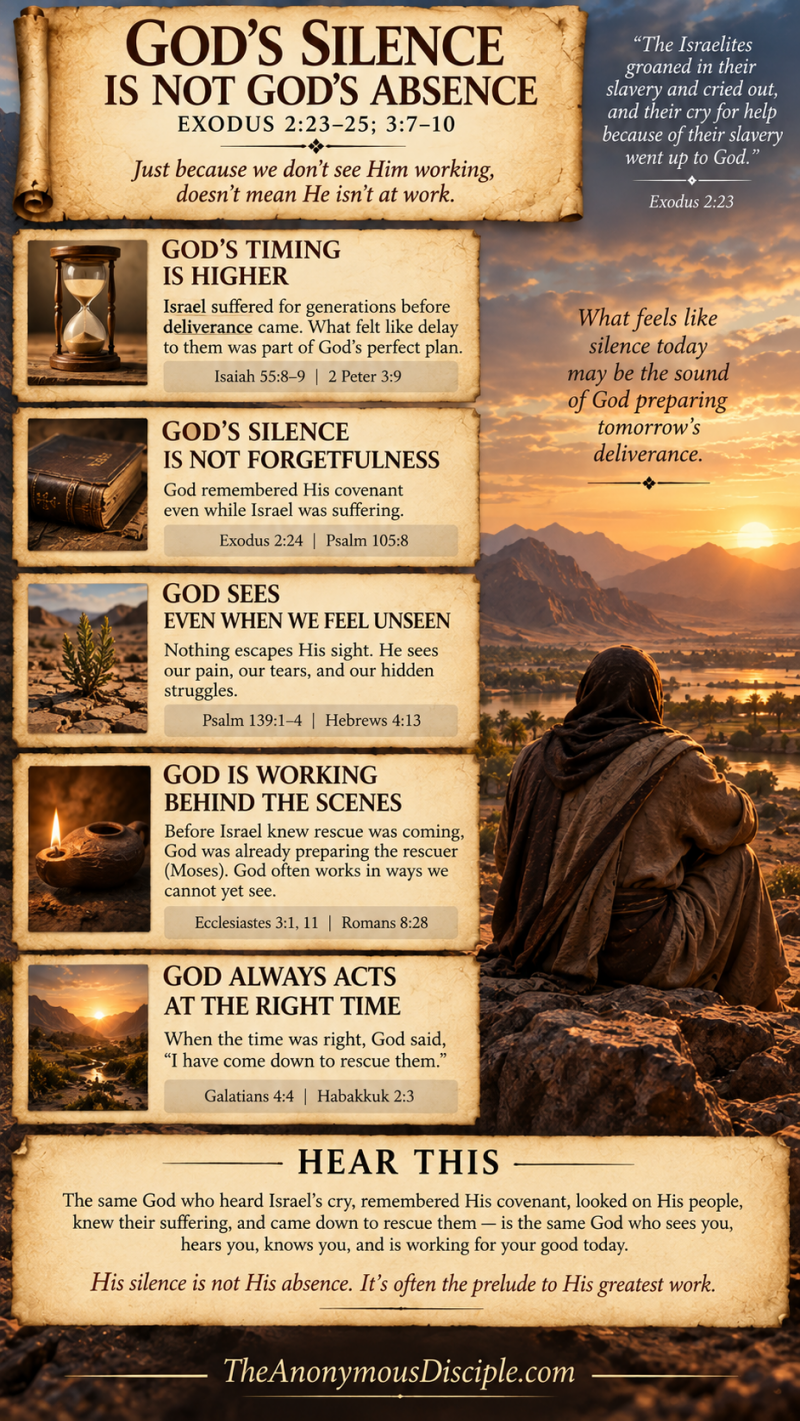
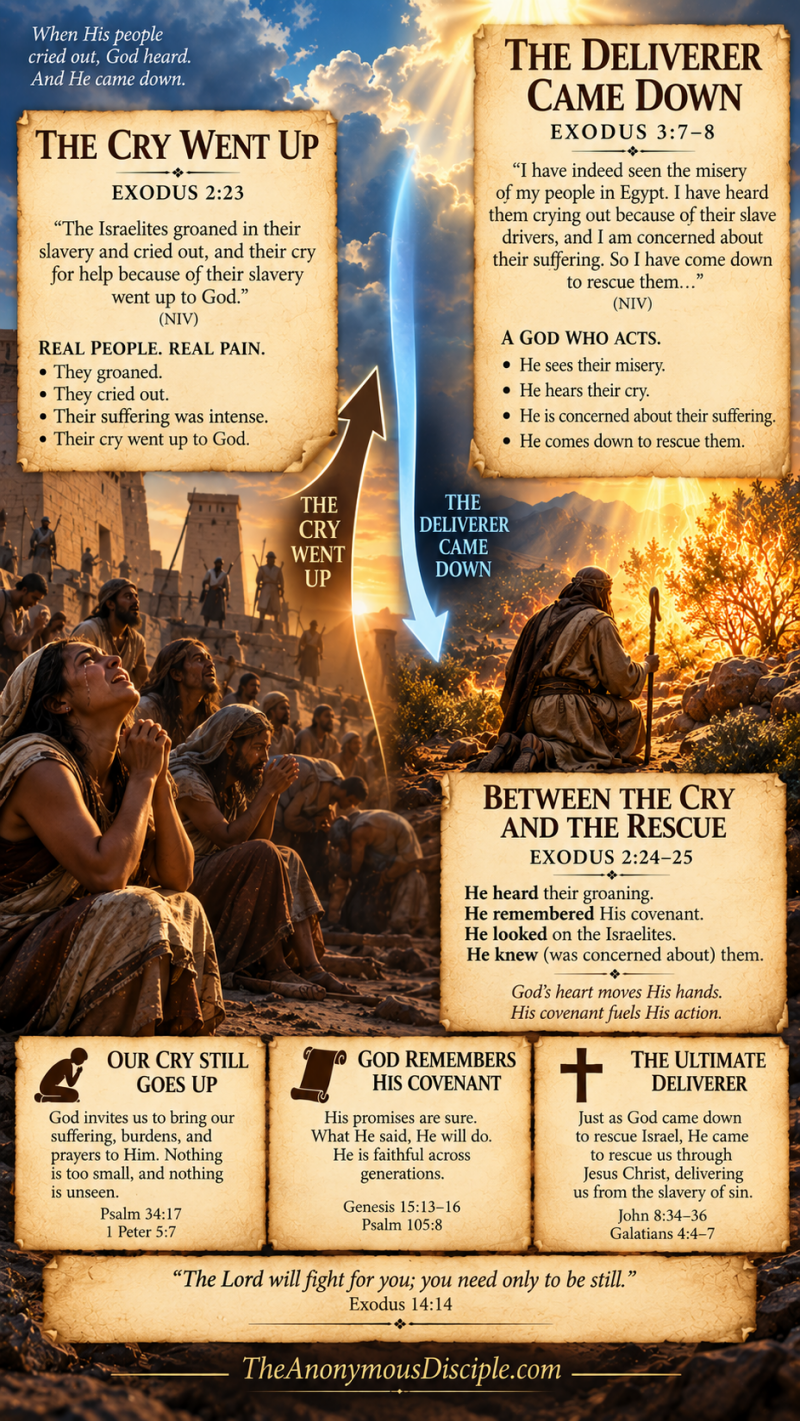
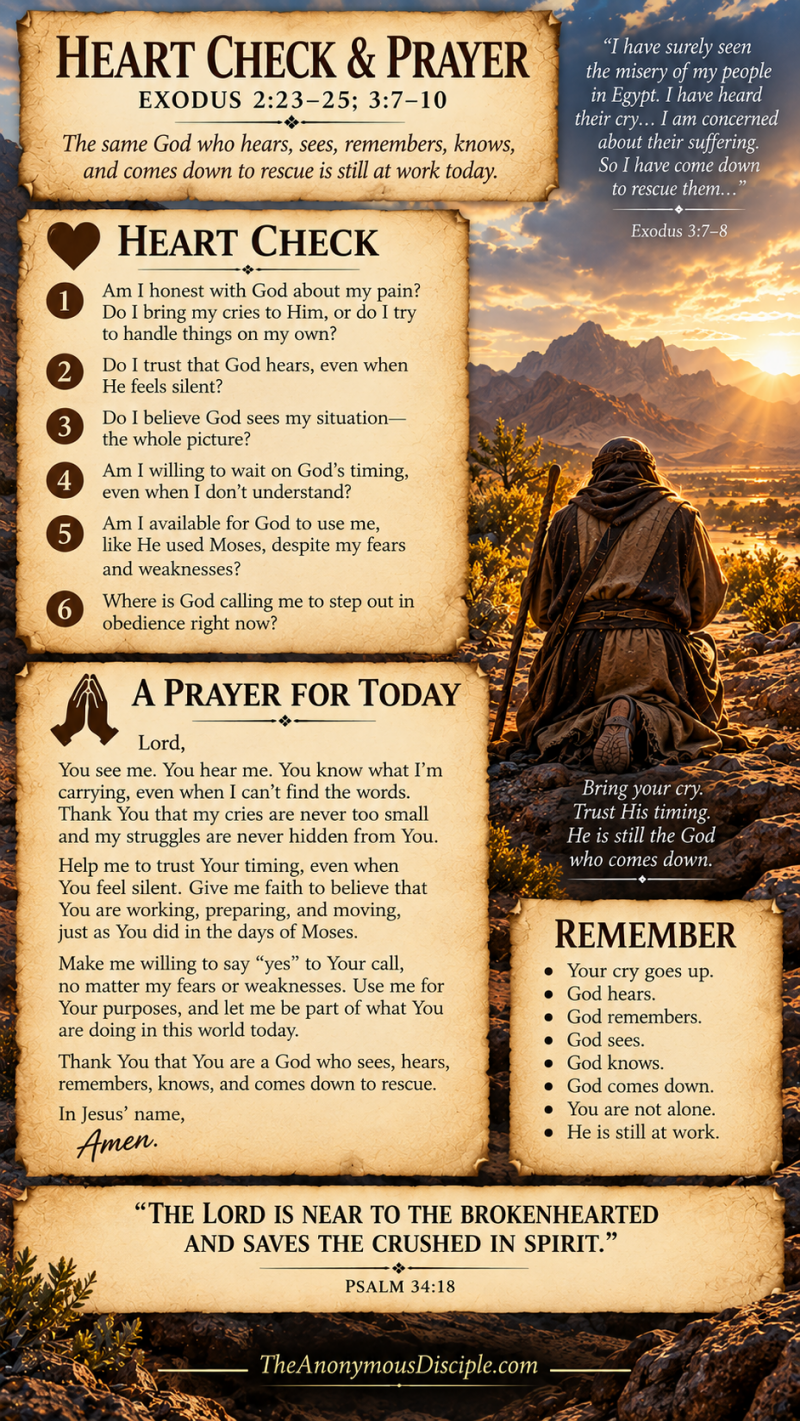
Israel had been suffering in Egypt for generations. They groaned under the weight of slavery, and their cry for help went up to God (Exodus 2:23). What they could not see was that God had not been absent or indifferent. He heard. He remembered His covenant. He saw. He knew (Exodus 2:24–25). Then, from the burning bush, God revealed what He intended to do: “I have come down to rescue them” (Exodus 3:8).
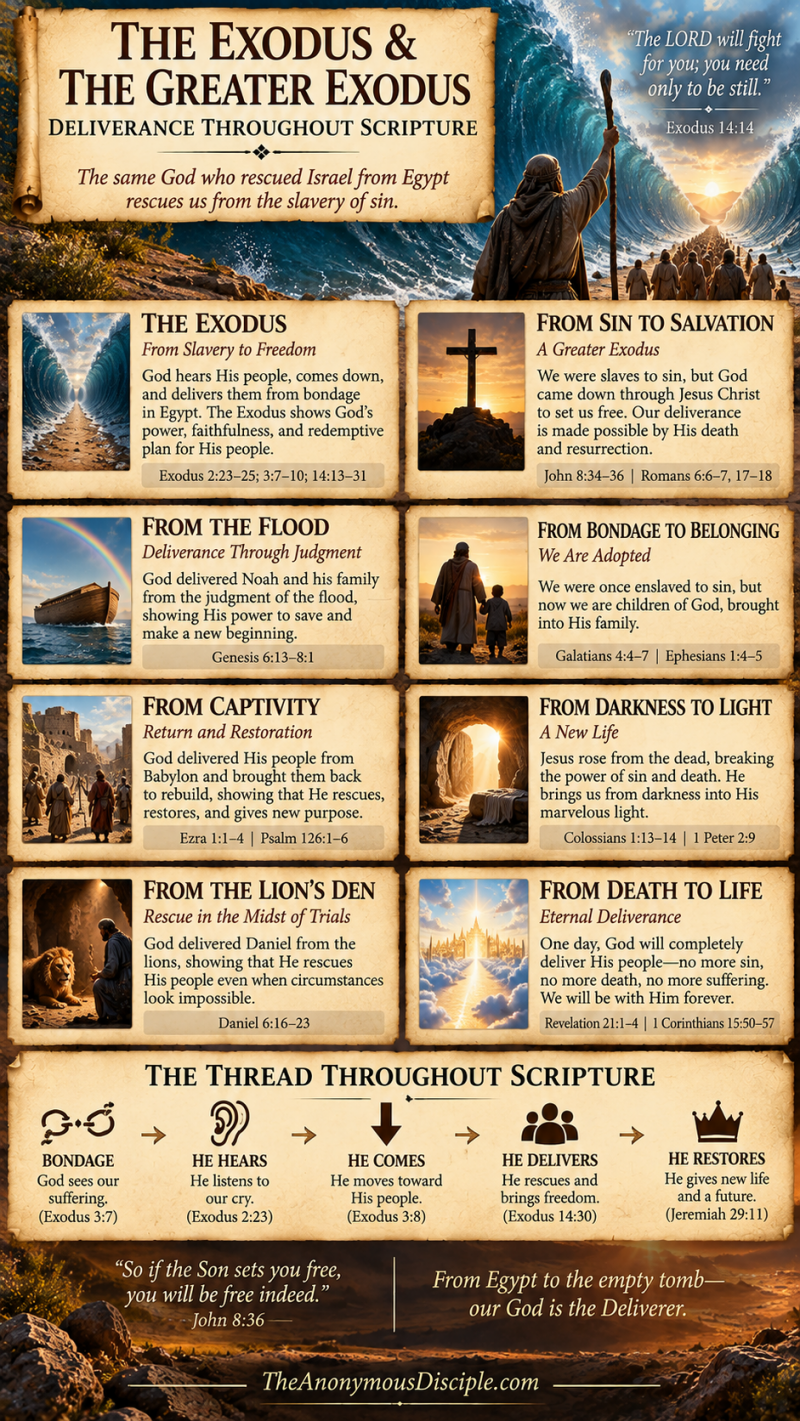
This passage gives us a beautiful picture of the God who hears the cries of His people and acts according to His promises. He would send Moses to bring Israel out of bondage (Exodus 3:10), pointing us toward an even greater Deliverer—Jesus Christ, who came down to free us from slavery to sin (John 8:34–36).
The cry went up. The Deliverer came down. And between the cry and the rescue, God had never stopped seeing, hearing, knowing, remembering—or working. 🕊️❤️
Today's Study:
- KJV v ESV translation comparison
- Historical Snapshot
- Deep Dive card
- Verse by Verse breakdown with 𝕏James𝕏
- Companion card breakdowns throughout
- Cultural/Traditional notes throughout
- Heart Check & Prayer card (plus pdf)
- Deep Dive Study Notes with 🪄Jenny🪄
- Cross References
Exodus 2:23–25
KJV
23 And it came to pass in process of time, that the king of Egypt died: and the children of Israel sighed by reason of the bondage, and they cried, and their cry came up unto God by reason of the bondage.
24 And God heard their groaning, and God remembered his covenant with Abraham, with Isaac, and with Jacob.
25 And God looked upon the children of Israel, and God had respect unto them.
Exodus 3:7–10
7 And the LORD said, I have surely seen the affliction of my people which are in Egypt, and have heard their cry by reason of their taskmasters; for I know their sorrows;
8 And I am come down to deliver them out of the hand of the Egyptians, and to bring them up out of that land unto a good land and a large, unto a land flowing with milk and honey; unto the place of the Canaanites, and the Hittites, and the Amorites, and the Perizzites, and the Hivites, and the Jebusites.
9 Now therefore, behold, the cry of the children of Israel is come unto me: and I have also seen the oppression wherewith the Egyptians oppress them.
10 Come now therefore, and I will send thee unto Pharaoh, that thou mayest bring forth my people the children of Israel out of Egypt.
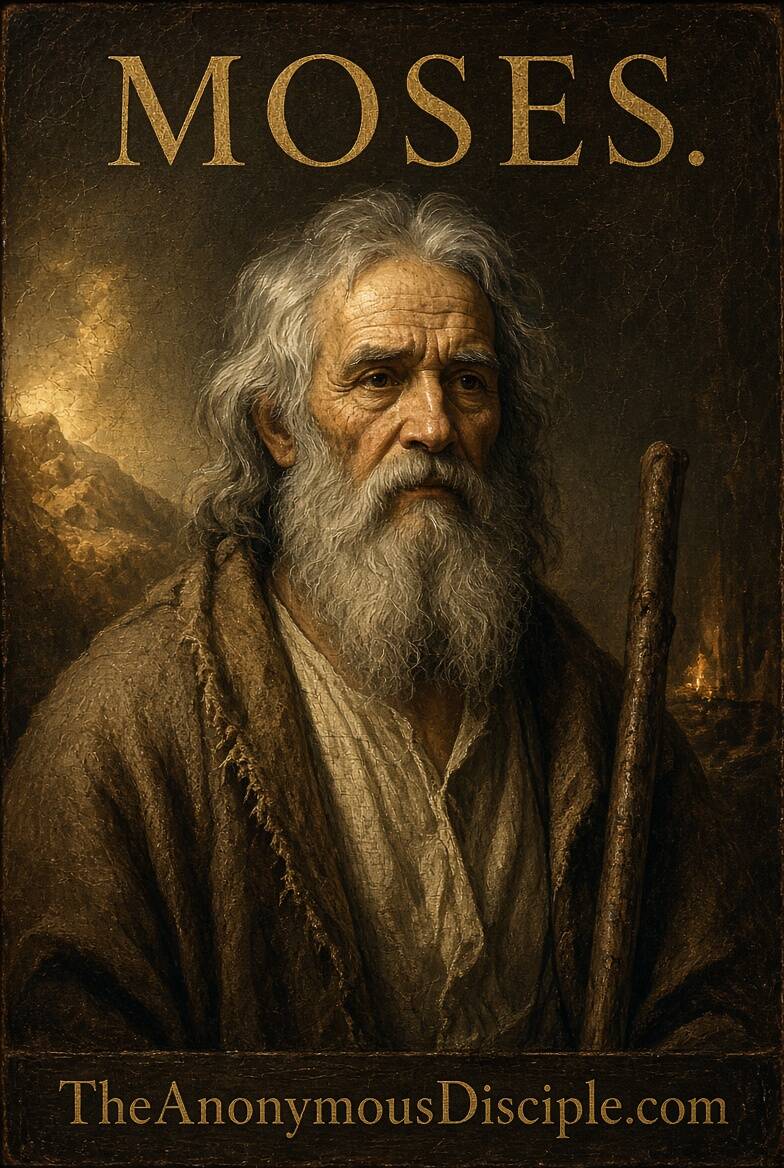
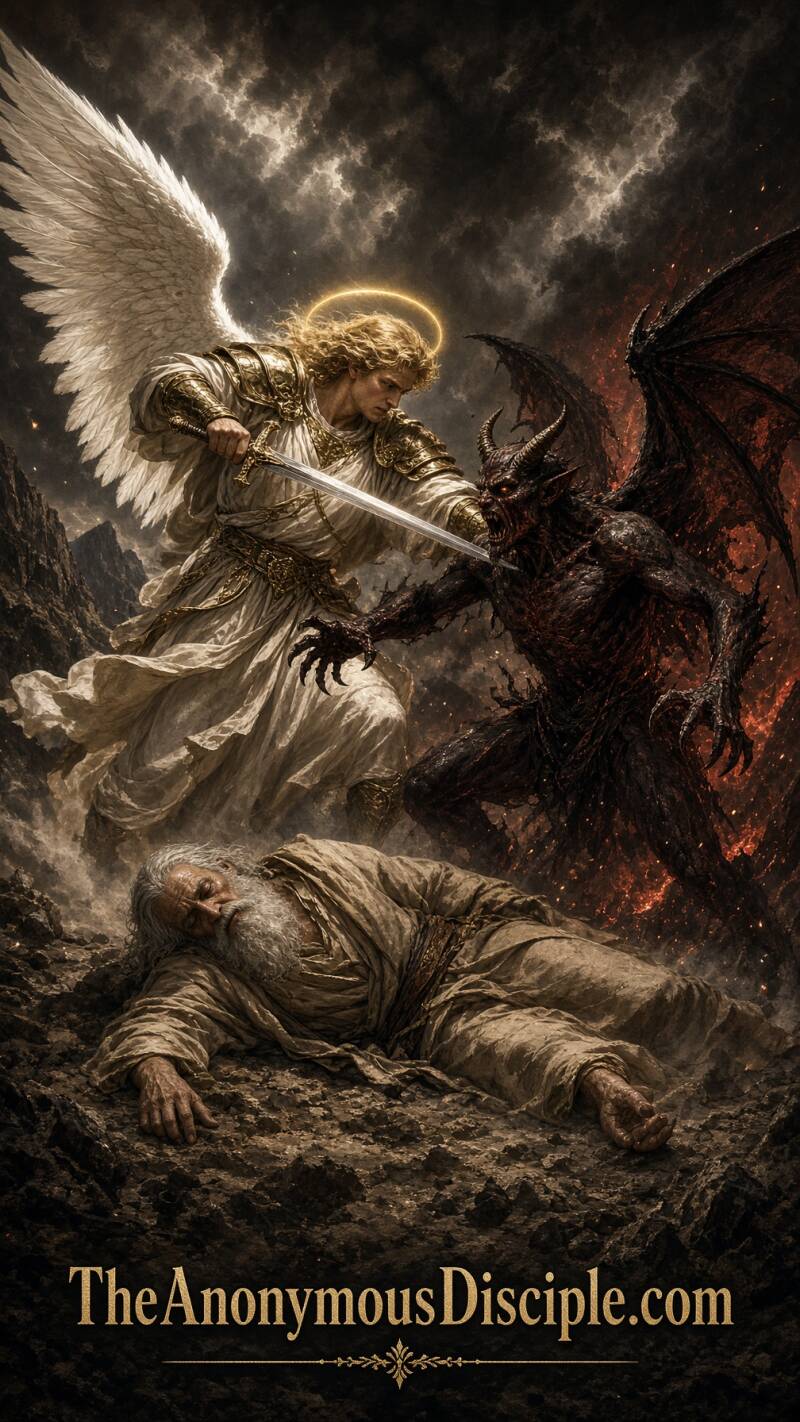
Michael & Satan fighting over Moses' body
Jude 1:9, Deuteronomy 34:5–6
Exodus 2:23–25
ESV
23 During those many days the king of Egypt died, and the people of Israel groaned because of their slavery and cried out for help. Their cry for rescue from slavery came up to God.
24 And God heard their groaning, and God remembered his covenant with Abraham, with Isaac, and with Jacob.
25 God saw the people of Israel—and God knew.
Exodus 3:7–10
7 Then the LORD said, “I have surely seen the affliction of my people who are in Egypt and have heard their cry because of their taskmasters. I know their sufferings,
8 and I have come down to deliver them out of the hand of the Egyptians and to bring them up out of that land to a good and broad land, a land flowing with milk and honey, to the place of the Canaanites, the Hittites, the Amorites, the Perizzites, the Hivites, and the Jebusites.
9 And now, behold, the cry of the people of Israel has come to me, and I have also seen the oppression with which the Egyptians oppress them.
10 Come, I will send you to Pharaoh that you may bring my people, the children of Israel, out of Egypt.”
Who wrote it?
The book of Exodus is part of the Torah (the first five books). The consistent biblical claim is that Moses wrote it (see Exodus 17:14; 24:4; 34:27; Numbers 33:2; Deuteronomy 31:9, 24; also Jesus in John 5:46–47 and Luke 24:27, 44).
Moses is both a character in the story (especially chapter 3) and the human author who later recorded it. God is the One who ultimately gave the words; Moses put them down.
Some modern scholars argue the book was compiled much later from several sources. The text itself, and the rest of Scripture, points to Moses.
When?
Two “whens” matter:
When the events happened
- Exodus 2:23–25 takes place in Egypt, during Israel’s long slavery, after Moses had already fled to Midian. A new Pharaoh is on the throne; the old one who wanted Moses dead is gone.
- Exodus 3:7–10 happens about 40 years later, when Moses is 80, at the burning bush on Mount Horeb (Sinai) in Midian.
Using the earlier biblical timeline (1 Kings 6:1), the Exodus itself is often placed around 1446 BC. On that dating, Moses fled Egypt around 1486 BC and met God at the bush around 1446 BC. A later dating puts the Exodus in the 1200s BC. The story itself does not name the Pharaoh.
When it was written down Moses wrote during Israel’s years in the wilderness—after they left Egypt and before they entered the land, so roughly the 15th century BC on the early date (or 13th on the late date). He is looking back and writing the story for the people who came out with him and for their children.
Where?
- Events of 2:23–25: Egypt—the land of slavery.
- Events of 3:7–10: the wilderness of Midian, at Horeb, “the mountain of God.”
- Writing of the book: the wilderness, as Israel camped and moved after the Exodus (Sinai region and later toward the plains of Moab).
To whom?
First of all, the Israelites who had just been delivered—the generation that walked out of Egypt and their children growing up in the desert.
After that, every later generation of Israel, and then the church that reads these same Scriptures.
They needed to know: This is how we got here. This is who our God is.
Why?
Exodus was not written as a random history lesson. It answers the questions:
- Who is this God who brought us out?
- Did He actually hear us when we cried?
- Why should we trust Him now in the wilderness?
- Where did Moses get his authority?
These particular verses sit at the turning point. For a long time it looked like God was silent. Then:
- The people groaned and cried out.
- God heard, remembered His covenant with Abraham, Isaac, and Jacob, saw them, and knew.
- God came down and called Moses to go to Pharaoh.
The “why” of this snapshot is pastoral and theological: God keeps covenant. He hears the cry of His people. He sees. He knows. And when He acts, He often sends a person.
Moses writes it so Israel will not forget that their rescue did not start with Moses’ courage. It started with their groan going up to God, and with God choosing to remember His promise.
Verse by verse breakdown with 𝕏James𝕏
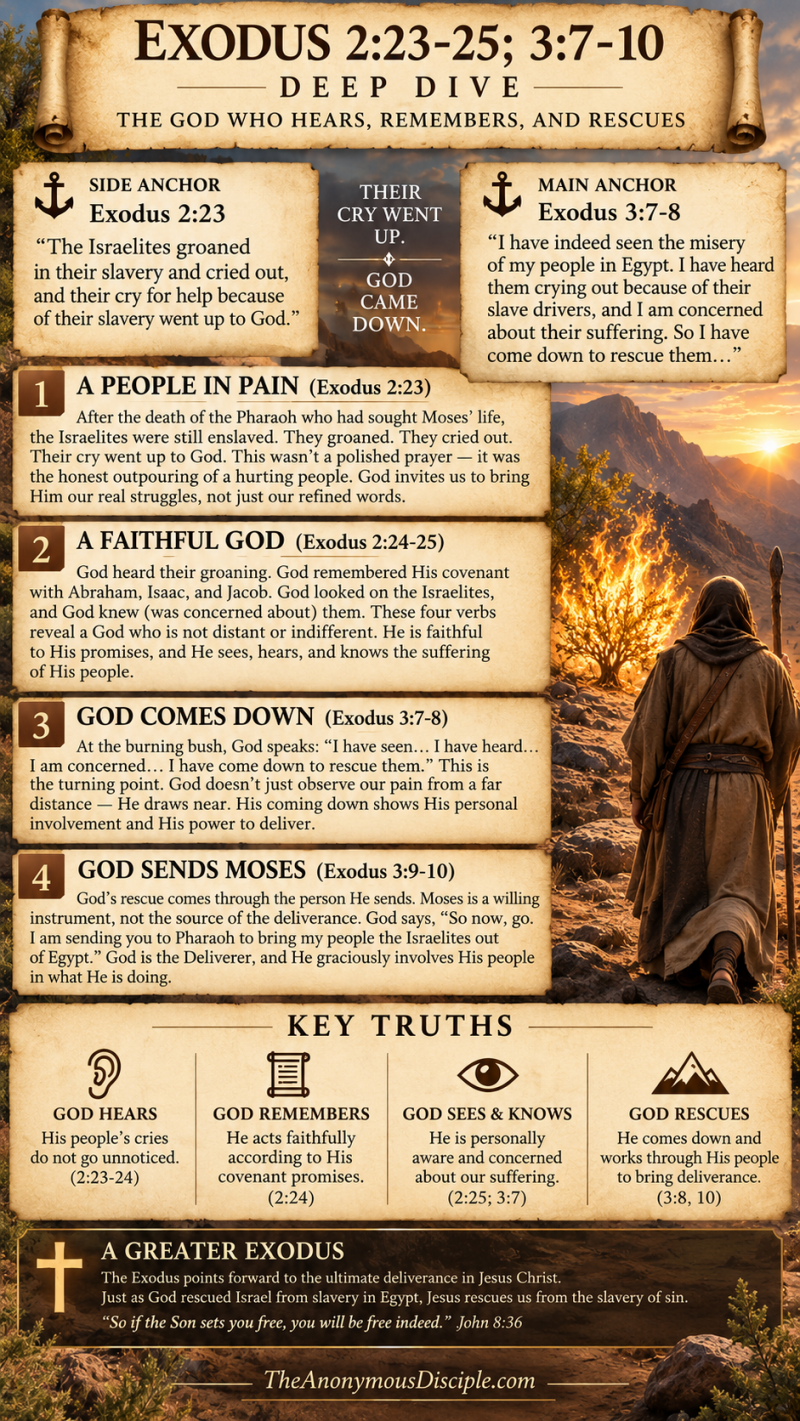
🪢 Side Anchor verse — Exodus 2:23
“During those many days the king of Egypt died, and the people of Israel groaned because of their slavery and cried out for help. Their cry for rescue from slavery came up to God.”
A long stretch of hard years went by. The old king died, but the slavery stayed the same. The people were worn out. They groaned and finally cried out for rescue. That cry didn’t stay on the ground—it went all the way to God.
For us today:
Sometimes the hard season lasts longer than we think it should. A change in circumstances (a new boss, a new year, a new diagnosis) doesn’t automatically fix the pain. God still hears the groan that comes from a tired heart. Your cry is not wasted air.
Exodus 2:23–25
Verse 23
The people are exhausted. They stop just talking to each other and cry out to God.
Verse 24
“And God heard their groaning, and God remembered his covenant with Abraham, with Isaac, and with Jacob.”
God heard. Then He “remembered” His promise. That doesn’t mean He had forgotten. It means He chose this moment to act on the promise He had already made.
Verse 25
“God saw the people of Israel—and God knew.”
He looked at them. He didn’t turn away. And He knew—He understood exactly what they were carrying.
For us today:
God is not waiting for us to use the perfect words. Groaning is enough. He hears. He keeps His old promises even when we feel forgotten. And He knows—not just the facts of our situation, but the weight of it. You are not invisible to Him.
Exodus 3:7–10
God is now speaking to Moses at the burning bush.
⚓ Main Anchor Exodus 3:7-8
Verse 7
“Then the LORD said, ‘I have surely seen the affliction of my people who are in Egypt and have heard their cry because of their taskmasters. I know their sufferings,’”
God says it again, stronger: “I have surely seen.” He has seen the misery, heard the cries caused by the people who were crushing them, and He knows their sufferings firsthand.
Verse 8
“and I have come down to deliver them out of the hand of the Egyptians and to bring them up out of that land to a good and broad land, a land flowing with milk and honey…”
God isn’t only watching. He is coming down to do two things: pull them out of Egypt and take them to a better, spacious place that can actually sustain them.
Verse 9
“And now, behold, the cry of the people of Israel has come to me, and I have also seen the oppression with which the Egyptians oppress them.”
He repeats it so Moses cannot miss it: the cry has reached Me, and I have seen how they are being treated.
Verse 10
“Come, I will send you to Pharaoh that you may bring my people, the children of Israel, out of Egypt.”
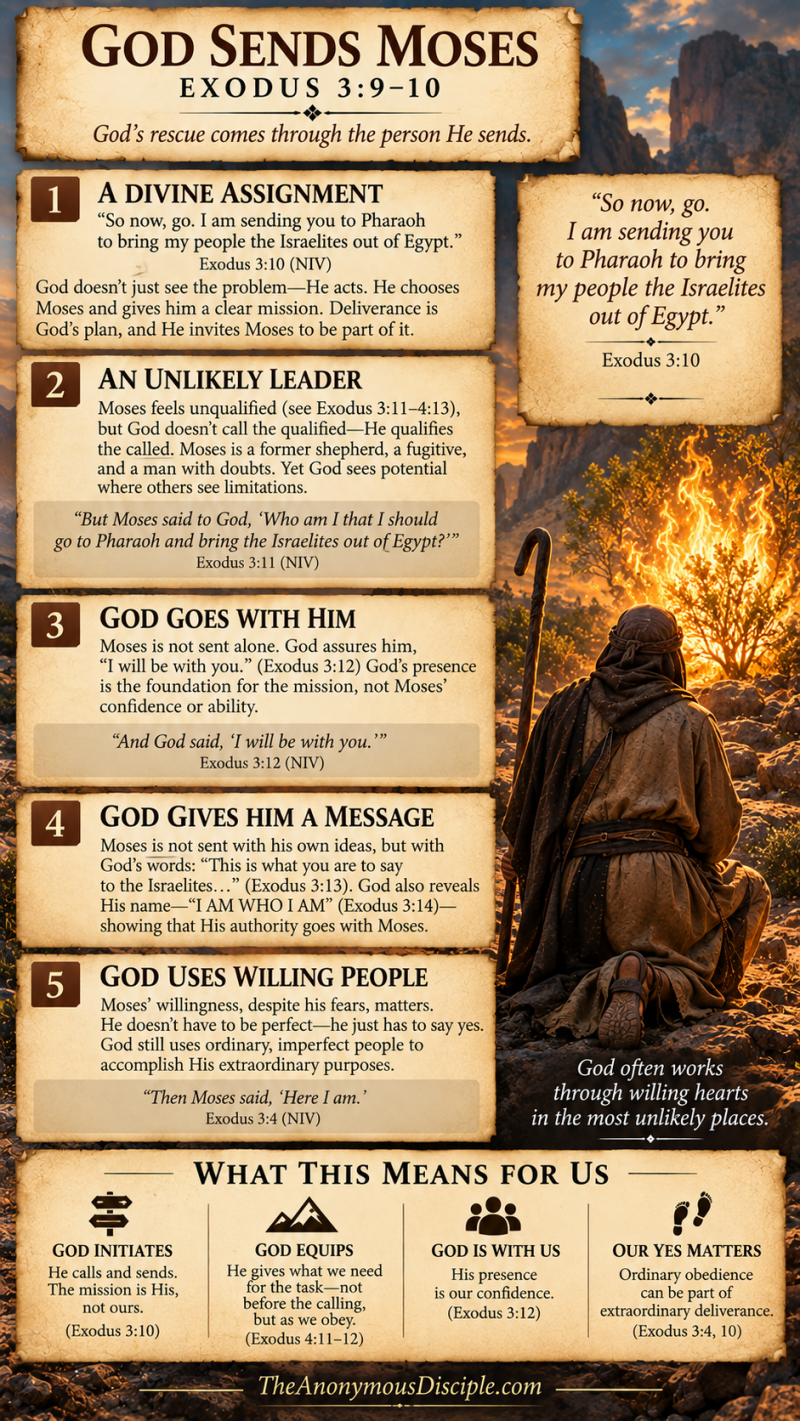
The plan now has a name attached to it. God tells Moses, “Come. I’m sending you.”
For us today:
God sees the specific people and situations that are wearing you down. He is not distant. “I have come down” is still His heart—He entered our world in Jesus and still draws near. Rescue often includes a next step He asks us to take. He doesn’t only comfort; He also sends. The same God who hears groans is the God who says, “Come. I will send you.”
That’s the whole movement: they cried → He heard, remembered, saw, and knew → He came down to rescue → He sent someone to walk it out.
Life under the taskmasters
Israel was not building the great stone pyramids. Those were already ancient by this period. The work in Exodus is mud-brick labor and field work—the kind of forced labor Egypt actually used for store-cities, temples, ramps, and walls.
Egyptian records and tomb art match the feel of the story:
- Bricks were made of Nile mud mixed with straw or chaff so they would not crumble. When straw was withheld, the work got much harder. Egyptian texts even complain about missing straw and missed brick quotas.
- Labor was organized in gangs with quotas. A leather scroll from the time of Ramesses II lists teams expected to produce thousands of bricks a day. The target was often missed.
- Oversight was two-layered, just like Exodus 5: Egyptian taskmasters over Hebrew foremen. If the count was short, the foremen were beaten.
- The tomb of Rekhmire (about 1450 BC) shows Semitic and Nubian workers mixing mud, pressing bricks in molds, stacking them to dry, while an Egyptian overseer stands with a rod. One caption reads, in spirit, “The rod is in my hand; do not be idle.”
So when the text says they “groaned because of their slavery,” it is not poetic fluff. It is the sound of quota labor, heat, mud, and the stick.
Why Egypt feared “Asiatics”
Egyptians called people from Canaan and Syria Aamu or Asiatics. After the Hyksos period—when Semitic rulers had controlled the Delta—later native kings treated large Semitic groups in the east as a possible threat: too many, too close to the border, too easy to side with an enemy. Forced labor was one way the state tried to control them.
That background helps Exodus 1 make sense culturally: a new king “who did not know Joseph,” fear of numbers, then crushing work. Chapter 2:23 is what that policy felt like after many years.
Midian: shepherds, priests, and desert holy ground
Moses is not in a palace anymore. He is a resident alien shepherd working his father-in-law’s flock. Midianites were semi-nomadic clans in northwest Arabia / the southern desert—herders, traders, sometimes raiders—moving flocks toward better pasture. Taking sheep “west of the wilderness” to Horeb fits how desert shepherds still chase seasonal grazing.
Jethro is called a priest of Midian. Desert tribes had clan priests. Mountains were often treated as sacred meeting places. “Horeb, the mountain of God” already has that reputation in the story before the bush burns. In that world, a strange fire on a holy mountain is the kind of sight a shepherd would turn aside to see.
Taking off sandals on holy ground (just before our verses, 3:5) was a known mark of reverence in the ancient Near East: you do not track common dust onto a place claimed by a deity.
“A land flowing with milk and honey”
This was not a fairy-tale slogan. It was an old way of saying a land that can feed both flocks and orchards.
- Milk points to good pasture—goats and sheep that actually give. Goats especially were the dairy animals of the hill country.
- Honey often means date syrup or fruit nectar as much as bee honey. Canaan was known for both.
Egyptian storytellers used the same kind of language. The Tale of Sinuhe praises a place in the Levant as full of figs, grapes, honey, oil, and cattle. Ugaritic poetry says that when the gods bless, “the heavens rain oil, the wadis run with honey.”
So when God promises “a good and broad land, flowing with milk and honey,” Moses hears: not brick-mud and Nile ration—open country that can actually sustain a people.
The six nations named in 3:8
God does not say “someplace nice.” He names Canaanites, Hittites, Amorites, Perizzites, Hivites, and Jebusites. That is how land grants and travel reports talked in that era: list the peoples who already hold the ground. The promise is specific, and it is also honest—the land is occupied. Rescue will not be a picnic.
Crying out and “remembering” a covenant
In the ancient world, a cry to a god was not only emotion. It was an appeal for a higher court to take the case. Slaves and the poor were supposed to have little legal voice. Exodus says their cry “came up to God.”
When the text says God remembered His covenant with Abraham, Isaac, and Jacob, that is covenant-lawsuit language. Kings and gods “remembered” treaties when they decided to act on them. God is not jogging His memory. He is invoking the old oath and moving to keep it.
“God saw… and God knew” is also thicker than English. In Hebrew, to “know” can mean personal involvement, not just information. He is not a distant record-keeper. He has taken their suffering into Himself.
One last contrast that makes the scene sharper
Egypt’s gods were tied to the Nile, the king, and the land’s order (maat). Midian’s holy mountain is outside that system. The God who speaks in chapter 3 is not a local Egyptian deity and not Pharaoh’s property. He identifies Himself as the God of the fathers who are buried in Canaan, and He talks about coming down into Egypt to take a people out.
That is culturally shocking. Pharaoh was supposed to be the one who “comes down” on subject peoples. Here the LORD does.
Deep Dive Study Notes with 🪄Jenny🪄
📜 TODAY’S PASSAGE
Exodus 2:23–25; 3:7–10
⚓ Main Anchor — Exodus 3:7–8
God sees, hears, knows, and comes down to rescue.
🪢 Side Anchor — Exodus 2:23
Exodus 2:23 — “The Israelites groaned in their slavery and cried out, and their cry for help because of their slavery went up to God.”
That gives today's study this beautiful movement:
Exodus 2:23 — The cry went UP. ⬆️
Exodus 3:8 — God came DOWN. ⬇️
Ohhhh, THAT'S our thread. ❤️🔥
Their cry went up.
God came down.
And between those two statements sits Exodus 2:24–25: God heard, remembered His covenant, looked upon His people, and knew/was concerned.
So I'd structure today's study around:
📜 Exodus 2:23–25; 3:7–10
⚓ Main Anchor: Exodus 3:7–8 — “I have come down to rescue them.”
🪢 Side Anchor: Exodus 2:23 — “Their cry for help…went up to God.”
⚓ Anchor: Exodus 3:7–8
The Israelites have been enslaved in Egypt for generations. The Pharaoh who had sought Moses’ life eventually dies, but Israel’s suffering does not end with him.
Exodus 2:23 — “The Israelites groaned in their slavery and cried out, and their cry for help because of their slavery went up to God.”
Notice: this isn't a polished prayer. Scripture describes groaning and crying out.
And God hears it.
❤️ Four verbs that change everything
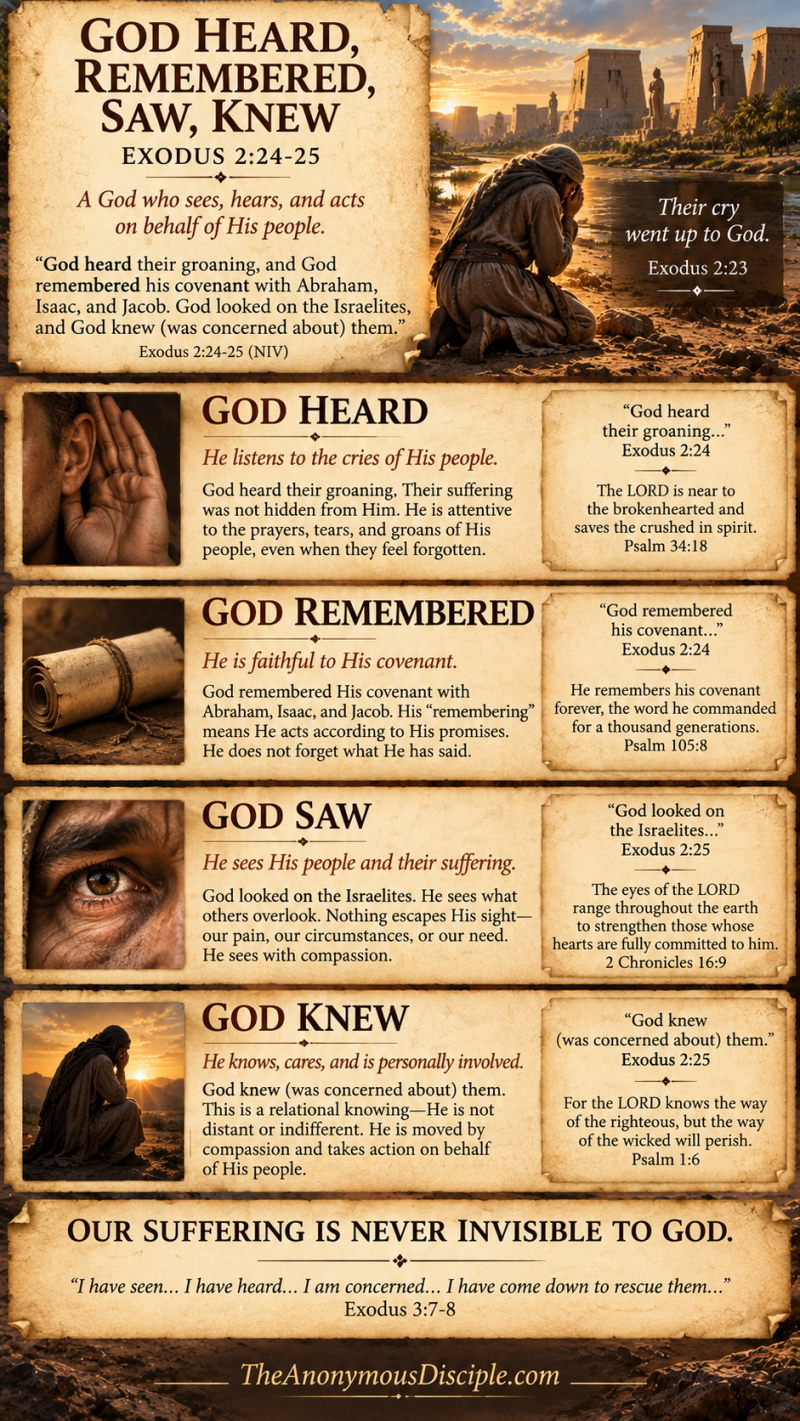
Exodus 2:24–25 tells us:
God heard their groaning.
God remembered His covenant.
God looked on the Israelites.
God was concerned about them.
“Remembered” does not mean God had forgotten Abraham, Isaac, Jacob, or Israel and suddenly thought, Oh! My covenant!
Biblically, when God “remembers,” it often signals that He is about to act faithfully according to His covenant. Compare Genesis 8:1, when “God remembered Noah,” immediately followed by God's action on Noah's behalf.
So Israel's deliverance isn't simply God responding emotionally to suffering.
It is God being faithful to His promise.
🔥 Then God speaks from the burning bush
Now listen to the language of Exodus 3:7–8:
Exodus 3:7–8 — “I have indeed seen the misery of my people in Egypt. I have heard them crying out because of their slave drivers, and I am concerned about their suffering. So I have come down to rescue them…”
Sherri, look at those words:
I have seen.
I have heard.
I am concerned.
I have come down.
God isn't observing suffering from some detached distance.
He knows.
And then comes one of the most important statements in the passage:
“I have come down to rescue them.” — Exodus 3:8
🔥 There is our turning point.
🕊️ But then comes a fascinating twist
God says:
Exodus 3:8 — “I have come down to rescue them…”
Then two verses later:
Exodus 3:10 — “So now, go. I am sending you to Pharaoh to bring my people the Israelites out of Egypt.”
Wait.
God: I have come down to rescue them.
Also God:
Moses, you're going.
😂❤️
But that's enormously important.
God is the Deliverer.
Moses is the instrument.
Moses doesn't rescue Israel because Moses is powerful enough.
God rescues Israel through Moses.
That pattern appears over and over throughout Scripture: God accomplishes His purposes while graciously involving people in what He is doing.
✝️ And Moses points beyond Moses
Here's where we need to be careful not to force every detail into symbolism—but Scripture itself gives us this connection.
Deuteronomy 18:15 — “The LORD your God will raise up for you a prophet like me from among you, from your fellow Israelites. You must listen to him.”
The New Testament explicitly applies this promise to Jesus in Acts 3:20–22.
Moses becomes a major biblical pattern of deliverance:
Israel is enslaved → God hears → God comes down → God sends a deliverer → the people are brought out of bondage.
And the greater rescue comes in Christ:
Humanity is enslaved to sin → God comes to us → Christ delivers → His people are brought from slavery into freedom.
Jesus says:
John 8:34, 36 — “Everyone who sins is a slave to sin… So if the Son sets you free, you will be free indeed.”
🔥 Exodus isn't merely the story of people escaping Egypt.
The Exodus becomes one of Scripture's great pictures of redemption.
🌿 “I know their suffering”
There's another tiny phrase worth slowing down for.
Exodus 3:7 — “I am concerned about their suffering.” (NIV)
Translations render the underlying idea somewhat differently. The ESV has:
“I know their sufferings.”
That is stronger than merely possessing information.
Throughout Scripture, biblical “knowing” can carry a deeply personal, relational sense.
God isn't saying:
I have received the report.
He's saying:
I know.
That's comforting precisely because Exodus doesn't pretend God's people never suffer.
They did.
For a long time.
The promise here isn't:
God's people will never hurt.
It is:
Their suffering is never invisible to God.
⏳ But why did God wait?
This is probably our harder companion card.
Israel's cry reaches God in Exodus 2, yet their oppression has existed for generations.
And way back in Genesis 15:13–16, God had already told Abraham that his descendants would live as foreigners and suffer oppression before He brought them out.
So God's deliverance wasn't an emergency Plan B.
God had already spoken about the Exodus centuries before Moses stood at the burning bush.
That doesn't make Israel's suffering insignificant.
It means something astonishing:
What felt like chaos from inside Egypt was not outside God's knowledge or sovereignty.
Israel could not see what God was preparing.
They didn't know there was a Moses in Midian.
They didn't know about the burning bush that was coming.
They didn't know Pharaoh's empire was about to collide with I AM.
🔥🔥🔥
⚓ THE HEART OF TODAY'S DEVOTION
I think this is our sentence:
God's silence is not God's absence.
Israel cried before they saw deliverance.
God heard before Israel saw evidence that He had heard.
And that's an important distinction.
The evidence of God's attention wasn't what made Him attentive.
He already saw.
He already heard.
He already knew.
And at the appointed time—
He acted.
Cross references
Exodus 2:23 — the cry goes up
The long wait / the king dies
- Exodus 4:19 — the men who sought Moses’ life are dead
- Exodus 7:7 — Moses is 80 when he finally goes
- Acts 7:23, 30 — Stephen: 40 years in Egypt, then 40 in Midian
They sighed and cried
- Genesis 16:11 — Hagar: the Lord has heard your affliction
- Numbers 20:16 — “when we cried to the LORD, he heard our voice”
- Deuteronomy 26:6–7 — Israel’s later confession: Egypt afflicted us; we cried; the LORD heard
- Psalm 12:5 — “Because of the oppression of the poor… I will now arise”
- James 5:4 — the cries of unpaid laborers reach the Lord of hosts
Their cry came up to God
- Exodus 3:7, 9 — God says the same cry has reached Him
- Genesis 18:20–21 — the outcry of Sodom came up to God
Exodus 2:24 — God heard and remembered
God heard their groaning
- Exodus 6:5 — “I have heard the groaning of the people of Israel… and I have remembered my covenant”
- Judges 2:18 — the LORD was moved to pity by their groaning
- Nehemiah 9:27–28 — in their distress they cried; You heard from heaven
- Psalm 22:24 — He has not despised the affliction of the afflicted
- Psalm 79:11; 102:20 — let the groans of the prisoners come before You
God remembered His covenant
- Genesis 15:13–18 — the oath: they will be afflicted, then come out
- Genesis 17:7–8 — covenant with Abraham and his offspring
- Genesis 26:3; 35:11–12 — the same promise repeated to Isaac and Jacob
- Genesis 50:24 — Joseph: God will surely visit you
- Psalm 105:8–11, 42 — He remembers His covenant forever… He remembered His holy promise
- Leviticus 26:42 — “I will remember my covenant with Jacob… Isaac… Abraham”
- Luke 1:72–73 — God remembers His holy covenant, the oath to Abraham
Exodus 2:25 — God saw and knew
- Exodus 3:7; 4:31 — He has seen their affliction; the people believe when they hear He has visited them
- 1 Samuel 1:11 — Hannah: if You will look on my affliction
- 2 Samuel 16:12 — “It may be that the LORD will look on my affliction”
- Psalm 1:6 — the LORD knows the way of the righteous
- Luke 1:25 — “the Lord has looked on me”
Exodus 3:7 — I have surely seen, heard, and know
- Exodus 2:23–25 — this verse is God saying out loud what 2:23–25 already narrated
- Exodus 1:11–14 — the taskmasters and the bitter labor
- Genesis 29:32 — “the LORD has looked upon my affliction”
- 1 Samuel 9:16 — “their cry has come to me”
- Psalm 106:44 — He looked upon their distress when He heard their cry
- Isaiah 63:9 — in all their affliction He was afflicted
- Exodus 22:23 — if the vulnerable cry to Me, I will surely hear
Exodus 3:8 — I have come down to deliver and to bring them up
God comes down
- Genesis 11:5, 7; 18:21 — the LORD comes down to see and to act
- Exodus 19:11, 18, 20 — He comes down on Sinai
- John 6:38 — Jesus: I have come down from heaven
- Philippians 2:6–8 — He emptied Himself and came down
Deliver / bring up to a good land
- Genesis 15:14, 18–21 — same land, same peoples already named to Abraham
- Exodus 3:17; 6:6–8; 13:5 — the promise repeated
- Deuteronomy 26:8–9 — the LORD brought us out… into a land flowing with milk and honey
- Acts 7:34 — Stephen quotes this almost word for word: “I have come down to deliver them. And now come, I will send you to Egypt.”
Milk and honey / the six nations
- Exodus 13:5; 33:3; Numbers 13:27; Deuteronomy 6:3; 11:9
- Genesis 15:19–21 — the earlier, longer list of nations
Exodus 3:9 — the cry has come to Me; I have seen the oppression
- Exodus 2:23; 3:7 — the same cry, said a third time so Moses cannot miss it
- Psalm 12:5 — because the needy groan, I will now arise
Exodus 3:10 — Come, I will send you
- Exodus 4:13; 6:11 — the sending continues even after Moses objects
- 1 Samuel 9:16 — “I will send you a man… their cry has come to me”
- Isaiah 6:8 — “Whom shall I send?”
- Matthew 28:18–20 — the risen Jesus still sends
- Acts 7:34–35 — “This Moses whom they rejected… God sent as both ruler and redeemer”
- Acts 26:16–18 — Paul is sent in the same pattern: seen, called, sent
The “big picture” verses that hold the whole unit together
If you only mark a few in your Bible, these are the strongest:
THEME
-
We cried, He heard
-
He remembered the covenant
-
He came down to save
-
He sends a person
BEST COMPANIONS
-
Deuteronomy 26:7; Psalm 34:17; Psalm 106:44
-
Genesis 15:13–18; Exodus 6:5; Psalm 105:8–42; Luke 1:72–73
-
Acts 7:34; John 6:38; Isaiah 63:9
-
Acts 7:34–35; Isaiah 6:8
Deuteronomy 26:7–8 is almost a miniature of this whole passage: we cried, He heard, He looked, He brought us out.
Add comment
Comments