

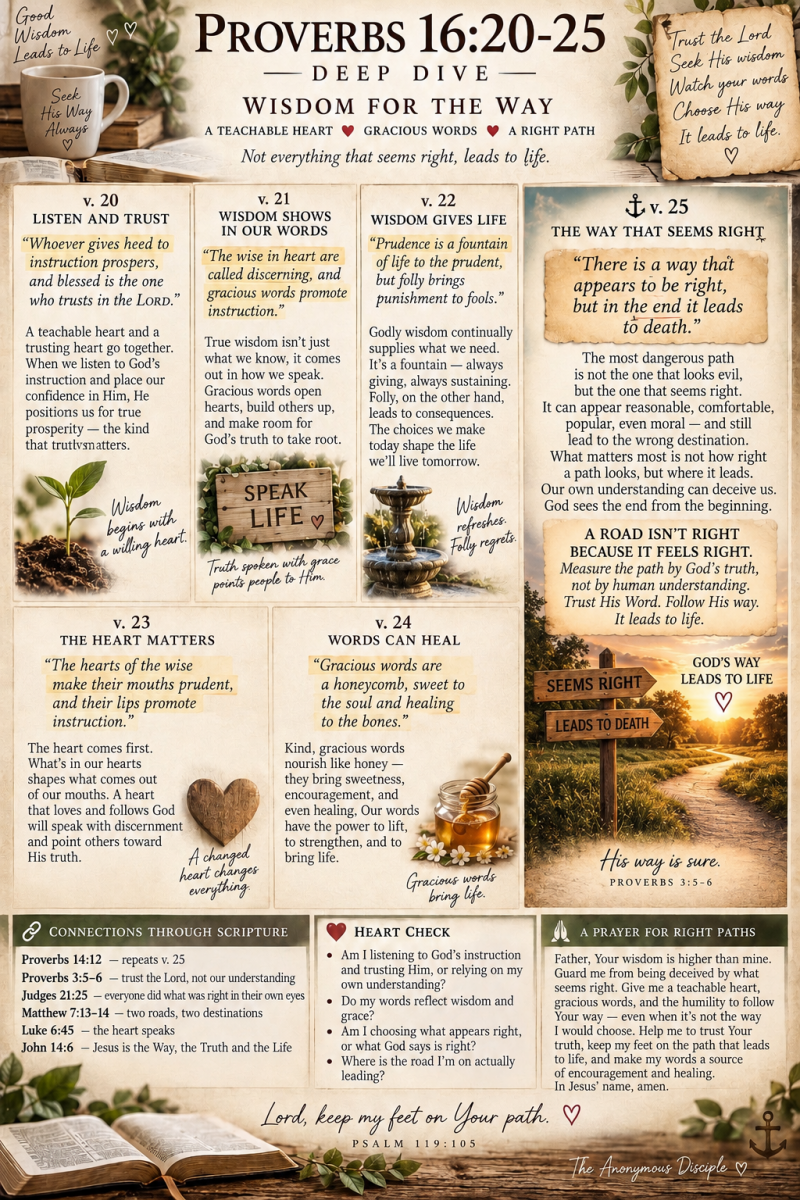
Proverbs 16:20–25 reminds us that true wisdom begins with listening to God and trusting Him rather than our own understanding. Wisdom shapes more than the decisions we make—it transforms our hearts, influences our words, and teaches us to speak with grace that brings life to others. But the passage ends with a sobering warning: a way can appear completely right to us and still lead to the wrong destination. Feelings, good intentions, popularity, and even sincerity are not reliable measures of truth. God sees where every road leads. This study challenges us to examine both our words and our way, measuring them against God's Word and trusting Him to guide our feet onto the path that leads to life. ❤️🕊️

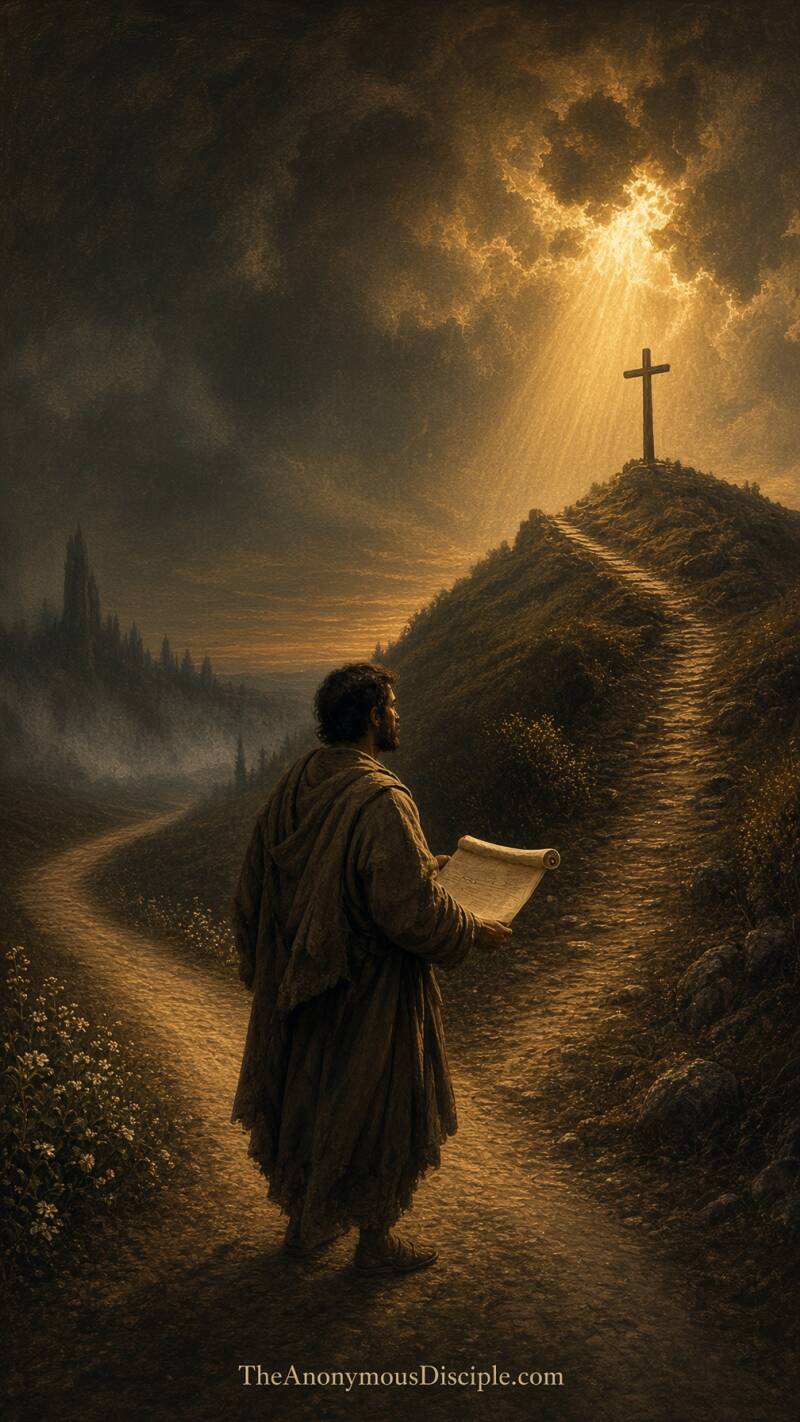
Proverbs 16:20-25 (KJV)
20 He that handleth a matter wisely shall find good:
and whoso trusteth in the LORD, happy is he.
21 The wise in heart shall be called prudent:
and the sweetness of the lips increaseth learning.
22 Understanding is a wellspring of life unto him that hath it:
but the instruction of fools is folly.
23 The heart of the wise teacheth his mouth,
and addeth learning to his lips.
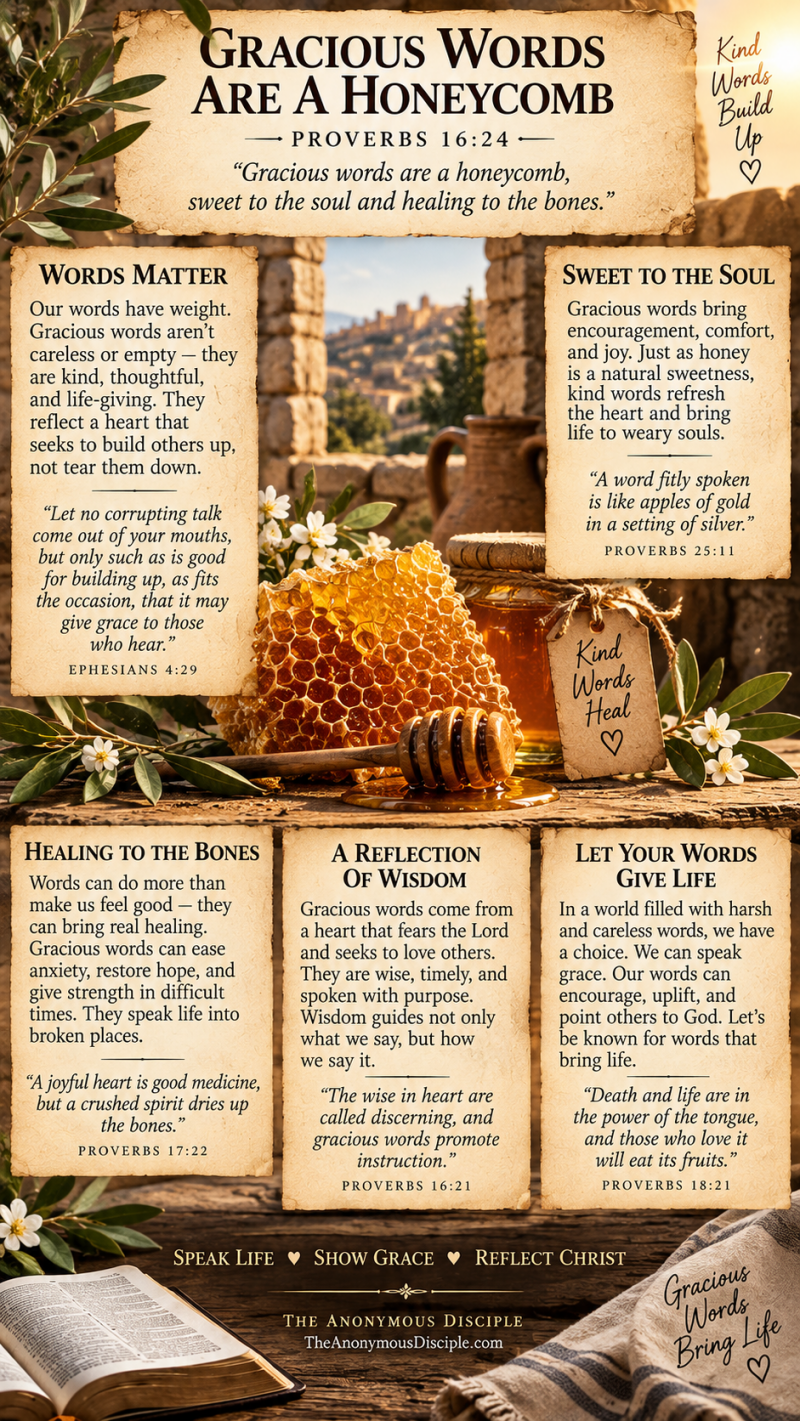
24 Pleasant words are as an honeycomb,
sweet to the soul, and health to the bones.
25 There is a way that seemeth right unto a man,
but the end thereof are the ways of death.

Proverbs 16:20–25 (NIV)
20 Whoever gives heed to instruction prospers,
and blessed is the one who trusts in the Lord.
21 The wise in heart are called discerning,
and gracious words promote instruction.
22 Prudence is a fountain of life to the prudent,
but folly brings punishment to fools.
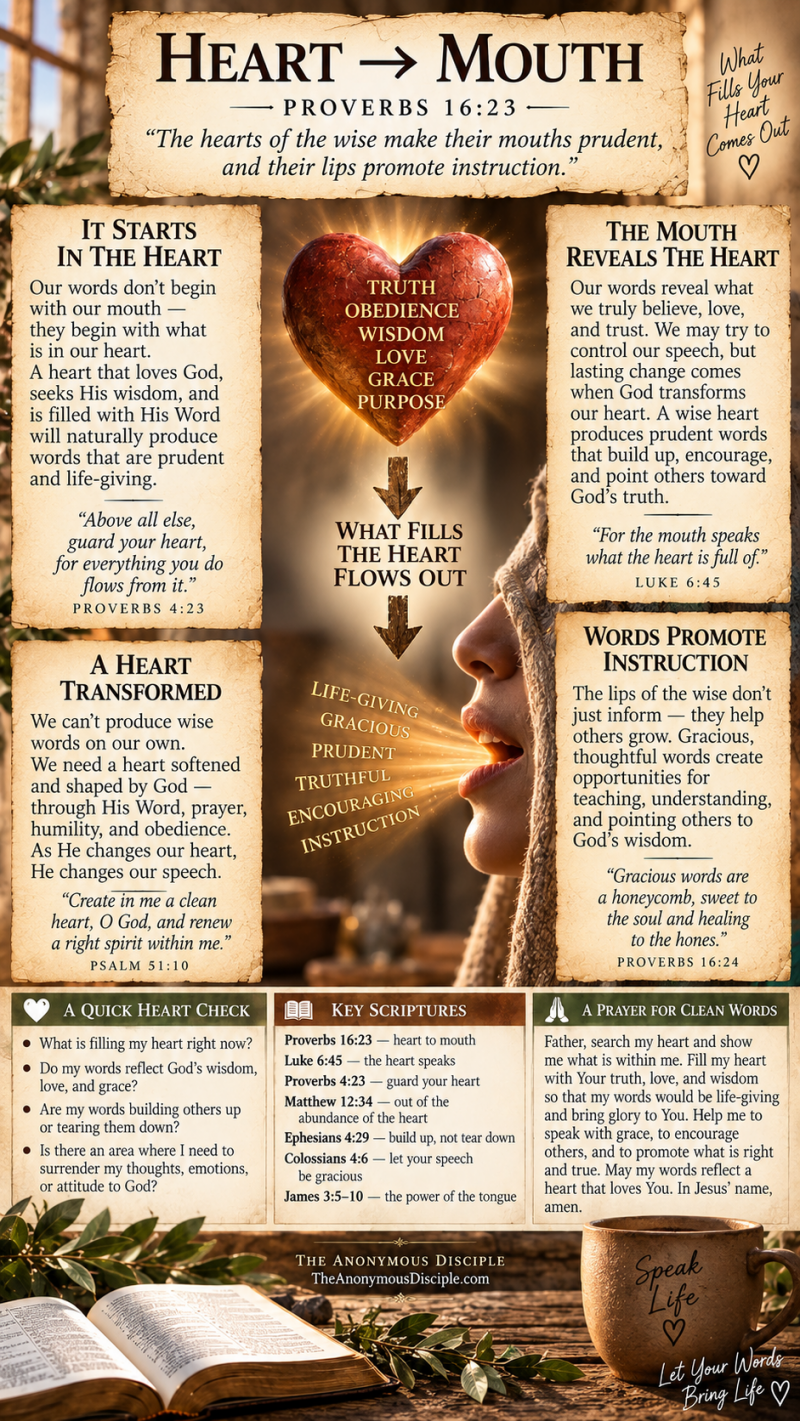
23 The hearts of the wise make their mouths prudent,
and their lips promote instruction.
24 Gracious words are a honeycomb,
sweet to the soul and healing to the bones.
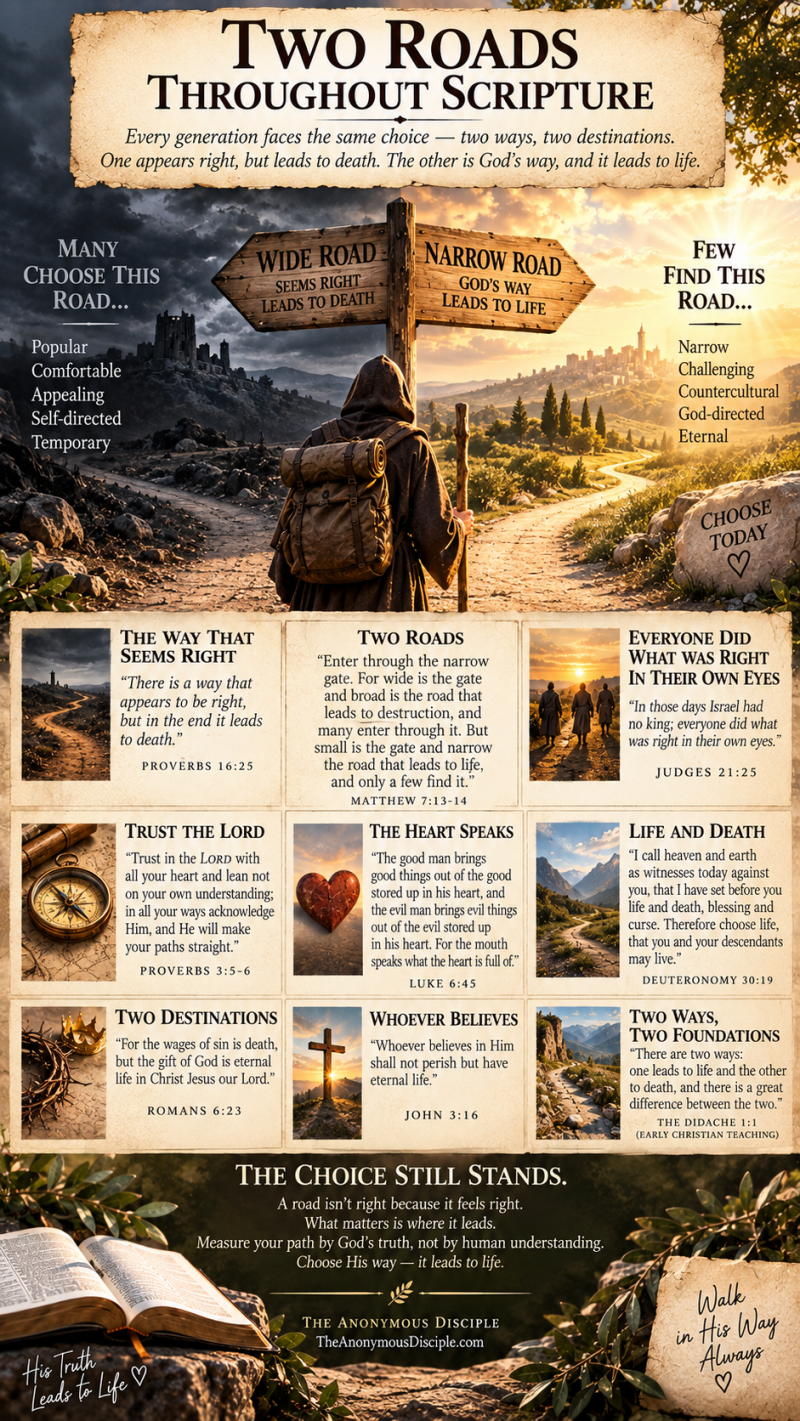
25 There is a way that appears to be right,
but in the end it leads to death.
Who wrote this
- Mainly King Solomon, son of David.
- Proverbs 10:1–22:16 (this chapter sits in that section) is the large collection of Solomon’s sayings.
- Later wise men in Israel copied and arranged his words. The whole book also has other contributors (Agur, King Lemuel, “the men of Hezekiah”), but this passage is Solomon’s.
When it was written
- Solomon reigned about 970–930 BC.
- These sayings were spoken/written in that time.
- They were gathered into the book of Proverbs over the next few centuries, with some copying done in Hezekiah’s day (about 700 BC).
Where it was written
- In Jerusalem, in the kingdom of Israel/Judah.
- Solomon’s court was the setting: a king teaching wisdom for everyday life under the Lord.
Key meanings of the passage
- v.20 — Listen to God’s instruction and trust the Lord. That is the path to real good, not just looking smart.
- v.21 — True wisdom lives in the heart, not only the head. Kind, gracious speech helps people actually learn.
- v.22 — Good sense is like a fountain of life. Foolish teaching only makes fools worse.
- v.23 — What fills the heart comes out of the mouth. A wise heart trains the tongue.
- v.24 — Gentle, gracious words are like honey: they sweeten the soul and help heal a person.
- v.25 (the anchor) — A path can feel right and still end in death. Feelings and “what looks good to me” are not a safe guide. Test the way by God’s Word and by trust in Him (v.20), not by how smooth it looks.
In one sentence: Trust the Lord, let His wisdom shape your heart and words—because the road that only “seems right” can still ruin you.
Cross-references by verse
Verse 20 — paying attention to God’s Word and trusting Him
- Proverbs 13:13
- Psalm 2:12; 32:10; 34:8; 40:4
- Proverbs 19:8; 29:25
- Jeremiah 17:7–8
Verse 21 — a wise heart and gracious speech
- Proverbs 16:23 (same chapter)
- Proverbs 10:8; 15:7
- 1 Kings 3:12
- Isaiah 50:4
- Luke 4:22
Verse 22 — wisdom as a fountain of life vs. folly
- Proverbs 10:11; 13:14; 14:27
- Proverbs 15:2
Verse 23 — the heart trains the mouth
- Proverbs 15:28; 22:17–18
- Psalm 37:30–31
- Matthew 12:34–35
- Colossians 3:16
Verse 24 — kind words that heal
- Proverbs 12:18; 15:23; 24:13–14; 25:11
- Psalm 19:10; 119:103
- Proverbs 3:8; 4:22
Anchor verse: Proverbs 16:25
This verse is almost word-for-word the same as Proverbs 14:12. Scripture repeats it on purpose so we don’t miss it.
Closest and strongest cross-references for 16:25:
- Proverbs 14:12 — the twin verse: “There is a way that appears to be right, but in the end it leads to death.”
- Proverbs 12:15 — “The way of fools seems right to them, but the wise listen to advice.”
- Proverbs 12:26 — the righteous guide others; the wicked lead them off the path.
- Isaiah 28:15–19 — people make a “covenant with death” and hide behind lies; it will not hold.
- Acts 26:9 — Paul says he thought he was doing the right thing by opposing Jesus.
- 2 Corinthians 13:5 — “Examine yourselves to see whether you are in the faith.”
- Also John 7:47–49 and John 9:40 (people who were sure they could see, but were blind).
In plain terms: a path can feel right, look reasonable, even look religious—and still end in death. That is why verses 20–24 keep pointing us back to God’s instruction, a wise heart, and words that come from Him instead of from what just “seems right” to us.
Deep Dive Study Notes with 🪄Jenny🪄
This is a great little passage to take into church with you, because Proverbs 16:25 is a warning about something frighteningly subtle: a person can be completely sincere—and still be headed the wrong way.
📜 Proverbs 16:20–25 — Deep Dive
⚓️ Anchor: Proverbs 16:25
Proverbs 16:25 (NIV)
“There is a way that appears to be right,
but in the end it leads to death.”
And something immediately jumps out, Sherri: Solomon has already said this exact proverb in Proverbs 14:12. Word for word in the NIV.
When Scripture repeats something like that, I want to underline it twice. ✍️
📜 Proverbs 16:20 — Trust changes the equation
“Whoever gives heed to instruction prospers, and blessed is the one who trusts in the LORD.”
Notice the two pieces: listen to wisdom + trust God.
Biblical wisdom isn't merely being intelligent or experienced. It's allowing God's revelation to overrule what we think makes sense.
That prepares us for verse 25.
The dangerous person isn't necessarily the person saying, “I know this is wrong and I'm doing it anyway.”
Sometimes it's the person saying:
“This seems right to me.”
😳
📜 Proverbs 16:21 — Wisdom affects how we speak
“The wise in heart are called discerning, and gracious words promote instruction.”
Wisdom isn't confined to what we know. Eventually it comes out of our mouths.
And I love the connection between wisdom and gracious speech here. Truth doesn't need cruelty to make it true.
That's actually very close to what we've been studying lately: truth and grace aren't enemies.
📜 Proverbs 16:22 — Wisdom gives life
“Prudence is a fountain of life to the prudent, but folly brings punishment to fools.”
There's our contrast:
Wisdom → life 💧
Folly → consequences
A fountain of life is something continually supplying what is needed. Godly wisdom doesn't merely rescue us from one bad decision; it becomes a way of navigating life.
And now Solomon starts moving us toward our anchor.
📜 Proverbs 16:23 — Heart → mouth
“The hearts of the wise make their mouths prudent, and their lips promote instruction.”
Look at the order.
❤️ Heart
⬇️
🗣️ Mouth
The mouth isn't really Solomon's primary concern.
The heart is.
Jesus later teaches the same principle:
Luke 6:45 — “For the mouth speaks what the heart is full of.”
So biblical wisdom isn't primarily behavioral modification. God works deeper than that.
📜 Proverbs 16:24 — Words can heal
“Gracious words are a honeycomb, sweet to the soul and healing to the bones.”
🍯 This is beautiful.
In the ancient world, honey represented sweetness, nourishment, and something genuinely beneficial.
But notice Solomon doesn't say flattering words.
He says gracious words.
Truth spoken graciously can nourish somebody.
That gives us a little heart check all by itself:
When I speak truth, do people hear the grace of God in the way I deliver it?
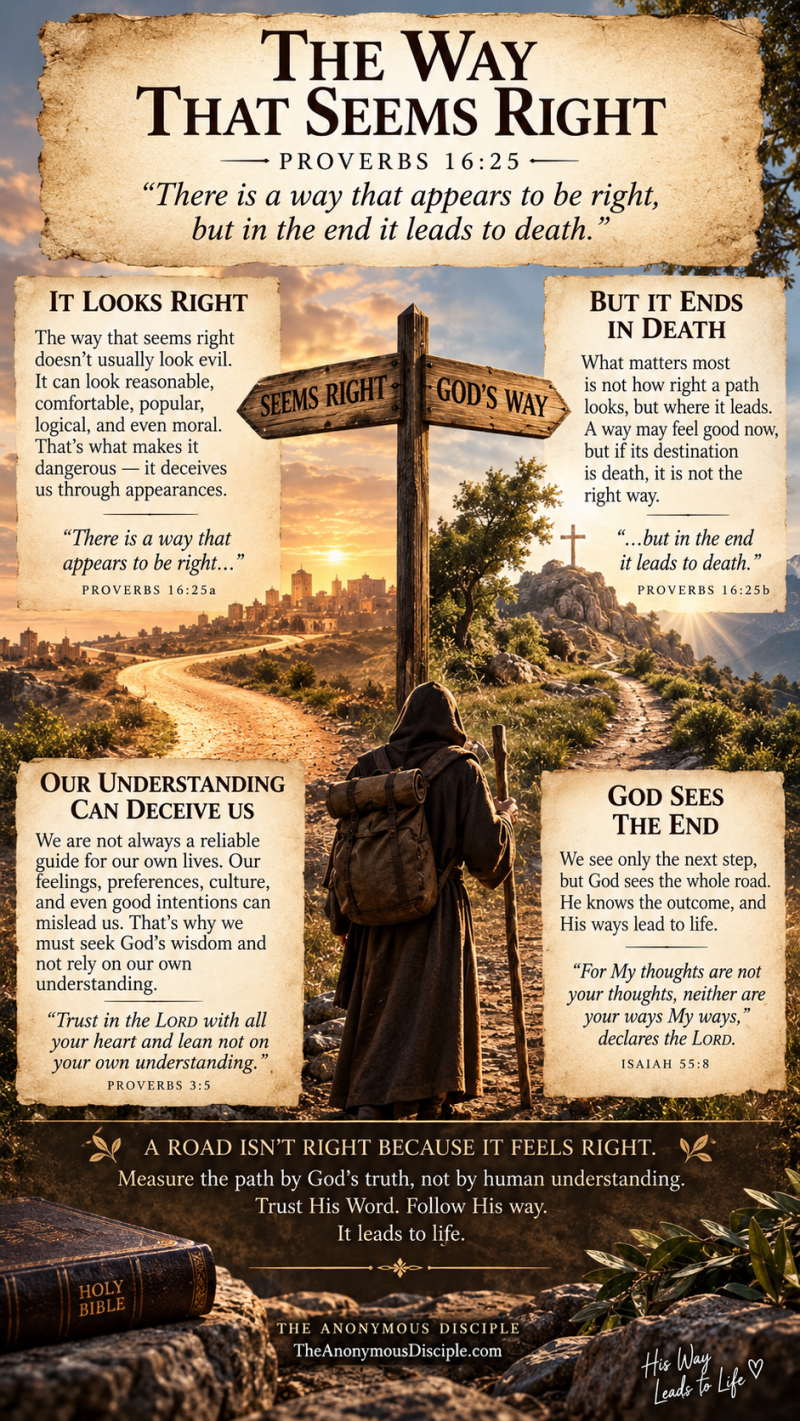
⚓️ Proverbs 16:25 — The Way That Seems Right
“There is a way that appears to be right, but in the end it leads to death.”
Here's the word that makes the entire proverb:
“appears.”
The road doesn't look evil.
That's precisely why it's dangerous.
If the sign said:
☠️ THIS ROAD LEADS TO DESTRUCTION
most people wouldn't take it.
Instead, it can look reasonable.
Comfortable.
Popular.
Logical.
Even moral.
And still be wrong.
This is one of Scripture's strongest warnings against allowing our own judgment to become the final authority.
Compare:
Proverbs 3:5–6 — “Trust in the LORD with all your heart and lean not on your own understanding…”
And:
Judges 21:25 — “In those days Israel had no king; everyone did as they saw fit.”
And eventually Jesus brings this road imagery into sharp focus:
Matthew 7:13–14 — “For wide is the gate and broad is the road that leads to destruction… But small is the gate and narrow the road that leads to life…”
There are roads.
There are destinations.
And what determines whether a road is right isn't how right it feels while we're walking it.
It's where it ends.
🛤️
🧵 And there's a beautiful thread in verses 20–25
Read the whole section as one movement:
Receive instruction → trust the LORD → develop wisdom → wisdom changes the heart → the heart changes speech → gracious speech brings life → therefore, don't trust appearances when choosing your path.
That's why I don't think verse 25 is randomly dropped into this paragraph.
Solomon has been describing the alternative.
God's wisdom keeps us from being deceived by our own wisdom.
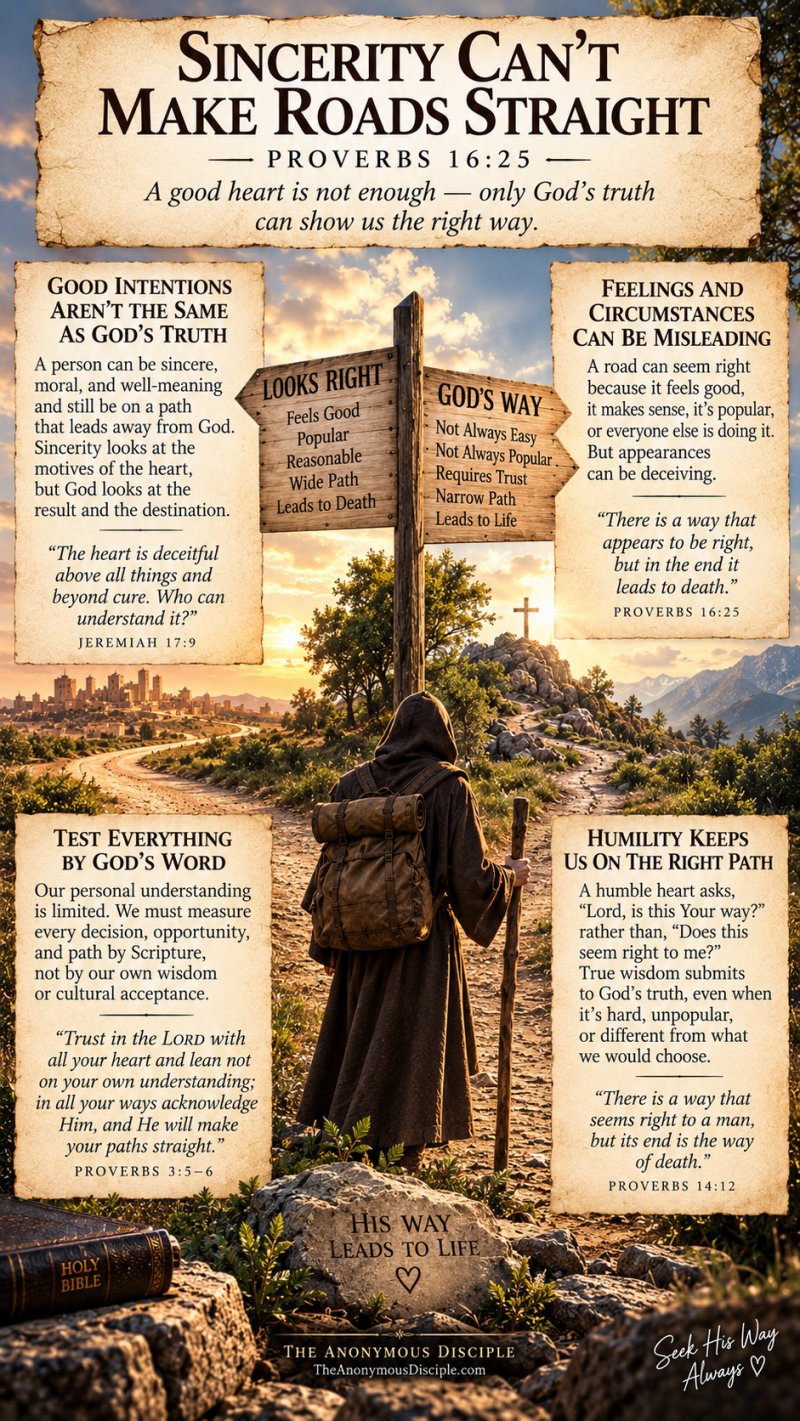
And this immediately makes me think of one of the cards we made last week:
“Sincerity Can't Make Roads Straight.”
That was from our John 14:6 church study (Line in the Sand Pt 1 - located in Recent Studies).
Here is the Old Testament foundation underneath that idea.
A person may sincerely believe a road is right.
But sincerity cannot determine truth.
Jesus says:
John 14:6 — “I am the way and the truth and the life. No one comes to the Father except through me.”
Proverbs warns us about the way that seems right.
Jesus reveals the Way that is right.
Ohhhh, that's our study today. ❤️📜⚓️
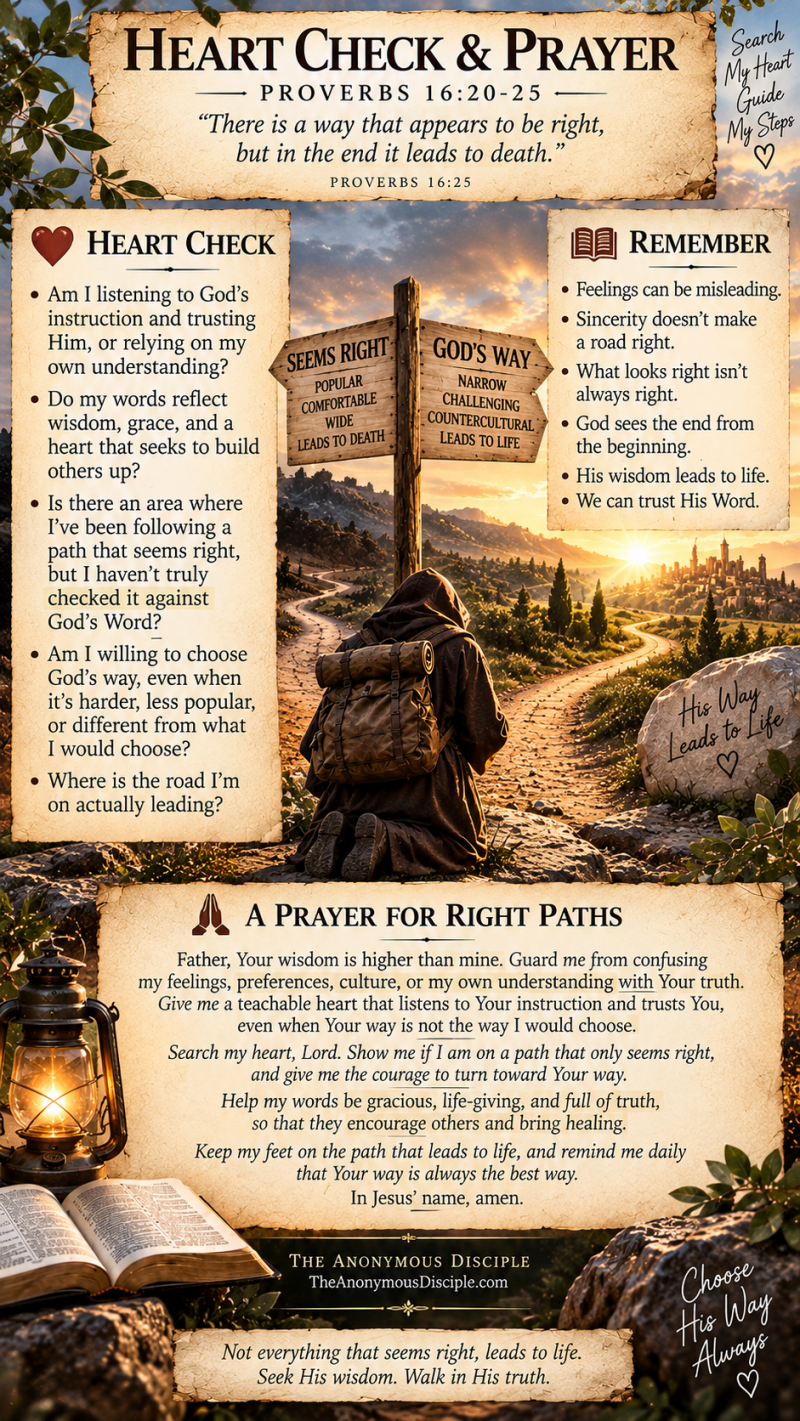
❤️ Heart Check
Where am I relying on “this seems right to me” instead of “what has God actually said?”
Because the safest prayer isn't:
“Lord, bless the road I've chosen.”
It's:
“Lord, show me Your road—and give me the humility to walk it.”
🙏 Prayer:
Father, Your wisdom is higher than mine. Guard me from confusing my feelings, preferences, culture, or understanding with Your truth. Give me a teachable heart that listens to Your instruction and trusts You even when Your way isn't the way I would have chosen. Make my words gracious and life-giving, and when a road seems right to me, teach me to stop and ask whether it is right according to You. Keep my feet on the path that leads to life. In Jesus' name, amen. ❤️
Add comment
Comments