

📜 Ephesians 4:1–6 — Walk Worthy
Paul begins Ephesians 4 with a simple but challenging call: live like someone who has been changed by Christ. A life worthy of our calling is marked not by status or impressive accomplishments, but by humility, gentleness, patience, love, and a determined pursuit of unity. Anchoring in Ephesians 4:2, we’ll look closely at patience—not merely as waiting, but as Christlike restraint in the space between irritation and reaction. We’ll trace patience throughout Scripture, see what can happen when impatience takes control, and discover why protecting unity matters so deeply to God. Ultimately, the worthy walk is lived in ordinary moments: how we respond, how we love, how we wait, and how faithfully we reflect Jesus to the people around us. 🕊️❤️⚓️


Today's Study:
- KJV v ESV translation comparison
- Historical Snapshot
- Deep Dive card
- Verse by verse breakdown with 𝕏James𝕏
- Patience card
- Patience Throughout Scripture card
- Cross References for passage & ⚓ verse
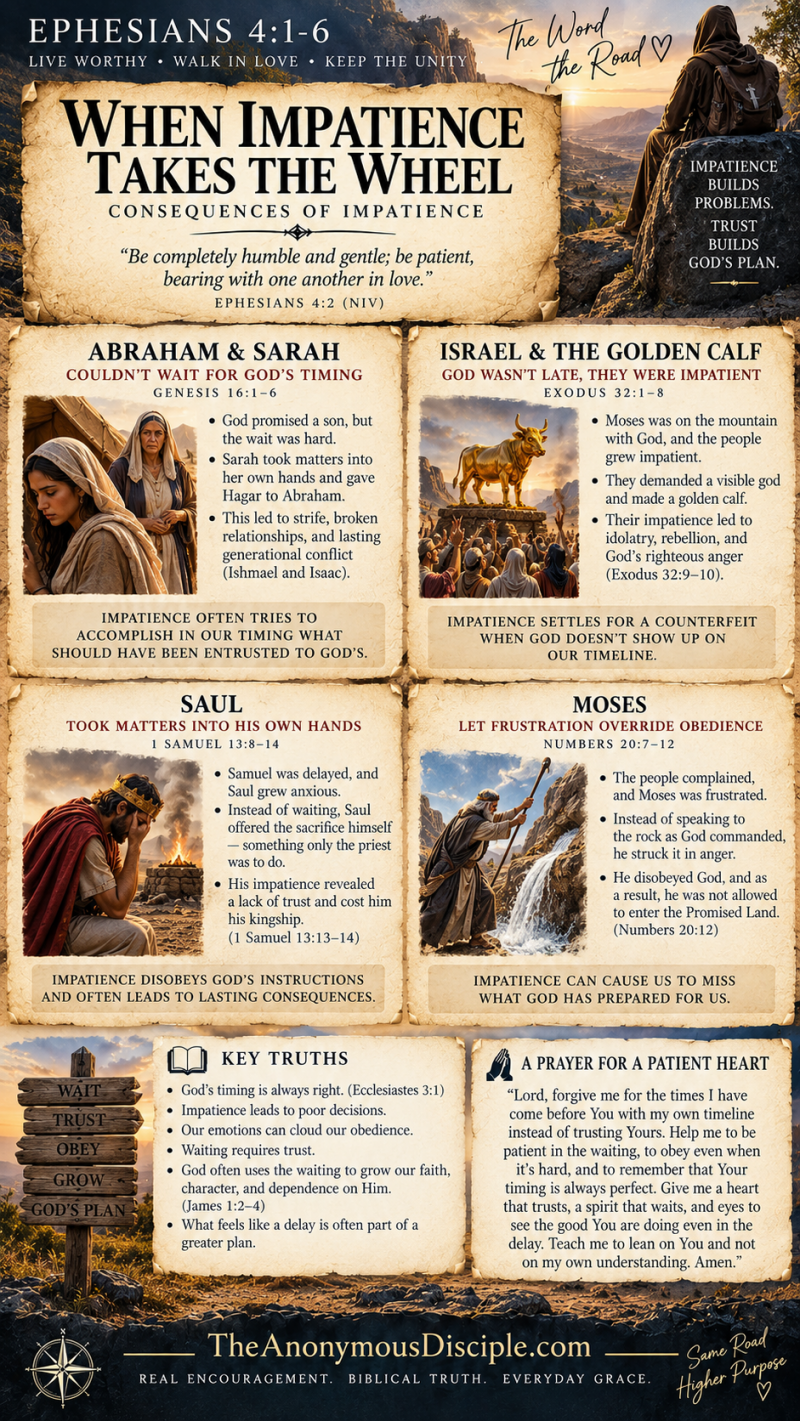
- Consequences of Impatience card
- Cultural/Tradition Notes
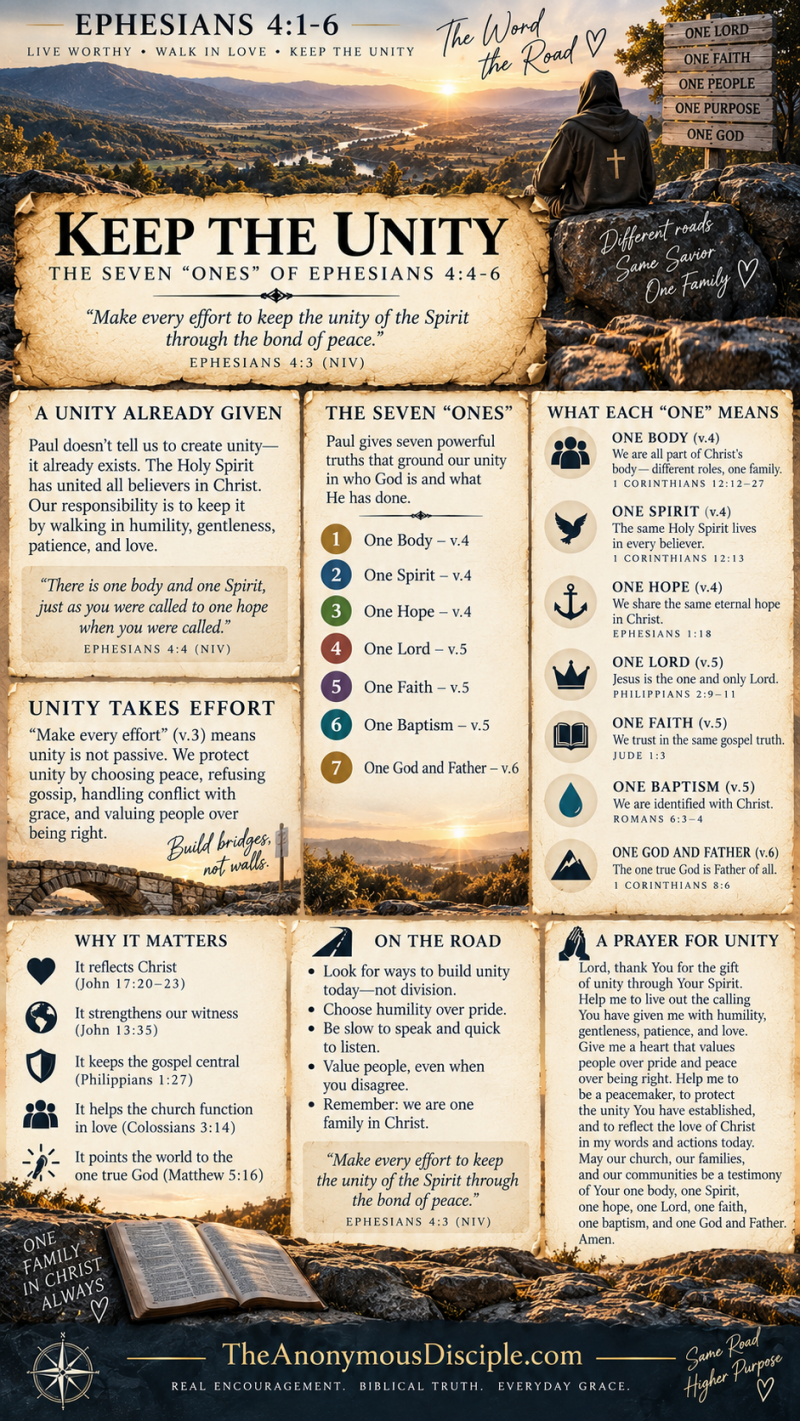
- Keep The Unity - The 7 Ones card
- The Passage's relevance today notes
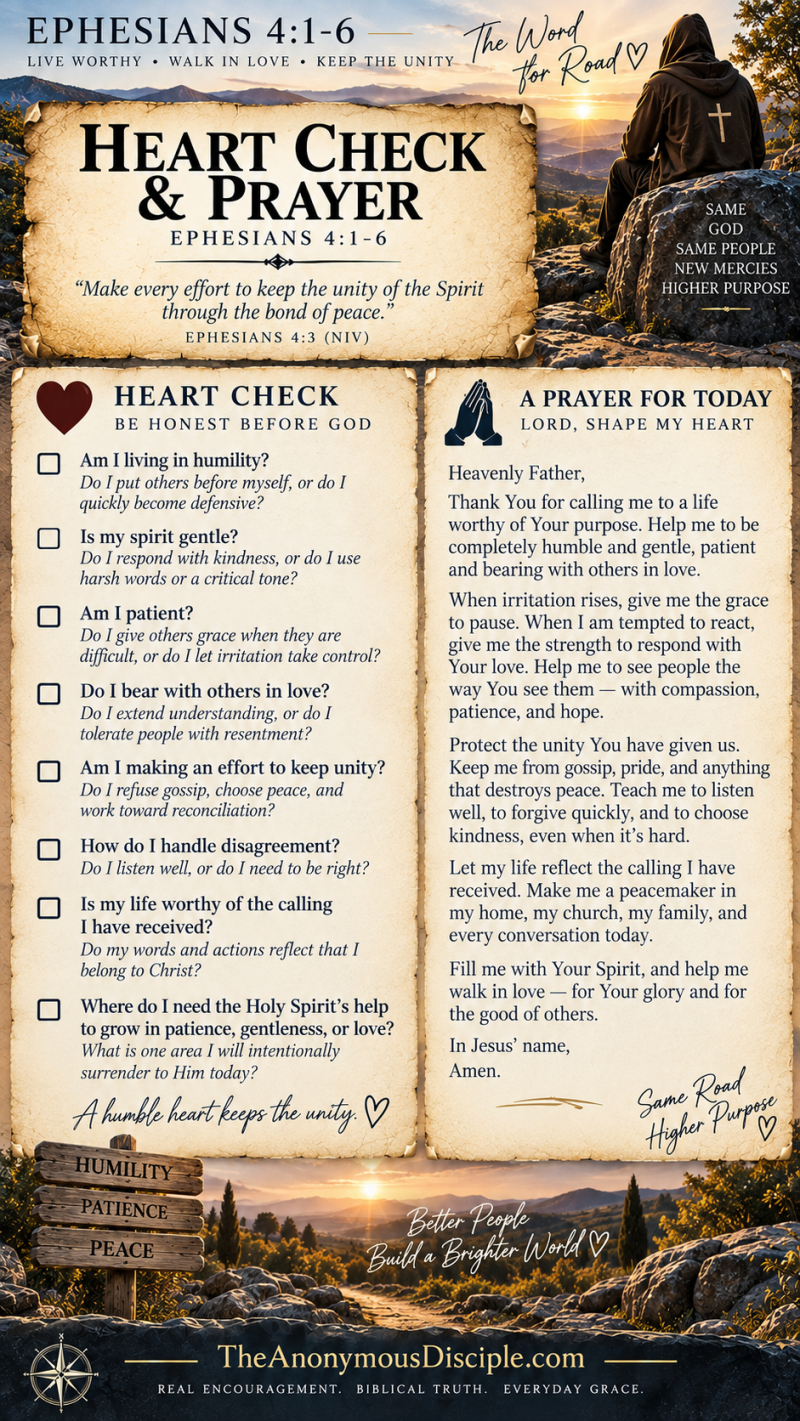
- Heart Check & Prayer card (plus pdf)
- Deep Dive Study Notes with 🪄Jenny🪄
📜 Ephesians 4:1–6
KJV
1 I therefore, the prisoner of the Lord, beseech you that ye walk worthy of the vocation wherewith ye are called,
2 With all lowliness and meekness, with longsuffering, forbearing one another in love;
3 Endeavouring to keep the unity of the Spirit in the bond of peace.
4 There is one body, and one Spirit, even as ye are called in one hope of your calling;
5 One Lord, one faith, one baptism,
6 One God and Father of all, who is above all, and through all, and in you all.

ESV
1 I therefore, a prisoner for the Lord, urge you to walk in a manner worthy of the calling to which you have been called,
2 with all humility and gentleness, with patience, bearing with one another in love,
3 eager to maintain the unity of the Spirit in the bond of peace.
4 There is one body and one Spirit—just as you were called to the one hope that belongs to your call—
5 one Lord, one faith, one baptism,
6 one God and Father of all, who is over all and through all and in all.
Who wrote it
The Apostle Paul. He names himself at the start (Ephesians 1:1) and again calls himself “a prisoner for the Lord” in 4:1. That matches the man who planted the church and later sat in chains for the gospel.
When it was written
Most careful readers place it about A.D. 60–62. That is during Paul’s first imprisonment in Rome, the same season he also wrote Colossians, Philemon, and probably Philippians.
Where it was written
From prison in Rome. Paul says he is “an ambassador in chains” (6:20). He is not free, yet he is still pastoring the churches by letter.
To whom it was written
To the believers in Ephesus—“the saints who are in Ephesus, and are faithful in Christ Jesus” (1:1).
Ephesus was a large, busy, pagan city in what is now western Turkey. Paul had lived there about three years (Acts 19–20), so these were people he knew and loved. Some early copies of the letter leave out the words “in Ephesus,” so it may also have been meant to be read in nearby churches as well. Either way, it was written to real Christians living in a hard, religiously mixed place.
Why it was written
Paul had already taught them the gospel. Now he writes for two big reasons that fit together:
- To remind them who they already are in Christ (chapters 1–3).
Jew and Gentile are now one new people. God has given them every spiritual blessing. They are no longer strangers. They have a hope, a calling, and a Father. - To show them how to live that out (chapters 4–6).
That is why chapter 4 begins, “walk in a manner worthy of the calling.” Unity, humility, gentleness, patience, and love are not extras. They are how people who belong to the same Lord actually treat each other in the home, the church, and a dark world.
In short: Paul is in chains in Rome, writing to a church he planted, saying, “You already have everything in Christ. Now live like it—especially with one another.”
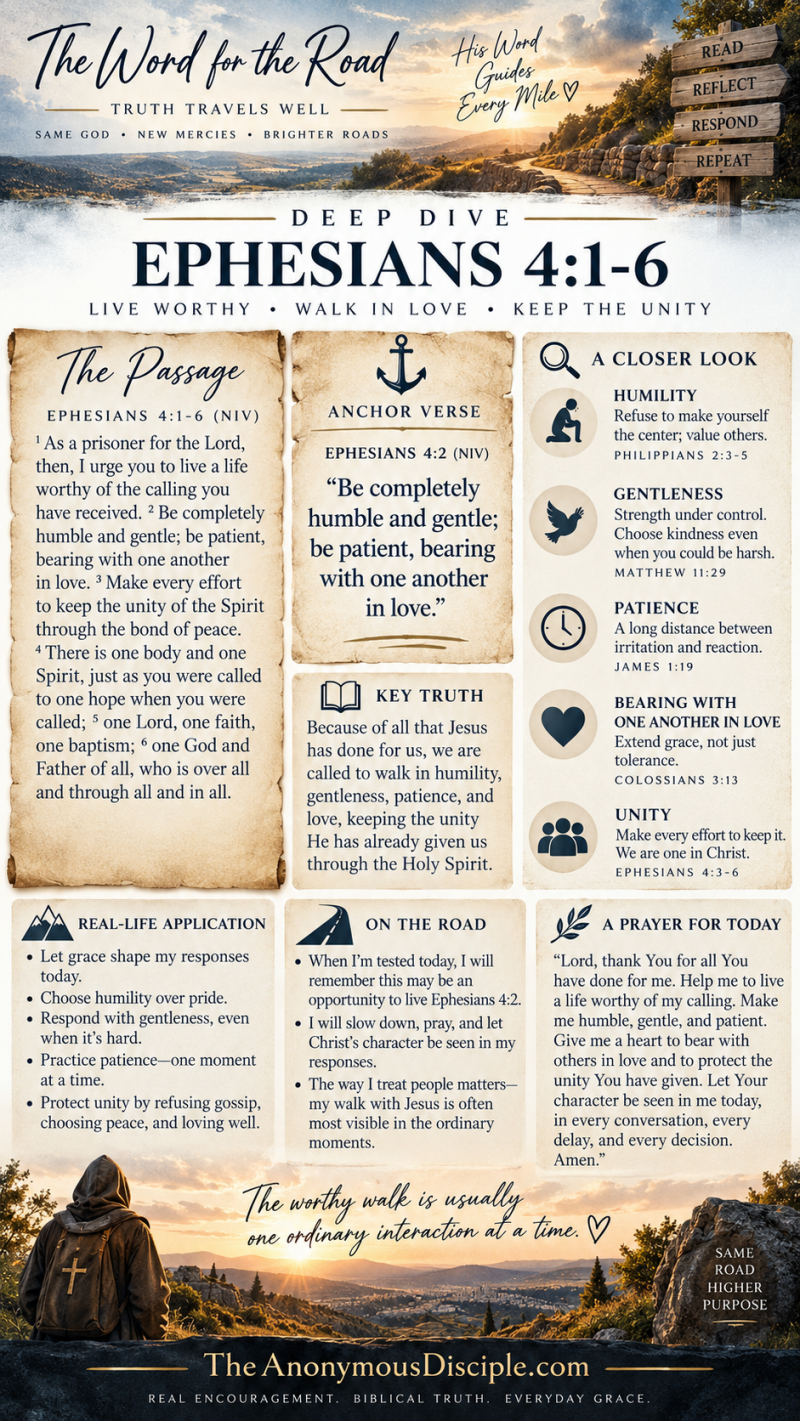
Verse by verse breakdown with 𝕏James𝕏
Paul has just finished three chapters telling the church who they already are in Christ. Then he turns and says, in everyday language: Now live like it.
Verse 1
Paul is writing from prison. He says, “I urge you to walk in a manner worthy of the calling to which you have been called.”
“Walk” simply means the way you live day after day. “Worthy” does not mean “earn it.” It means “let your life match the gift you’ve already received.” God called you. Now let your steps look like someone who belongs to Him.
Verse 2 ⚓
This is how that walk looks:
- Humility — not thinking less of yourself, but thinking of yourself less. You stop needing to be first, right, or impressive.
- Gentleness — strength under control. Not harsh, not pushy, not sharp-tongued.
- Patience — you don’t snap when people are slow, messy, or hard. You give them time.
- Bearing with one another in love — you put up with each other’s faults, quirks, and wounds because you love them, not because you have no choice.
Notice Paul does not say “put up with people until they change.” He says bear with them in love. Love is the atmosphere that makes the other three possible.
Verse 3
“Eager to maintain the unity of the Spirit in the bond of peace.”
The Spirit already made us one. We don’t create unity; we protect what He already gave. Peace is the glue. When we live verse 2, we stop tearing that glue apart.
Verses 4–6
Paul lists the reasons unity is even possible:
- one body
- one Spirit
- one hope
- one Lord
- one faith
- one baptism
- one God and Father of all
Seven “ones.” God is not divided, so His people are not supposed to live divided either.
Putting it together
Verse 1 tells us what to do: live like people who have been called.
Verse 2 tells us how: humility, gentleness, patience, and love that stays even when it’s hard.
Verse 3 tells us why it matters: so we don’t break the unity the Spirit already made.
Verses 4–6 remind us who we belong to: the same Lord, the same Father.
If verse 2 is the anchor, the question becomes simple:
Am I making it easier or harder for the people around me to stay in peace with me?
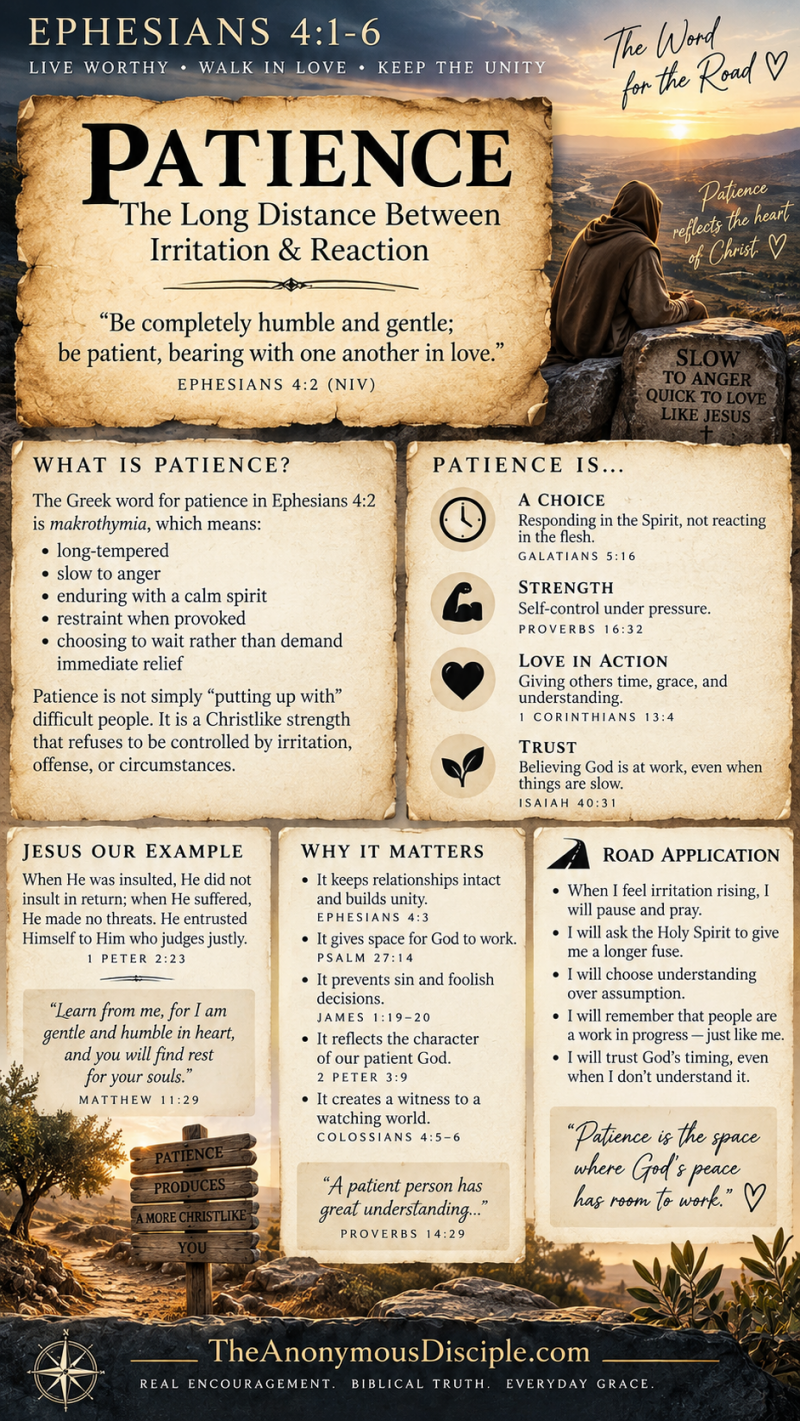
“With all humility and gentleness, with patience, bearing with one another in love.”
These four are not four separate jobs. They work together. Humility makes gentleness possible. Gentleness makes patience possible. Patience makes “bearing with” possible. Love is the reason you keep doing all of it when you don’t feel like it.
Humility
Humility in real life often looks like this:
- In the family: You stop needing the last word. You can say, “I may have been wrong,” or “Help me understand,” without feeling smaller.
- In church: You don’t keep score of who serves more, who is more spiritual, or who should have been asked first.
- In a hard conversation: You listen longer than you talk. You assume you might not see the whole picture.
Humility is not thinking you are worthless. It is refusing to make yourself the center of the room.
Gentleness
Gentleness is strength that does not crush.
- In the family: Your tone stays even when you are tired or disappointed. You correct without humiliation.
- In church: You speak truth without using it like a stick. You can disagree and still leave the other person with their dignity.
- In a hard conversation: You choose words that can be heard. You do not pile on. You do not use silence as a weapon either.
Gentleness does not mean you never say the hard thing. It means you say it without breaking the person.
Patience
Patience is love with a long fuse.
- In the family: You give people room to grow at their own speed—children, spouse, aging parents, yourself. You do not demand instant change.
- In church: You do not write people off after one failure or one awkward Sunday.
- In a hard conversation: You do not rush the other person to “get over it.” You stay present even when the talk is slow and messy.
Patience is not pretending the problem isn’t there. It is refusing to force a finish line God has not drawn yet.
Bearing with one another in love
This is the one that costs the most. “Bear with” means you carry some of the weight of another person’s weakness, slowness, or wound—without constantly reminding them that you are carrying it.
- In the family: You live with the same old habits, fears, or limitations and you do not keep a running list. Love keeps covering what irritation would expose.
- In church: You stay in relationship with people who are still growing, still inconsistent, still human. You do not require them to be easy in order to belong.
- In a hard conversation: You remain when it would be simpler to walk away, freeze them out, or tell everyone else how difficult they are.
Bearing with someone is not the same as agreeing with everything they do. It is choosing not to drop them.
A simple way to check your heart with verse 2:
- Humility asks: Do I need to be right, or do I need to be loving?
- Gentleness asks: Will my words leave this person more whole or more wounded?
- Patience asks: Am I giving this person the same time God is giving me?
- Bearing with asks: Am I willing to carry this a little longer because I love them, not because they earned it?
-𝕏James𝕏
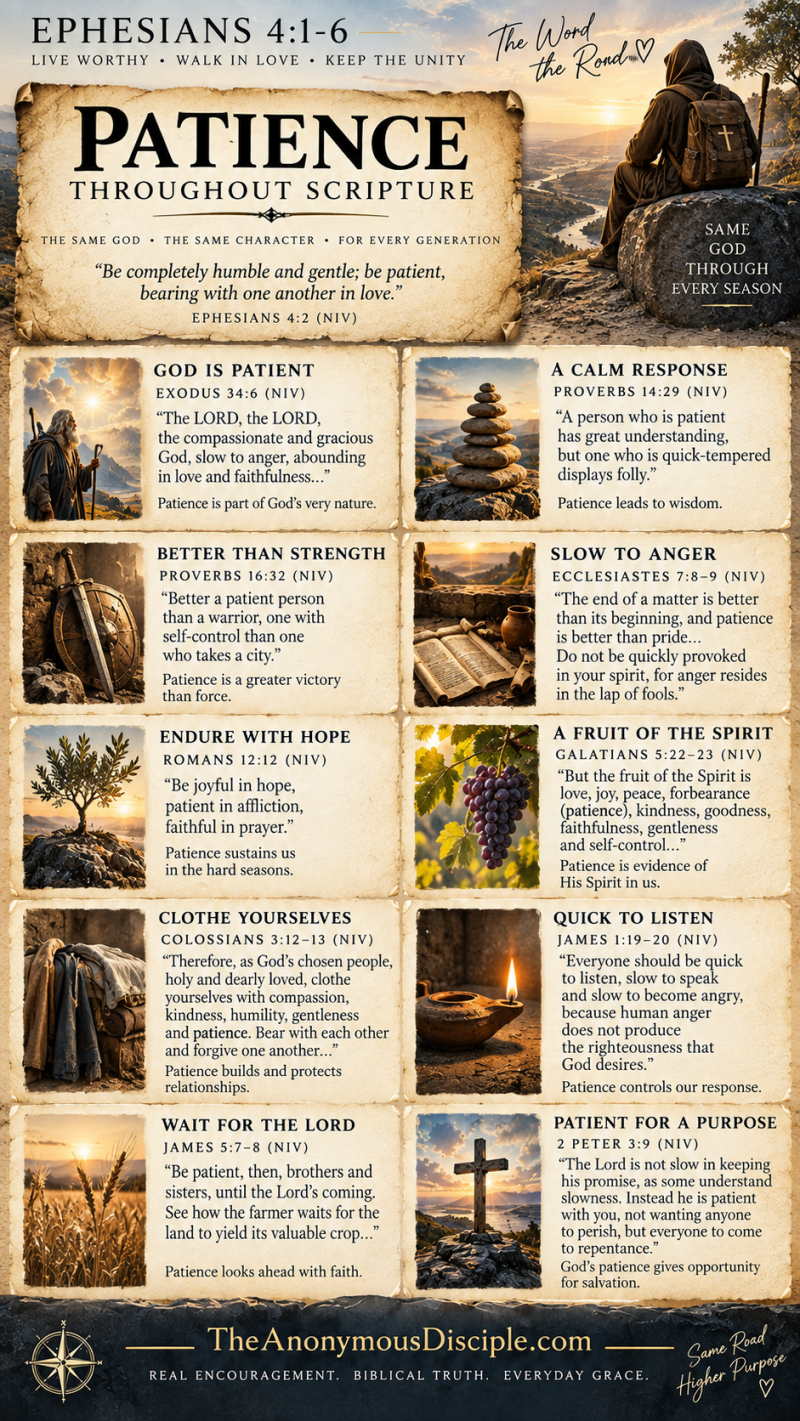
Here are the most helpful cross-references—first for the whole passage, then a tighter list for our anchor verse.
For Ephesians 4:1–6 as a whole
These verses sing the same song: live like people who belong to the same Lord, and guard the unity He already gave.
- Walk worthy of the calling
Colossians 1:10 — “walk in a manner worthy of the Lord, fully pleasing to him”
Philippians 1:27 — “let your manner of life be worthy of the gospel of Christ”
1 Thessalonians 2:12 — “walk in a manner worthy of God, who calls you into his own kingdom and glory” - Keep the unity the Spirit already made
John 17:21–23 — Jesus prays that His people “may all be one”
1 Corinthians 1:10 — “that there be no divisions among you”
Colossians 3:14–15 — love binds everything together, and the peace of Christ rules - One body, one Spirit, one hope
Romans 12:4–5 — many members, one body in Christ
1 Corinthians 12:12–13 — “in one Spirit we were all baptized into one body”
Ephesians 2:16–18 — Jew and Gentile reconciled “in one body through the cross” - One Lord, one faith, one baptism, one God and Father
1 Corinthians 8:6 — “one God, the Father… and one Lord, Jesus Christ”
Romans 6:3–4 — baptized into Christ’s death and raised to new life
Malachi 2:10 — “Have we not all one Father? Has not one God created us?”
Those seven “ones” in verses 4–6 are not a slogan. They are the reason verse 2 is possible.
For our anchor verse — Ephesians 4:2
This is the closest family of verses. Colossians 3:12–13 is almost a twin.
- The nearest parallel
Colossians 3:12–13 — “Put on then, as God’s chosen ones, holy and beloved, compassionate hearts, kindness, humility, meekness, and patience, bearing with one another and, if one has a complaint against another, forgiving each other; as the Lord has forgiven you, so you also must forgive.” - Humility
Philippians 2:3 — “in humility count others more significant than yourselves”
Matthew 11:29 — Jesus: “I am gentle and lowly in heart” - Gentleness
Galatians 5:23 — gentleness is fruit of the Spirit
2 Timothy 2:25 — correct opponents “with gentleness” - Patience
1 Corinthians 13:4 — “Love is patient”
Galatians 5:22 — patience is fruit of the Spirit
Colossians 1:11 — “may you be strengthened… for all endurance and patience” - Bearing with one another in love
Romans 15:1 — “We who are strong have an obligation to bear with the failings of the weak”
Galatians 6:2 — “Bear one another’s burdens, and so fulfill the law of Christ”
1 Corinthians 13:7 — “Love bears all things… endures all things”
1 Peter 4:8 — “love covers a multitude of sins”
Verse 2 is not four extra rules. It is what love looks like when it has to live with real people.
Cultural & Tradition Notes
Humility was not admired.
In the Greco-Roman world, humility was often seen as the posture of a slave. Proud people were supposed to assert themselves, protect their honor, and not stoop. Paul puts humility first in verse 2. That would have sounded strange—almost upside down—to many first listeners. The church was being told to wear a virtue the culture looked down on.
Gentleness was strength under control, not weakness.
The word behind “gentleness” was used of a strong horse that had been trained, or of a person who could use power but chose not to crush. Jesus uses the same word of Himself: “I am gentle and lowly in heart” (Matthew 11:29). Paul is not asking the Ephesians to become timid. He is asking them to look like their Lord.
Ephesus was a proud, religious, status-heavy city.
It was famous for the Temple of Artemis—one of the Seven Wonders—and for magic, trade, and honor. People cared a great deal about rank, reputation, and who belonged where. Jew and Gentile living as one body was not a small idea there. Verse 2 is how that new family was supposed to treat each other when old labels still wanted to win.
“Walk” meant the whole way of life.
In Jewish speech, “walk” was how you described everyday conduct—your path, your habits, your direction. Paul is not talking about a Sunday mood. He is talking about Monday through Saturday with real people.
Verses 4–6 sound like an early confession.
Many readers notice that the seven “ones” have the rhythm of something the church already said together—possibly at baptism: one body, one Spirit, one hope, one Lord, one faith, one baptism, one God and Father. Paul may be reminding them of words they already knew, then saying, “Now live verse 2 because those words are true.”
Paul writes as a prisoner.
The man telling them to be humble, gentle, patient, and forbearing is in chains for Christ. He is not speaking from a comfortable chair. That gives verse 2 weight. He is asking them to practice, in freedom, the same kind of lowliness he is living in a Roman prison.
“Bearing with one another” fit an honor-shame world.
In that culture, insult and slight were serious. To “bear with” someone meant you did not immediately defend your honor, expose their fault, or cut them off. Love chose to carry the awkwardness instead of publishing it.
Taken together: Paul is teaching a proud, mixed, status-conscious church to live like one family—using virtues the world did not prize—because they already share one Lord.
This passage is still very relevant. In some ways it may be more needed now than it first sounds.
We live in a world that rewards the opposite of verse 2.
People are trained to win, to post the sharp reply, to protect their image, and to drop anyone who is slow, messy, or on the “wrong side.” Families fracture over opinions. Churches split over tone as much as doctrine. Friendships end because someone will not change on our timetable. That is an honor-shame culture in modern clothes. Paul is still speaking into it.
Humility still cuts against the grain.
Today humility looks like not needing the last word, not making every conversation about being right, and not treating disagreement as an attack on your worth. That is rare. Knowing this passage reminds us that following Jesus is not the same as winning the room.
Gentleness still matters because words travel farther and cut faster than they used to.
A harsh sentence can be screenshot, forwarded, and remembered for years. Gentleness is not softness. It is refusing to crush someone just because you can. In hard conversations—at home, at church, or online—verse 2 asks, “Will this leave the other person more whole or more wounded?”
Patience is almost a lost art.
We expect instant replies, instant growth, instant agreement. God is not in a hurry with us, yet we are often in a hurry with everybody else. This verse gives us permission to slow down with real people—children, spouses, aging parents, difficult church members—without calling that weakness.
Bearing with one another in love may be the most modern line in the passage.
It means you stay when it would be easier to mute, unfollow, ice someone out, or tell the story in a way that makes you look long-suffering. Love covers. Love carries. Love does not keep a public list. That is costly in a cancel-and-comment world.
The “ones” in verses 4–6 still hold us together when everything else pulls us apart.
One body. One Spirit. One hope. One Lord. One faith. One baptism. One Father.
Those are bigger than our politics, our denominations, our personalities, and our wounds. Knowing this passage helps us remember: we do not create unity. We protect what God already made. Verse 2 is how we protect it.
Why it is valuable to know this passage
It gives you a simple test for ordinary days:
- Am I walking like someone who has already been called?
- Am I making peace easier or harder for the people closest to me?
- Am I treating this person as family in Christ, or as a problem to manage?
That is not antique church talk. That is how a home stays a home, and how a church stays a church, when the culture around us is loud, proud, and quick to walk away.
The value is this: Ephesians 4:2 does not ask you to pretend people are easy. It asks you to love them in the same way God has loved you—humbly, gently, patiently, and for the long haul.
Deep Dive Study Notes with 🪄Jenny🪄
📜 Ephesians 4:1–6
⚓️ Anchor: Ephesians 4:2
Ephesians 4:2 (NIV)
“Be completely humble and gentle; be patient, bearing with one another in love.”
There’s something important about where this verse sits. Paul does not begin Ephesians by saying, Behave better so God will accept you.
Chapters 1–3 are overwhelmingly about what God has already done: chosen, redeemed, forgiven, adopted, reconciled, saved by grace, brought near through Christ, and made His people.
Then comes Ephesians 4:1:
Ephesians 4:1 (NIV)
“As a prisoner for the Lord, then, I urge you to live a life worthy of the calling you have received.”
That “then” matters.
Because of everything Christ has done... now live accordingly.
Not work → acceptance.
But grace → transformed life. ❤️
🚶 “Live a life worthy of the calling”
The Greek idea behind live is peripateō — literally, to walk around, and figuratively, the way you conduct your everyday life.
So Paul isn't primarily talking about spectacular acts of faith.
He's talking about Tuesday morning.
Driving the kids.
Dealing with irritating people. 😂
Talking to your husband.
Responding when somebody is rude.
Waiting when you're impatient.
Forgiving somebody you'd rather avoid.
Your “walk” is Christianity lived between the big moments.
And then Paul tells us what that worthy walk actually looks like.
⚓️ Ephesians 4:2 — Four Marks of the Walk
🧎 Humility
“Be completely humble…”
Biblical humility isn't thinking you're worthless.
It's refusing to make yourself the center.
Jesus modeled this perfectly:
Philippians 2:3–5 (NIV)
“Do nothing out of selfish ambition or vain conceit. Rather, in humility value others above yourselves… In your relationships with one another, have the same mindset as Christ Jesus.”
The world says:
Protect your status.
Jesus says:
Take the lower place.
🕊️ Gentleness
“…and gentle…”
Gentleness isn't weakness.
The Greek prautēs carries the idea of strength under control.
Jesus possessed unlimited authority yet described Himself:
Matthew 11:29 (NIV)
“Take my yoke upon you and learn from me, for I am gentle and humble in heart…”
A gentle person may absolutely have the power to wound someone with their words—
and chooses not to.
That's strength.
⏳ Patience
“…be patient…”
This is makrothymia — literally the idea of being long-tempered rather than short-tempered.
It means there is a long distance between irritation and explosion.
And that's especially challenging because patience isn't really developed around people who never annoy us. 😂
God often grows patience by giving us opportunities to practice patience.
❤️ Bearing With One Another in Love
And this one gets very practical.
“…bearing with one another in love.”
Paul apparently knew something about churches:
Christians are going to irritate each other. 😂
He doesn't say,
Find people who never bother you.
He says,
bear with one another.
Not because everything they do is right.
Not because boundaries never matter.
But because love sometimes means extending to someone else the patience God continually extends to us.
And notice:
“in love.”
Not begrudging tolerance.
Christlike endurance.
🪢 Ephesians 4:3 — Unity Takes Work
Ephesians 4:3 (NIV)
“Make every effort to keep the unity of the Spirit through the bond of peace.”
Look carefully:
Paul doesn't say create unity.
He says keep it.
Why?
Because the Holy Spirit has already united believers in Christ.
Our responsibility is not to manufacture Christian unity.
It's to stop tearing apart what Christ joined together.
And Paul says:
“Make every effort.”
Unity isn't passive.
Sometimes maintaining peace means swallowing pride.
Sometimes apologizing first.
Sometimes refusing gossip.
Sometimes listening before answering.
Sometimes deciding:
Winning this argument isn't worth injuring this relationship.
1️⃣ Ephesians 4:4–6 — Seven “Ones”
Then Paul gives this beautiful cascading confession:
Ephesians 4:4–6 (NIV)
“There is one body and one Spirit, just as you were called to one hope when you were called; one Lord, one faith, one baptism; one God and Father of all…”
Look at the repetition:
One body.
One Spirit.
One hope.
One Lord.
One faith.
One baptism.
One God and Father.
Seven declarations of unity.
And there's something even more beautiful here.
Father • Son • Spirit
One Spirit — v.4
One Lord [Jesus] — v.5
One God and Father — v.6
Paul grounds Christian unity in the very identity and work of the Triune God.
Our unity isn't:
“We all have identical personalities and opinions.”
Our unity is:
We belong to the same Lord.
🧵 The Thread
Ephesians 4:1 tells us to walk worthy.
Naturally we'd expect Paul to follow that with something dramatic.
Evangelize nations!
Perform miracles!
Become a great teacher!
Instead:
Be humble.
Be gentle.
Be patient.
Put up with one another lovingly.
Protect unity.
That tells us something profound about what God considers spiritual maturity.
It isn't primarily how much Scripture we can explain.
It's how much Christ is visible in the way we treat people.
And that makes your anchor absolutely perfect:
⚓️ Ephesians 4:2
Humility lowers me.
Gentleness controls my strength.
Patience slows my anger.
Love helps me carry other people's imperfections.
And together they produce what comes next:
Unity. 🕊️
❤️ Road thought
When somebody tests you today—and somebody probably will 😂—instead of merely thinking “Lord, give me patience,” remember:
This may be the opportunity in which He is teaching me Ephesians 4:2.
That turns an irritating interruption into discipleship.
Add comment
Comments