

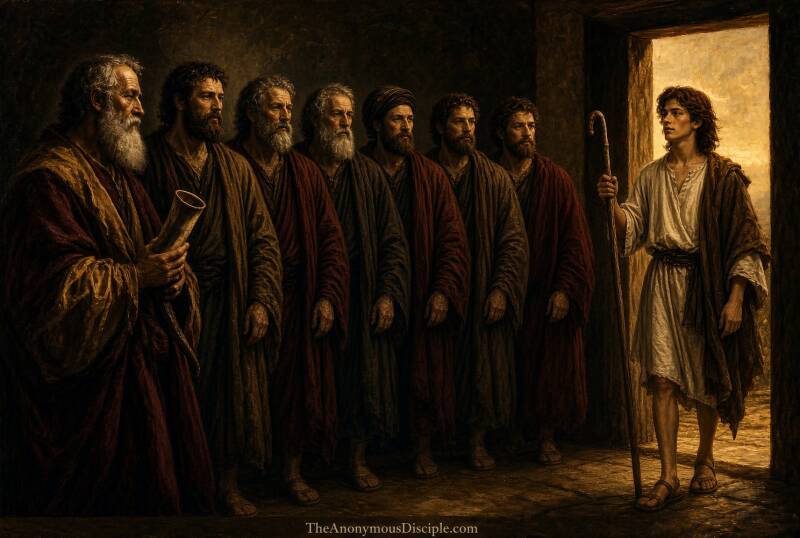
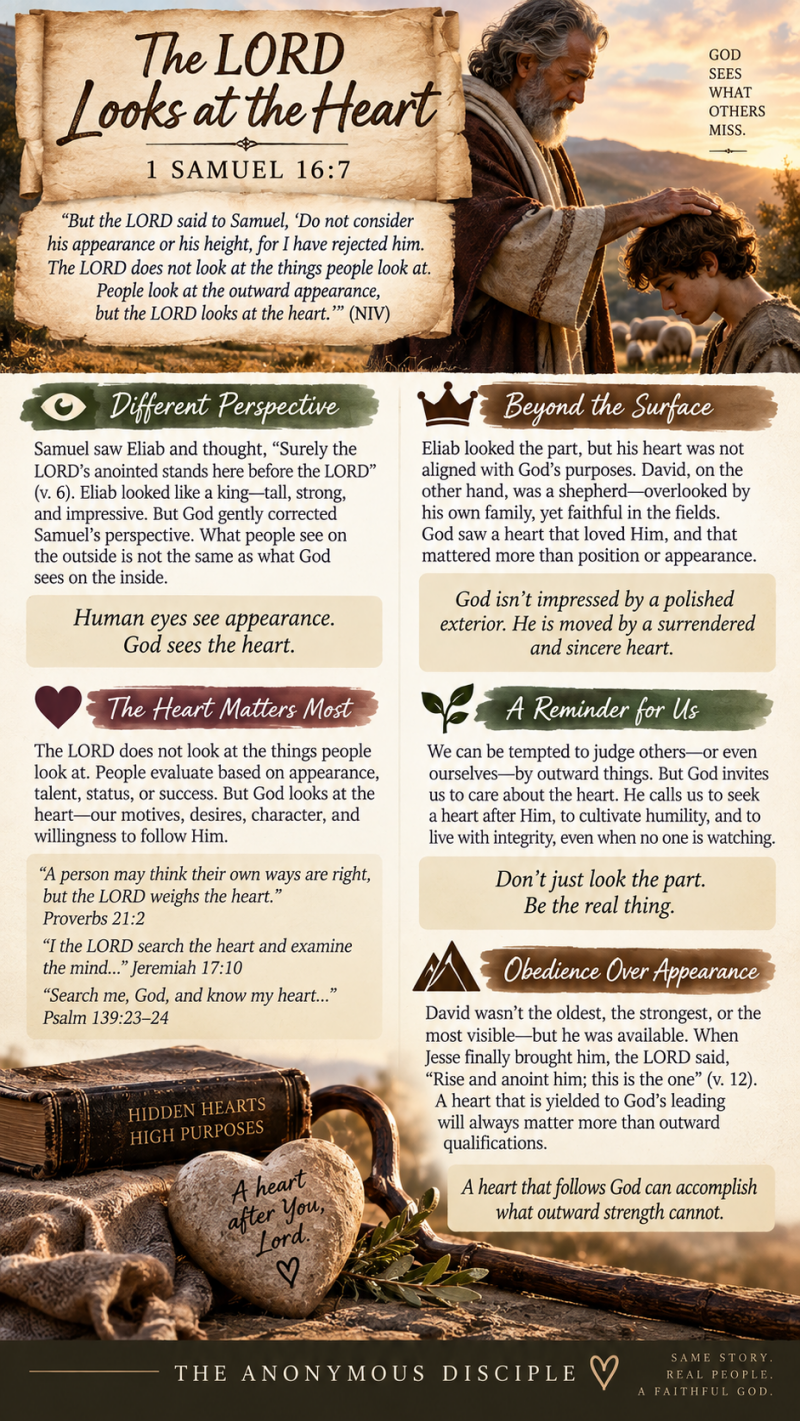
In 1 Samuel 16:6–12, Samuel arrives at Jesse’s house looking for Israel’s next king—and almost immediately assumes he has found him. Eliab looks the part. But God corrects Samuel with a truth that reaches far beyond David’s story: “People look at the outward appearance, but the LORD looks at the heart” (1 Samuel 16:7).
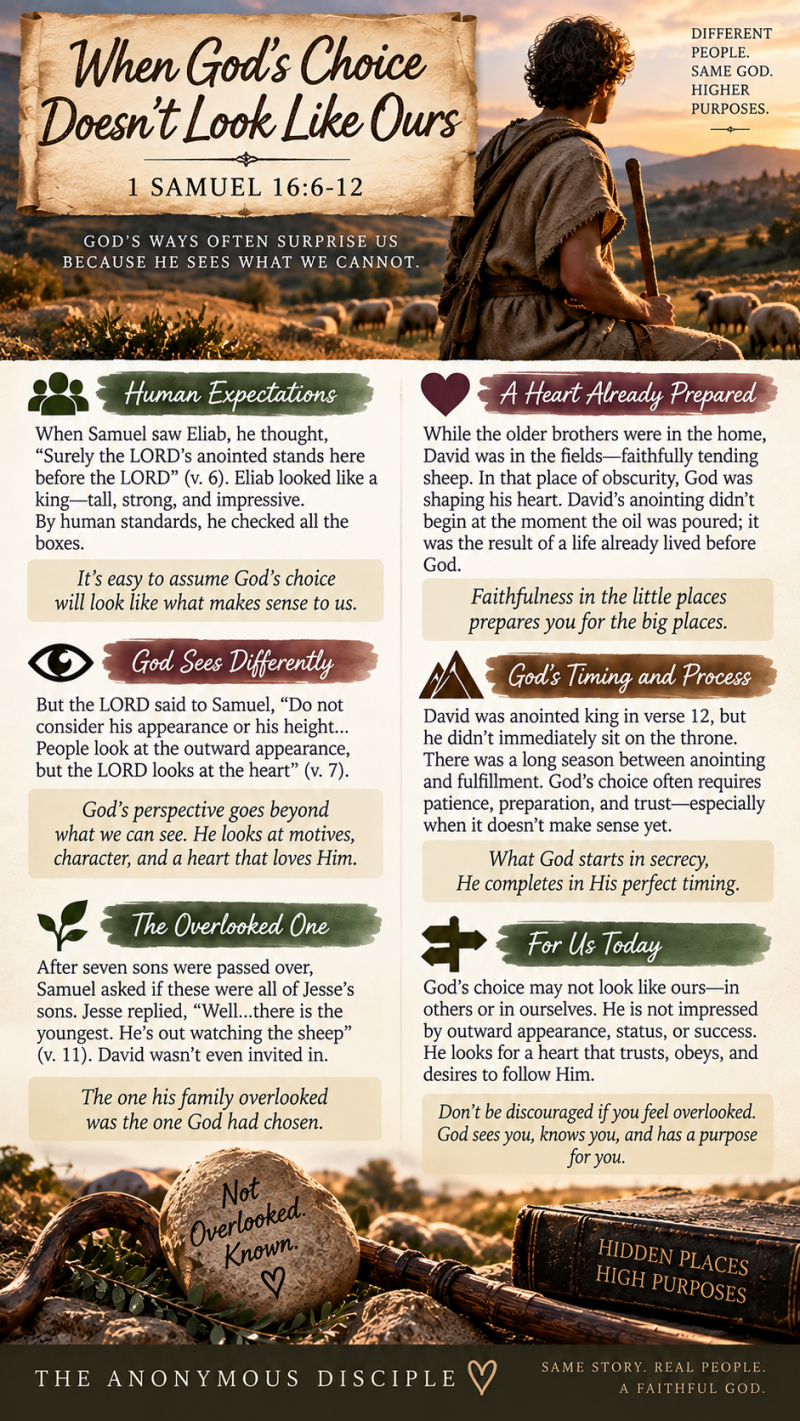
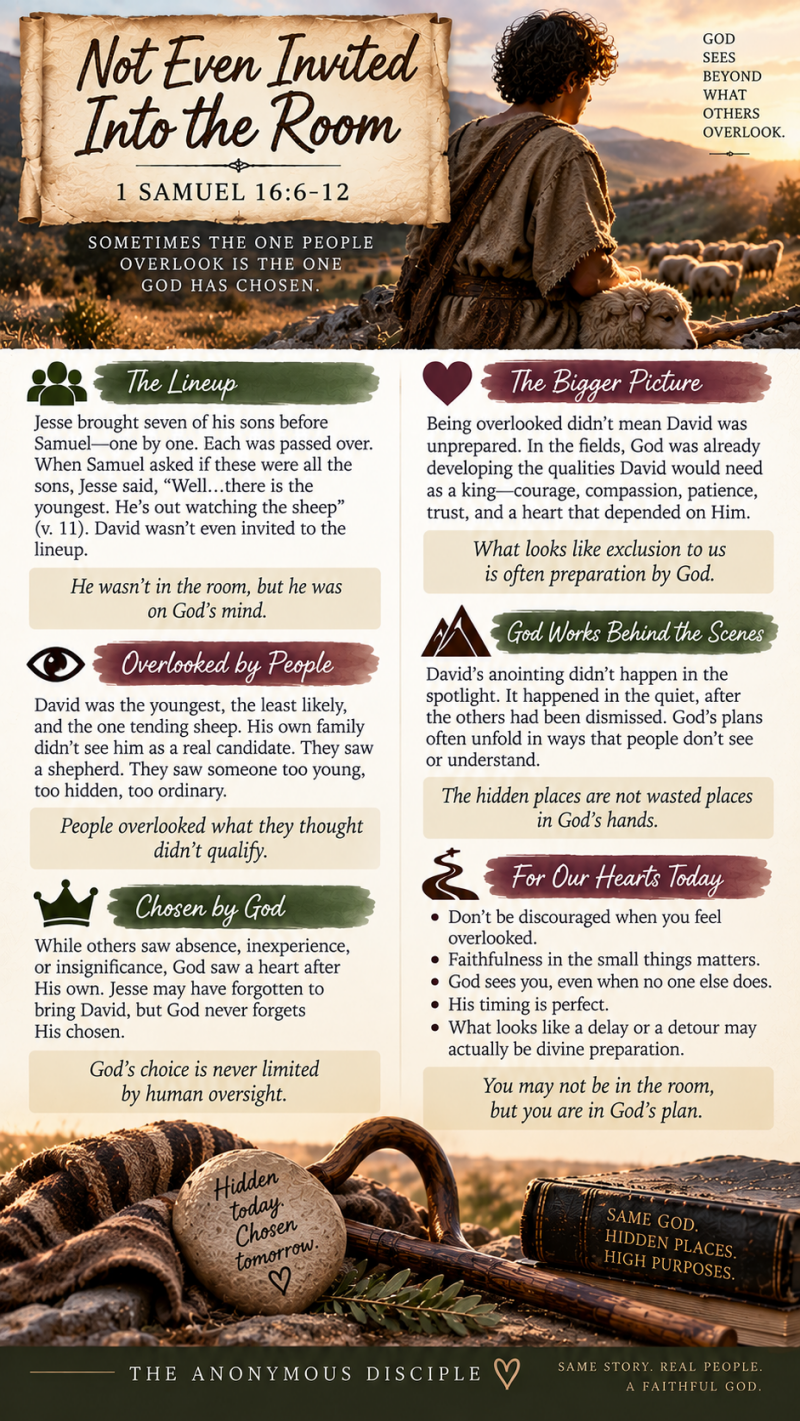
One by one, Jesse’s sons pass before Samuel, but God chooses none of them. The one God has chosen isn’t even in the room. David—the youngest, the shepherd, the overlooked son—is out in the fields faithfully tending sheep.
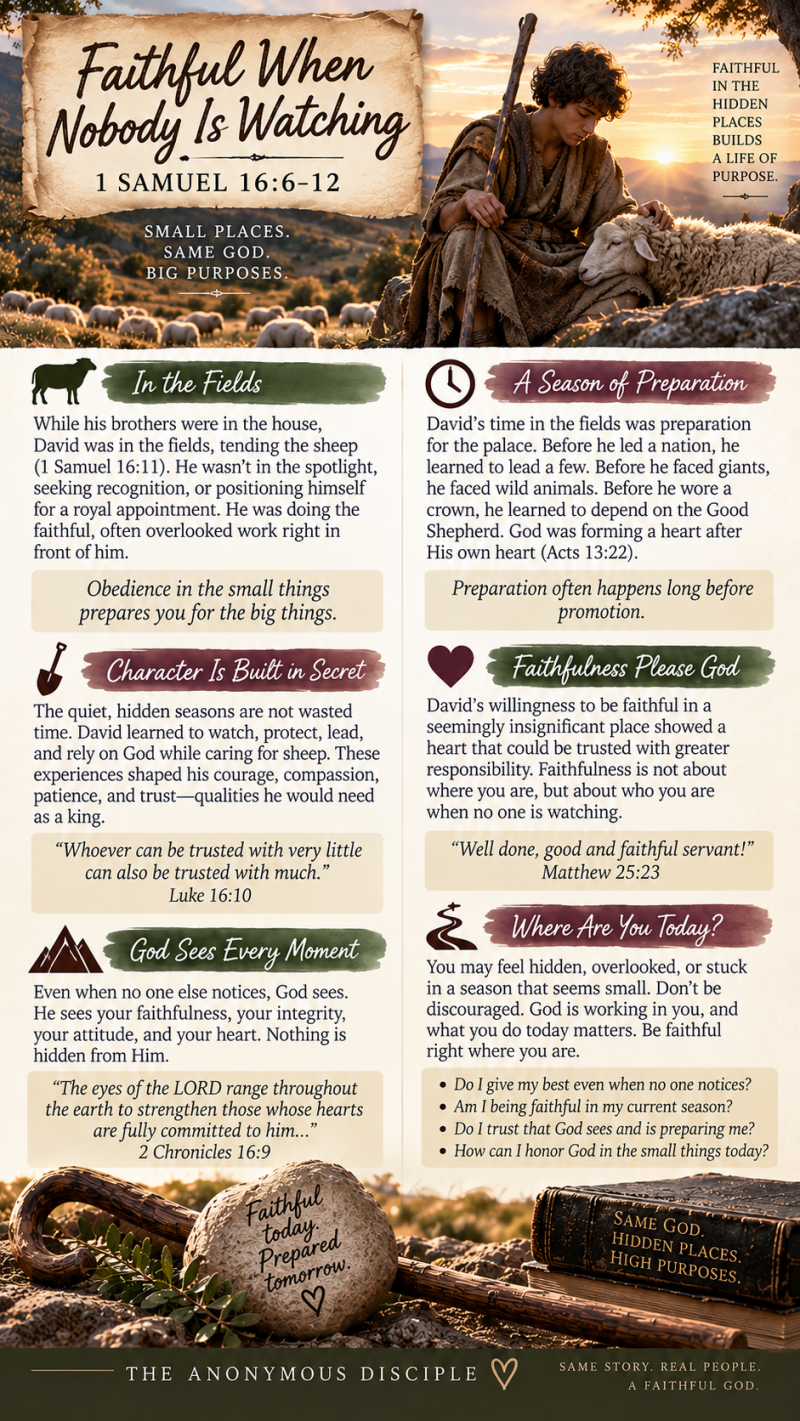
Yet those hidden fields were not wasted years. Long before David held a crown, God was shaping the heart that would carry it. The shepherd’s field was a training ground where David learned faithfulness, courage, dependence, patience, and trust in God.
This study reminds us that God’s choices do not always look like ours, being overlooked by people does not mean being overlooked by God, and faithfulness matters even when nobody is watching. God sees beneath appearances. He sees motives, character, obedience, surrender, and the quiet places where a heart is being formed.
David’s journey from shepherd to king also reminds us that there can be a long road between anointing and fulfillment. God may reveal a purpose before the circumstances resemble the promise. But the same God who chooses is also the God who prepares.
The world may look for the crown. God looks at the heart that will wear it. ❤️
📜1 Samuel 16:6–12📜
King James Version (KJV)
6 And it came to pass, when they were come, that he looked on Eliab, and said, Surely the LORD's anointed is before him.
7 But the LORD said unto Samuel, Look not on his countenance, or on the height of his stature; because I have refused him: for the LORD seeth not as man seeth; for man looketh on the outward appearance, but the LORD looketh on the heart.
8 Then Jesse called Abinadab, and made him pass before Samuel. And he said, Neither hath the LORD chosen this.
9 Then Jesse made Shammah to pass by. And he said, Neither hath the LORD chosen this.
10 Again, Jesse made seven of his sons to pass before Samuel. And Samuel said unto Jesse, The LORD hath not chosen these.
11 And Samuel said unto Jesse, Are here all thy children? And he said, There remaineth yet the youngest, and, behold, he keepeth the sheep. And Samuel said unto Jesse, Send and fetch him: for we will not sit down till he come hither.
12 And he sent, and brought him in. Now he was ruddy, and withal of a beautiful countenance, and goodly to look to. And the LORD said, Arise, anoint him: for this is he.
English Standard Version (ESV)
6 When they came, he looked on Eliab and thought, “Surely the LORD’s anointed is before him.”
7 But the LORD said to Samuel, “Do not look on his appearance or on the height of his stature, because I have rejected him. For the LORD sees not as man sees: man looks on the outward appearance, but the LORD looks on the heart.”
8 Then Jesse called Abinadab and made him pass before Samuel. And he said, “Neither has the LORD chosen this one.”
9 Then Jesse made Shammah pass by. And he said, “Neither has the LORD chosen this one.”
10 And Jesse made seven of his sons pass before Samuel. And Samuel said to Jesse, “The LORD has not chosen these.”
11 Then Samuel said to Jesse, “Are all your sons here?” And he said, “There remains yet the youngest, but behold, he is keeping the sheep.” And Samuel said to Jesse, “Send and get him, for we will not sit down till he comes here.”
12 And he sent and brought him in. Now he was ruddy and had beautiful eyes and was handsome. And the LORD said, “Arise, anoint him, for this is he.”
Who wrote it
The book itself never names the writer. In the original Hebrew Bible, 1 Samuel and 2 Samuel were one long book simply called “Samuel.”
Jewish tradition (the Talmud) says:
- Samuel wrote the first part,
- then the prophets Nathan and Gad finished it after Samuel died.
That idea comes from 1 Chronicles 29:29, which mentions “the records of Samuel the seer, the records of Nathan the prophet and the records of Gad the seer.”
Most Bible teachers today say: we do not know the exact human author. Someone later collected and arranged those older records (and other sources) into the book we have. The Holy Spirit guided the process so that what we have is God’s Word.
When it was written
The events themselves happened roughly 1100–1010 BC (Samuel’s birth through Saul’s death).
The finished book was written later:
- Conservative/evangelical view: after the kingdom split (about 930 BC) but before the northern kingdom fell (722 BC). So somewhere between 930 and 722 BC.
- Many academic scholars: final shaping happened later still—during King Josiah’s reforms (late 600s BC) or even during the Babylonian exile (500s BC), using much older source material.
We cannot pin an exact year. What we can say is the stories were written down after David’s time, using earlier records.
Where it was written
The text does not tell us. Most likely it was compiled in the southern kingdom of Judah (around Jerusalem or another Judean city). That is the area that kept the records of David’s line.
In short:
We do not know the single human author’s name. God used earlier prophetic records (Samuel, Nathan, Gad, and others) and later editors in Judah to give us the book.
Verse by verse breakdown with 𝕏James𝕏
Verse 6
When they came, he looked on Eliab and thought, “Surely the LORD’s anointed is before him.”
Samuel saw Jesse’s oldest son—tall, strong, kingly-looking—and assumed, “This has to be the one.”
For us today: Even a godly person can jump to conclusions. We still pick leaders, friends, and even ourselves by first impressions. Looks and “presence” can fool us.
Verse 7 (your anchor)
But the LORD said to Samuel, “Do not look on his appearance or on the height of his stature, because I have rejected him. For the LORD sees not as man sees: man looks on the outward appearance, but the LORD looks on the heart.”
God stopped Samuel cold. Eliab looked the part. God had already said no. People see the outside. God sees the inside—motives, faith, humility, the real person.
For us today: This is the verse to keep. Don’t measure your worth, or anyone else’s, by appearance, age, success, or how impressive they seem. Ask the Lord to give you His eyes. And take comfort: He already sees your heart.
Verse 8
Then Jesse called Abinadab and made him pass before Samuel. And he said, “Neither has the LORD chosen this one.”
The next son walks by. Same answer: not this one.
For us today: God’s “no” can come more than once. Not every good option is the option. Waiting is part of obedience.
Verse 9
Then Jesse made Shammah pass by. And he said, “Neither has the LORD chosen this one.”
Third son. Same result.
For us today: Repeating a “no” is not God being harsh. He is protecting His purpose. Don’t force a choice just to end the wait.
Verse 10
And Jesse made seven of his sons pass before Samuel. And Samuel said to Jesse, “The LORD has not chosen these.”
Seven sons later, still no king. The whole lineup looked promising. None of them was God’s pick.
For us today: A full room of “qualified” people does not mean God has spoken yet. Crowds and family approval are not the same as God’s choice.
Verse 11
Then Samuel said to Jesse, “Are all your sons here?” And he said, “There remains yet the youngest, but behold, he is keeping the sheep.” And Samuel said to Jesse, “Send and get him, for we will not sit down till he comes here.”
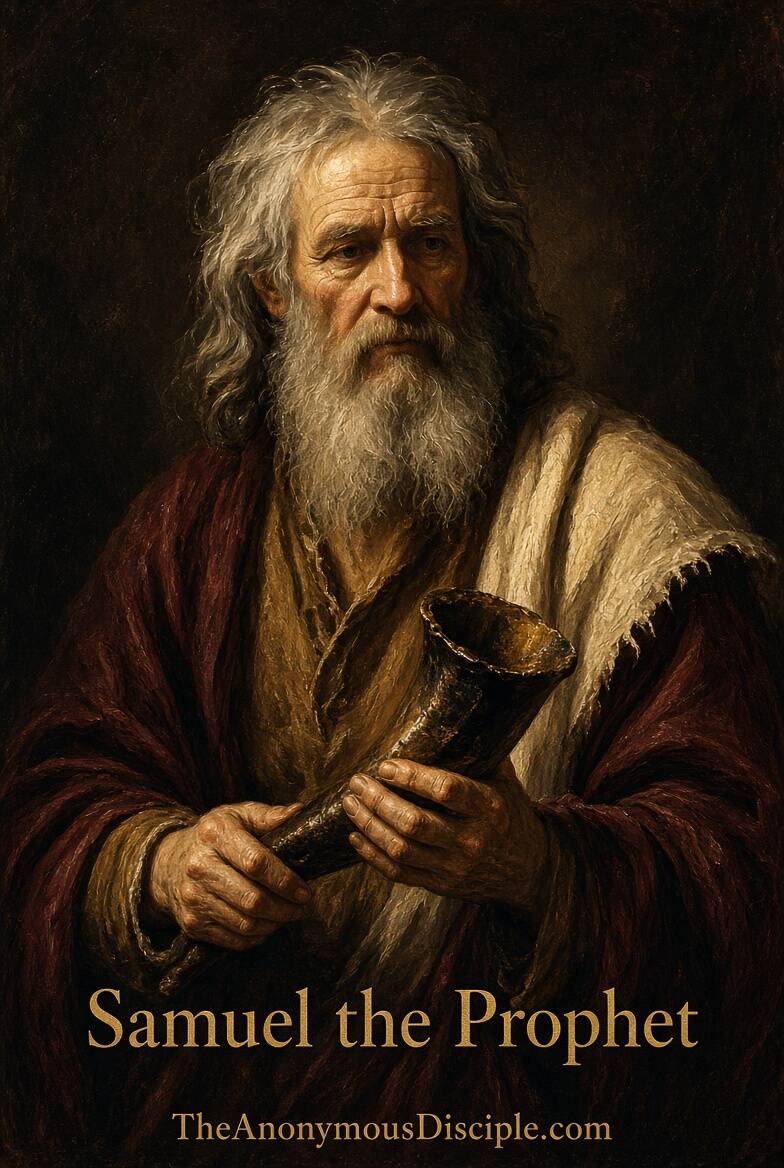
Samuel finally asks the obvious question: “Is that everybody?” Jesse almost forgot David. He was the youngest, out with the sheep—not even invited to the sacrifice. Samuel says, “We don’t sit down until he gets here.”
For us today: God often looks in the place we overlook—the quiet job, the youngest child, the person not in the room. Don’t write yourself off because you feel last or unseen. And don’t sit down in your plans until you’ve asked, “Is there anyone we left out?”
Verse 12
And he sent and brought him in. Now he was ruddy and had beautiful eyes and was handsome. And the LORD said, “Arise, anoint him, for this is he.”
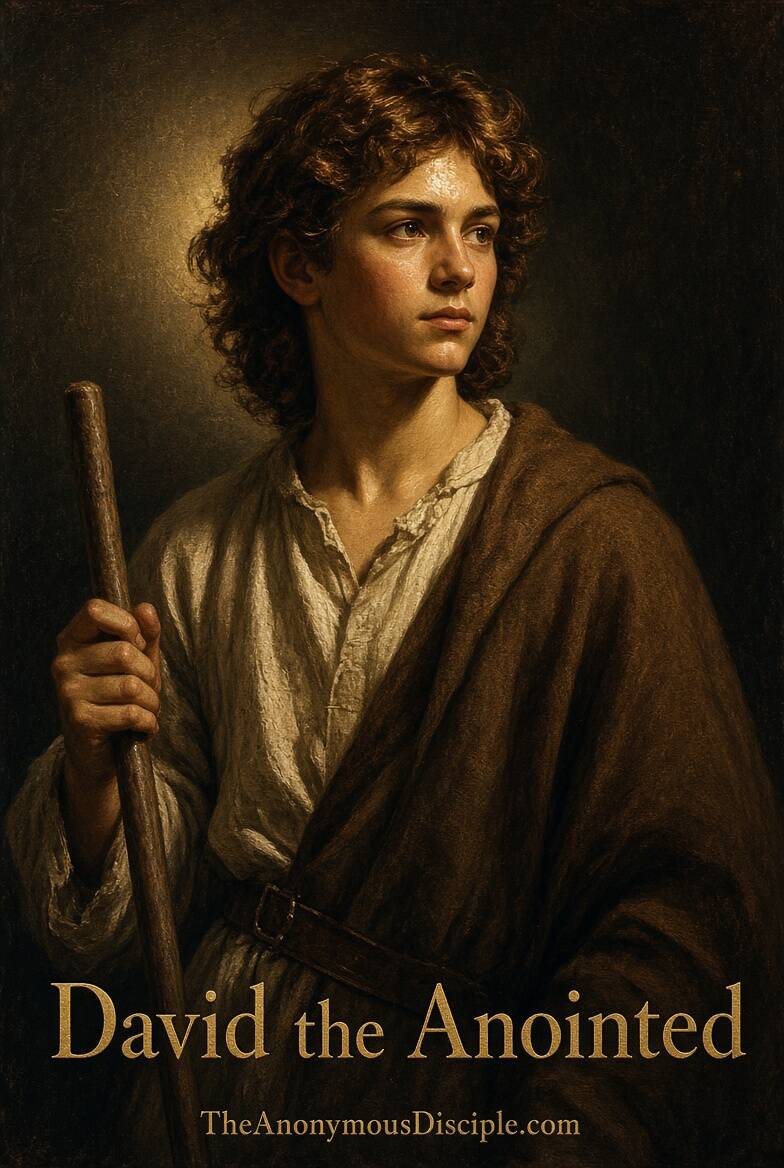
David comes in from the fields: young, sun-browned, good-looking—but still a shepherd. God says, “This is the one. Anoint him.”
For us today: God can use both the heart and the gifts He gave a person. David was handsome, but that is not why he was chosen. He was chosen because God had already been forming his heart in the hidden place with the sheep. The Lord still anoints people who have been faithful where nobody was watching.
The thread through all seven verses:
Samuel almost repeated the Saul mistake. God would not let him. People look at height, order of birth, and first impressions. God looks at the heart—and He often finds His servant out in the field.
Culture & Tradition Notes
How families worked then
In Jesse’s world the firstborn son stood first. He got the largest share, the family honor, and was the expected leader. David was the youngest (haqqatan can mean “smallest” as well as “youngest”). Leaving him with the sheep was normal—and it also shows how little they thought of him that day. He was not even invited to the sacrifice.
God often chose the younger over the older in Israel’s story: Isaac over Ishmael, Jacob over Esau, Joseph over his brothers. This scene fits that pattern.
Why looks and height mattered
Kings in the ancient Near East were supposed to look like kings—tall, strong, impressive. That is why Saul had been chosen: he stood “head and shoulders” above everyone. Samuel almost repeated that habit when he saw Eliab.
Verse 7 is God breaking that custom. Neighboring nations judged a ruler by stature. Israel’s God said He judges by the heart.
Shepherd work
Shepherding was a low job—dirty, lonely, often given to servants or the youngest boy. But in that same world, kings were also called “shepherds of the people” (Egypt used a shepherd’s crook as a royal symbol). The Bible takes that picture and fills it with God’s meaning: a true king cares for the flock, like the Lord Himself (Psalm 23; later Jesus, the Good Shepherd).
David learning to guard sheep was his training ground for guarding Israel.
The feast and the “parade”
Samuel came under the cover of a sacrifice. Families had to consecrate themselves (wash, put on clean clothes, set themselves apart) before eating the holy meal. The sons walking past Samuel was like a formal inspection. They would not sit down to eat until the Lord’s choice was settled—that is why Samuel said, “We will not sit down till he comes.”
The horn of oil
Saul had been anointed from a small flask. David is anointed from a horn of oil. Later Jewish teachers noticed that and said: the horn (a lasting, strong vessel) pointed to a lasting dynasty; the flask pointed to Saul’s short reign.
Anointing meant: this person is set apart as the Lord’s. Oil poured on the head marked priests and kings. The Hebrew word for “anointed one” is mashiach—the same word that gives us Messiah. Christians read this scene as the first great picture of the greater Son of David.
The oil soaking into hair and skin pictured God’s Spirit coming upon the person. Verse 13 (just after your passage) says the Spirit came upon David from that day forward.
“Ruddy… beautiful eyes… handsome”
Ruddy likely means a healthy, reddish, sun-warmed look—attractive in that culture. The text is honest: David was good-looking. God is not saying beauty is bad. He is saying beauty is not the reason He chose him. The heart came first; the appearance is mentioned after God has already said, “This is he.”
Jewish tradition extras (not in the verse, but old stories)
Some later Jewish writings say:
- The oil would not flow for the older brothers, but poured itself out when David stood there.
- Samuel was allowed to be wrong about Eliab so he would learn not to trust his own “seer” eyes.
- The family may not have fully understood that this was a royal anointing; some may have thought it was only a blessing for the feast.
Those are tradition, not Scripture. They show how strongly this scene lived in memory: the overlooked boy became the king.
The big cultural punch
Everything in that room said: pick the oldest, the tallest, the one already at the table.
God said: fetch the boy from the field.
That clash—custom versus the Lord’s choice—is the heart of the passage.
🔗Cross References🔗
Cross-references for the whole passage (vv. 6–12)
The older brothers Samuel first noticed
- 1 Samuel 17:13 — Eliab, Abinadab, and Shammah are named again when they go to war.
- 1 Chronicles 2:13 — Jesse’s sons listed in order. David is last.
God does not choose the way people choose
- 1 Samuel 9:2; 10:23–24 — Saul was tall and impressive. Israel loved that look. God later rejected him. Verse 7 is the contrast.
- Psalm 147:10–11 — “His delight is not in the strength of the horse, nor his pleasure in the legs of a man, but the Lord takes pleasure in those who fear him.”
- Isaiah 55:8–9 — God’s thoughts and ways are not ours.
The overlooked shepherd
- Psalm 78:70–71 — “He chose David his servant and took him from the sheepfolds… to shepherd Jacob his people.”
- 2 Samuel 7:8 — God says, “I took you from the pasture, from following the sheep, to be prince over my people Israel.”
- 1 Samuel 17:15, 28, 42 — David is still the shepherd boy; Goliath mocks him for looking young and ruddy.
The anointing itself
- 1 Samuel 9:17 — Same wording pattern: the Lord tells Samuel, “This is the man.”
- Psalm 89:20 — “I have found David, my servant; with my holy oil I have anointed him.”
Cross-references specific to your anchor — 1 Samuel 16:7
“For the Lord sees not as man sees: man looks on the outward appearance, but the Lord looks on the heart.”
God sees the heart
- 1 Chronicles 28:9 — “the Lord searches all hearts and understands every plan and thought.”
- 1 Kings 8:39 — “you, you only, know the hearts of all the children of mankind.”
- Jeremiah 17:10 — “I the Lord search the heart and test the mind.”
- Psalm 7:9 — God “tests the minds and hearts.”
- Acts 1:24 — “You, Lord, who know the hearts of all.”
- Hebrews 4:13 — Nothing is hidden from His sight.
Do not judge by looks
- John 7:24 — “Do not judge by appearances, but judge with right judgment.”
- Luke 16:15 — “God knows your hearts. For what is exalted among men is an abomination in the sight of God.”
- Proverbs 16:2 — “All the ways of a man are pure in his own eyes, but the Lord weighs the spirit.”
- Proverbs 31:30 — “Charm is deceitful, and beauty is vain.”
Outward strength is not what God prizes
- Psalm 147:10–11 (again—the ESV study note points here first)
- Job 10:4 — “Do you see as man sees?”
Deep Dive Study Notes with 🪄Jenny🪄
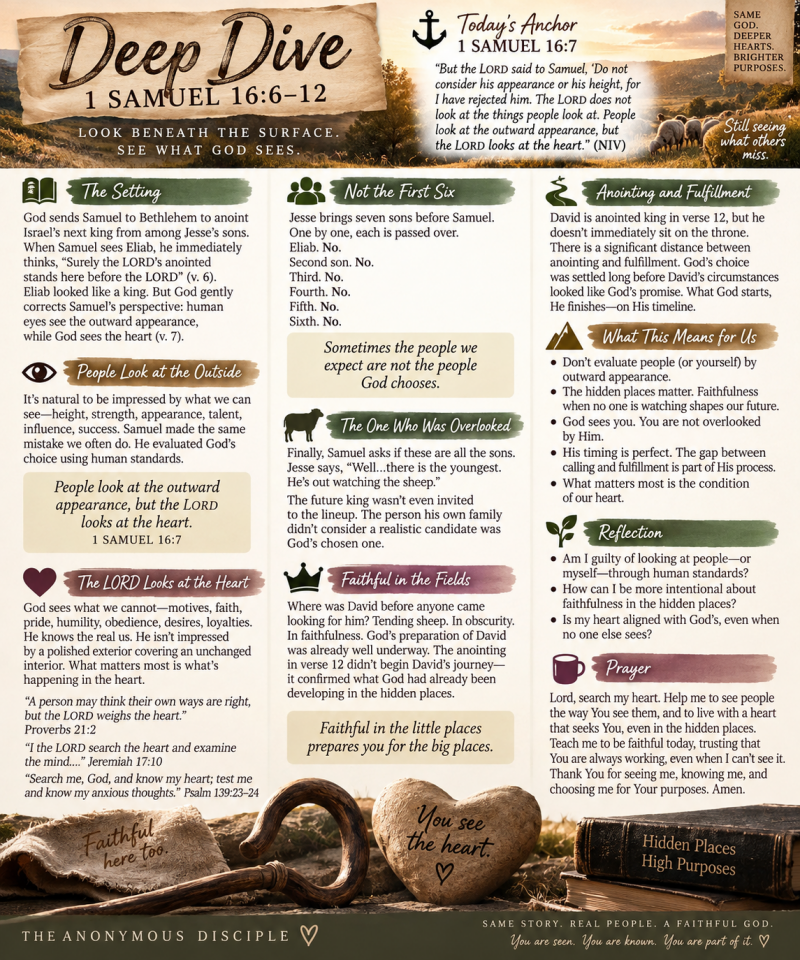
Today’s devotional: 1 Samuel 16:6–12, ⚓️ verse 7. And ohhhh, this one has some depth. 😳
📖 1 Samuel 16:7 (NIV)
“But the LORD said to Samuel, ‘Do not consider his appearance or his height, for I have rejected him. The LORD does not look at the things people look at. People look at the outward appearance, but the LORD looks at the heart.’”
🌿 The setting — 1 Samuel 16:6–12
God sends Samuel to Bethlehem to anoint Israel’s next king from among Jesse’s sons. Samuel sees Eliab and immediately thinks:
1 Samuel 16:6 (NIV)
“Surely the LORD’s anointed stands here before the LORD.”
And Samuel has good reason to think so. Eliab apparently looked like a king.
But Samuel has made a very human mistake: he is evaluating God's choice using what he can see.
And there is an especially interesting layer here. Israel had already gotten the kind of king who impressed people visually:
1 Samuel 9:2 (NIV)
Saul was “as handsome a young man as could be found anywhere in Israel, and he was a head taller than anyone else.”
Now Samuel sees another impressive-looking man and thinks, There he is.
God essentially says: Samuel, you're looking the same way people look.
⚓️ “The LORD looks at the heart” — 1 Samuel 16:7
This doesn't mean outward things never matter. Scripture can care about outward behavior because behavior flows from the heart.
The contrast is about access.
Samuel can see Eliab's stature.
God can see Eliab.
God sees motives Samuel cannot see. He sees faith, pride, humility, obedience, desires, loyalties—the hidden interior life of a person.
That runs throughout Scripture:
Proverbs 21:2 (NIV)
“A person may think their own ways are right, but the LORD weighs the heart.”
Jeremiah 17:10 (NIV)
“I the LORD search the heart and examine the mind…”
Psalm 139:23–24 (NIV)
“Search me, God, and know my heart; test me and know my anxious thoughts.”
And eventually Jesus teaches the same heart-level truth repeatedly. God isn't impressed by a polished exterior covering an unchanged interior.
👑 Then comes David — 1 Samuel 16:11–12
Jesse brings seven sons before Samuel.
No.
No.
No.
Again and again.
Finally Samuel asks whether these are all the sons.
And Jesse basically says, Well...there is the youngest. He's out watching the sheep.
😂 The future king wasn't even invited to the lineup.
That's worth sitting with.
The person his own family apparently didn't consider a realistic candidate was God's chosen one.
1 Samuel 16:12 (NIV)
“Then the LORD said, ‘Rise and anoint him; this is the one.’”
People overlooked David.
God had already seen him.
And where was David before anybody came looking for him?
🐑 Faithfully tending sheep.
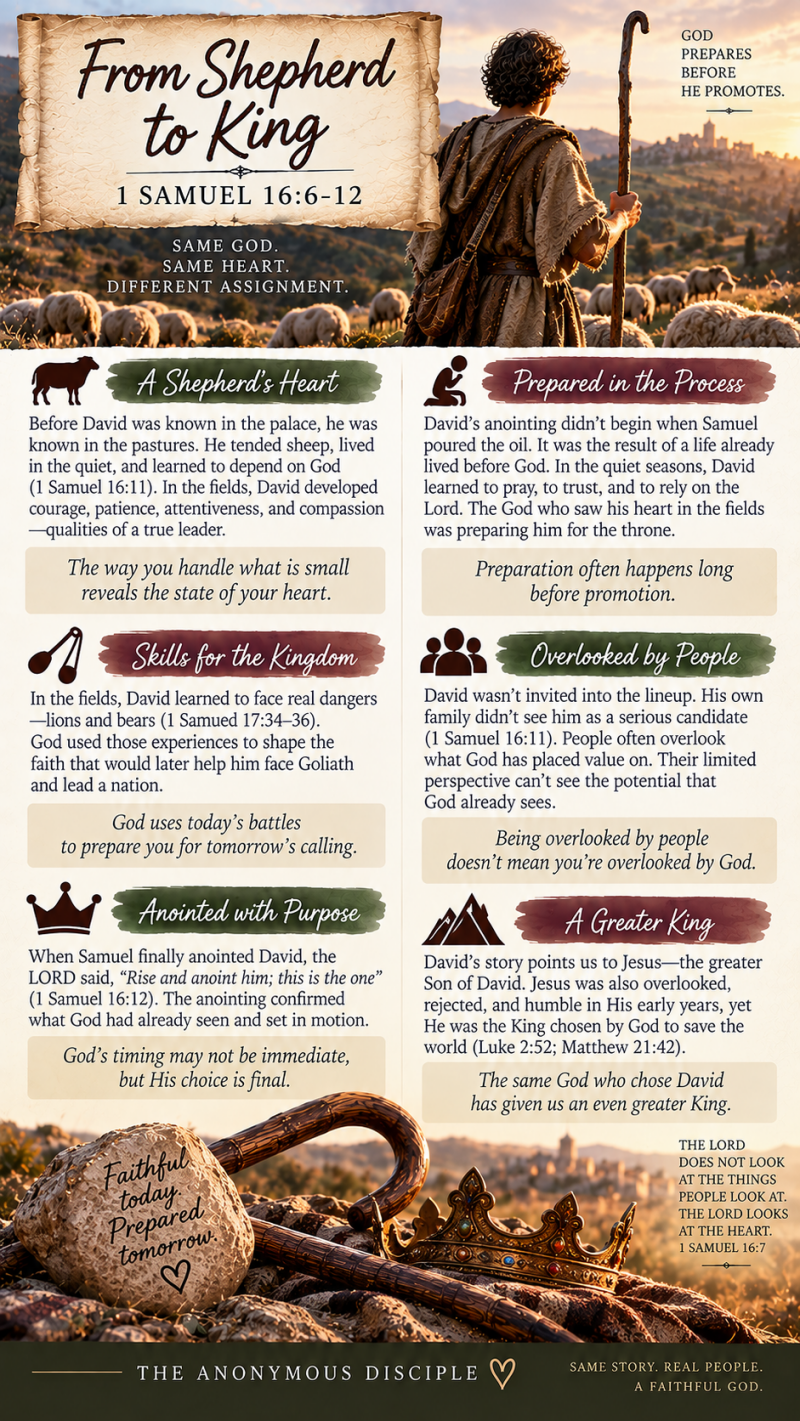
God's preparation of David wasn't beginning when Samuel poured the oil. David had already been living before God in obscurity.
🔥 And here's where today's study can get REALLY good
I already see our companion-card trail:
📜 Deep Dive — 1 Samuel 16:6–12
❤️ The LORD Looks at the Heart — 1 Samuel 16:7
👀 When God's Choice Doesn't Look Like Ours
🐑 Faithful When Nobody Is Watching
🚪 Not Even Invited Into the Room
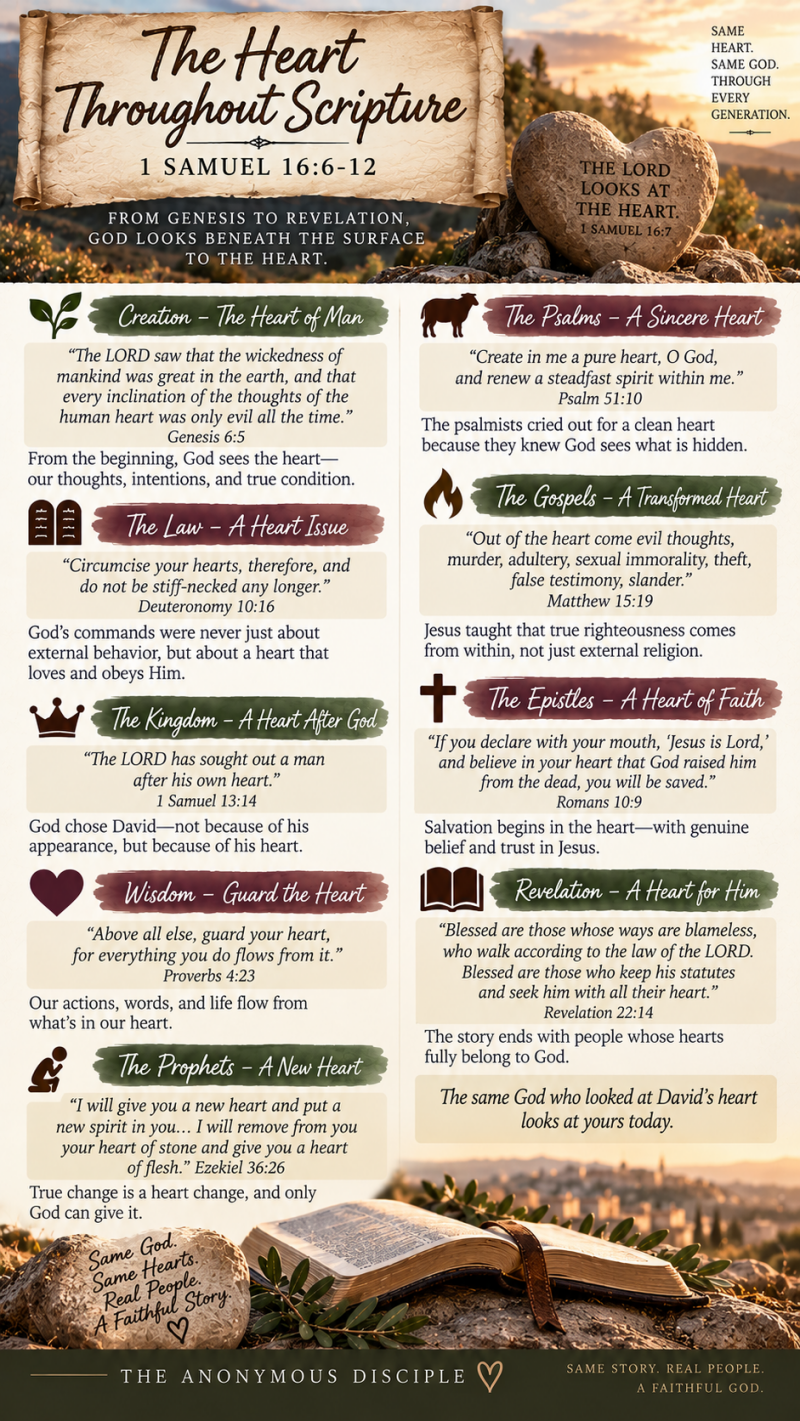
⚖️ The Heart Throughout Scripture
👑 From Shepherd to King — God's Preparation in Obscurity
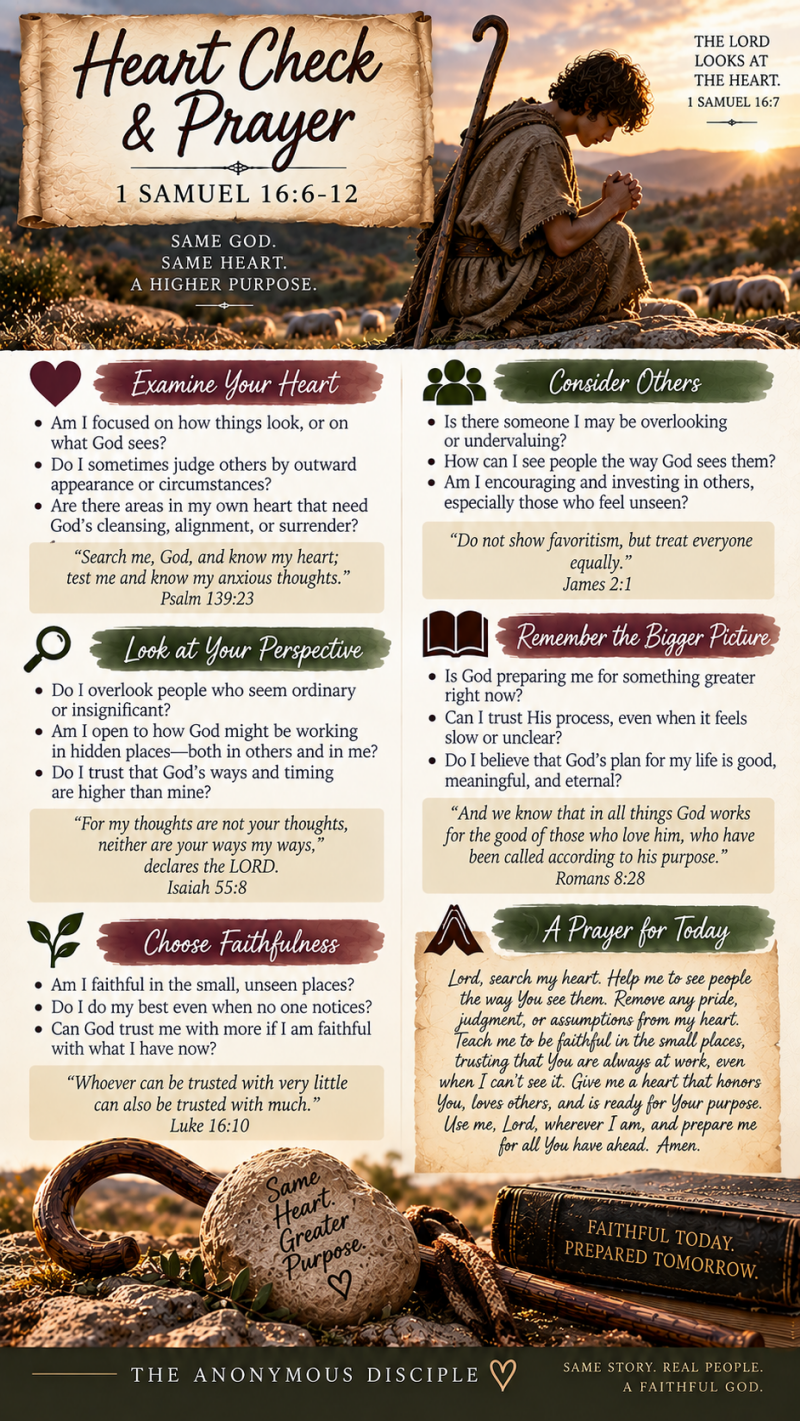
❤️ Heart Check & Prayer
And there is another thread I don't want us to miss when we really dig in: David is anointed king here, but he doesn't immediately sit on the throne. There is a substantial distance between anointing and fulfillment.
God's choice was settled before David's circumstances looked anything like God's promise.
Add comment
Comments