

**There’s one historical wrinkle here that actually makes this entry especially interesting: the prayer is traditionally called the Prayer of St. Ephrem, but we cannot confidently say Ephrem personally wrote the exact prayer we have today.
Prayer of St. Ephrem the Syrian — Study Notes
Who was Ephrem the Syrian?
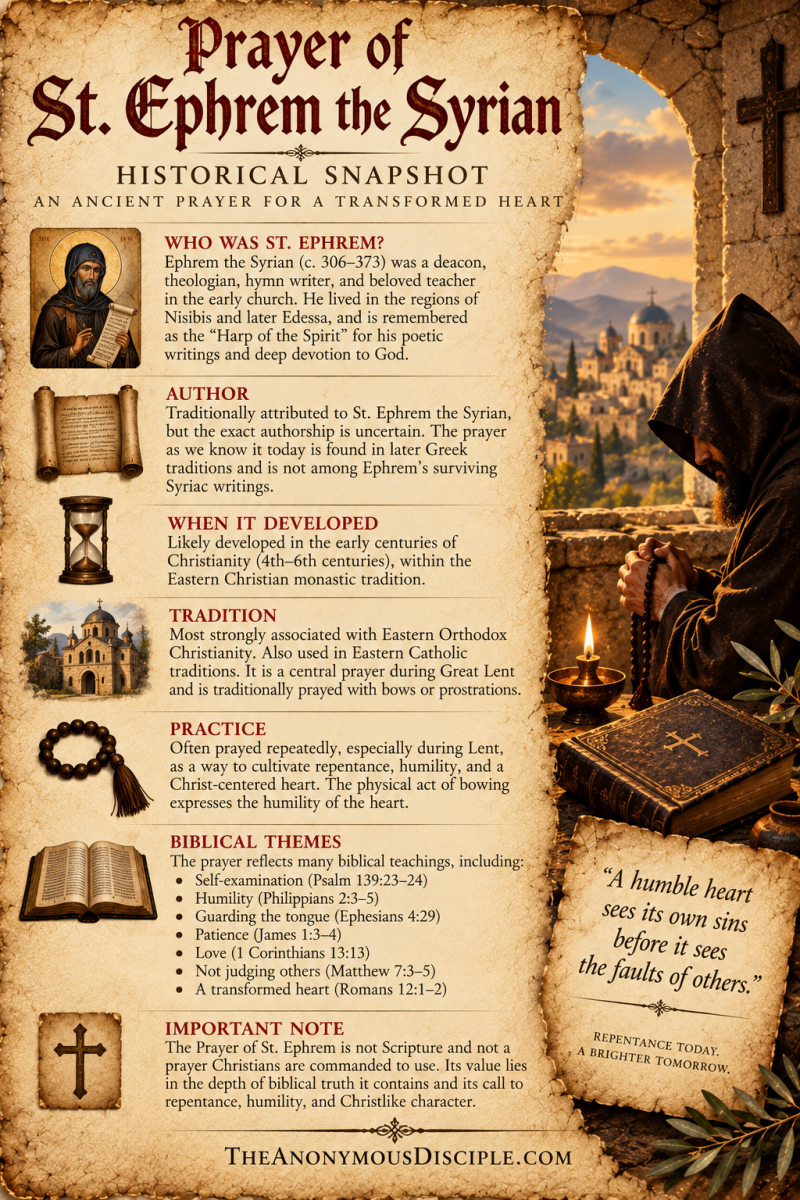
Ephrem the Syrian (c. AD 306–373) was a fourth-century Christian deacon, Bible teacher, theologian, poet, and hymn writer. He lived first around Nisibis in Mesopotamia and later in Edessa, and became one of the most important voices of Syriac Christianity. His genuine writings include biblical commentaries, theological poetry, hymns, and teaching centered heavily on repentance and devotion to God.
He became so renowned for his hymns that later generations called him the “Harp of the Spirit.”
Did Ephrem actually write this prayer?
Traditionally attributed to St. Ephrem the Syrian.
Eastern Christian tradition has associated the prayer with him for centuries, and Orthodox churches continue to call it the Prayer of St. Ephrem.
But scholars point out something important: Ephrem wrote in Syriac, while this particular prayer survives within the later Greek tradition attributed to Ephrem and is not found among his established Syriac works. Its exact author and date therefore remain uncertain. One scholarly treatment notes that the form known today appears to belong to a later stage of monastic development than Ephrem's lifetime.
Traditional attribution: St. Ephrem the Syrian
Historical certainty: The exact authorship is uncertain.
When and where was it used?
The prayer became deeply embedded in the spirituality of the Eastern Christian Church, especially the Byzantine tradition.
Today it is particularly associated with Eastern Orthodox Great Lent. It is prayed repeatedly during weekday Lenten services and is traditionally accompanied by bows or full prostrations. Orthodox liturgical instructions prescribe it at multiple Lenten services, and the prayer is used through the first part of Holy Week.
It is also familiar within Byzantine Catholic traditions.
The physical prostrations are significant in Eastern spirituality: repentance isn't regarded merely as something happening intellectually. The body joins the heart in prayer.
That practice itself isn't commanded of Christians in Scripture, but bodily expressions of worship certainly appear throughout Scripture.
Psalm 95:6
“Come, let us bow down in worship, let us kneel before the LORD our Maker.”
The prayer has three movements
And this is what I love about it. ❤️
It is almost like a tiny spiritual examination.
1. Lord, remove what should not be in me.
Sloth.
Despair.
Love of power.
Idle speech.
2. Lord, cultivate what should be in me.
Purity.
Humility.
Patience.
Love.
3. Lord, change where my eyes are looking.
Instead of constantly examining everyone else's sins:
show me mine.
That last movement may be the most piercing part of the entire prayer.
“Lord and Master of my life”
The prayer begins by recognizing God's authority.
It doesn't begin:
Lord, improve the circumstances around me.
It begins essentially:
You are the Master of me.
That fits beautifully with:
Romans 14:7–8
“For none of us lives for ourselves alone, and none of us dies for ourselves alone. If we live, we live for the Lord…”
The person praying is surrendering the whole life to God before asking Him to change anything.
“Take from me the spirit of sloth”
This isn't simply:
Lord, make me less lazy.
Biblically, spiritual sloth can mean becoming indifferent, passive, careless, or lukewarm toward the things of God.
Romans 12:11
“Never be lacking in zeal, but keep your spiritual fervor, serving the Lord.”
And:
Hebrews 6:12
“We do not want you to become lazy, but to imitate those who through faith and patience inherit what has been promised.”
The prayer asks:
Lord, don't let my soul become spiritually asleep.
“Despair”
This one struck me.
Christianity certainly doesn't pretend believers never experience sorrow, grief, fear, or discouragement.
But despair says:
There is no hope.
The Gospel says otherwise.
2 Corinthians 4:8–9
“We are hard pressed on every side, but not crushed; perplexed, but not in despair; persecuted, but not abandoned; struck down, but not destroyed.”
And:
Psalm 42:11
“Why, my soul, are you downcast? Why so disturbed within me? Put your hope in God…”
Biblical hope isn't pretending everything is good.
It's believing God remains good even when everything isn't.
“Lust of power”
This isn't referring to sexual lust. Here it means a craving to control, dominate, rule over, or elevate oneself above others.
Jesus specifically confronted that impulse in His disciples.
Mark 10:42–45
Jesus tells them that worldly rulers “lord it over” others, then says:
“Not so with you. Instead, whoever wants to become great among you must be your servant…”
And then Jesus presents Himself as the model:
“For even the Son of Man did not come to be served, but to serve…”
So the prayer is asking:
Lord, remove my desire to control people and replace it with the heart of a servant.
That is profoundly Christlike.
“Idle talk”
Oh boy. 😂 This prayer has officially come for everybody now.
Scripture treats speech seriously.
Ephesians 4:29
“Do not let any unwholesome talk come out of your mouths, but only what is helpful for building others up…”
And Jesus says:
Matthew 12:36
“Everyone will have to give account on the day of judgment for every empty word they have spoken.”
Gossip.
Needless criticism.
Boasting.
Cruel words.
Constant complaining.
Talking simply because silence feels uncomfortable.
The prayer essentially says:
Lord, govern my mouth.
“Give to me the spirit of chastity”
This word can sound almost entirely sexual to modern English ears.
But the underlying idea in this prayer is broader.
Some translations use words closer to purity, integrity, sound-mindedness, or self-control. The surviving Greek and Slavonic traditions actually contain several wording differences, which explains why English versions of the prayer don't always look identical.
Think:
a life brought into proper order under God.
Titus 2:11–12
God's grace teaches us:
“to say ‘No’ to ungodliness and worldly passions, and to live self-controlled, upright and godly lives…”
That's a good biblical lens for understanding the petition.
“Humility”
Now notice what replaces the lust for power:
humility.
That's not accidental.
Philippians 2:3–5
“Do nothing out of selfish ambition or vain conceit. Rather, in humility value others above yourselves…”
And Paul immediately points us toward the mind of Christ.
Biblical humility isn't:
I am worthless.
It is:
God is great, I depend upon Him, and I don't need to elevate myself over everybody else.
“Patience”
Again, look at the contrast.
Sloth isn't replaced by frantic activity.
It's accompanied by patient faithfulness.
Colossians 3:12
“Clothe yourselves with compassion, kindness, humility, gentleness and patience.”
And:
James 1:3–4
“The testing of your faith produces perseverance. Let perseverance finish its work…”
Patience is faith that refuses to abandon obedience simply because God hasn't moved according to our timetable.
“And love”
And everything leads here.
1 Corinthians 13:13
“And now these three remain: faith, hope and love. But the greatest of these is love.”
Jesus likewise said:
John 13:34–35
“As I have loved you, so you must love one another.”
Christian maturity isn't merely becoming more disciplined.
It's becoming more like Christ.
And Christlike character ultimately produces love.
“Grant me to see my own sins”
🔥 There it is.
This may be the spiritual center of the whole prayer.
Jesus said:
Matthew 7:3–5
“Why do you look at the speck of sawdust in your brother's eye and pay no attention to the plank in your own eye?”
First:
examine yourself.
Then you may actually be able to help your brother.
David prayed something very similar:
Psalm 139:23–24
“Search me, God, and know my heart; test me and know my anxious thoughts. See if there is any offensive way in me…”
That's almost exactly the posture of this prayer.
Lord, show me what I cannot—or don't want to—see in myself.
“And not to judge my brother”
Again, straight into Scripture.
Romans 14:10
“You, then, why do you judge your brother or sister?”
And:
James 4:11–12
James warns believers against speaking evil against one another and reminds us that there is one Lawgiver and Judge.
The prayer isn't telling Christians that discernment is forbidden. Scripture repeatedly commands discernment.
It's asking God to remove the spirit that constantly:
condemns, compares, criticizes, and looks down on another person while ignoring our own sin.
That's an important distinction.
There are also different versions
Readers may encounter slightly different wording.
For example, versions may use:
- sloth / idleness
- despair / despondency
- lust of power / love of power
- idle talk / vain speaking
- chastity / purity / sober-mindedness
- sins / transgressions / failings
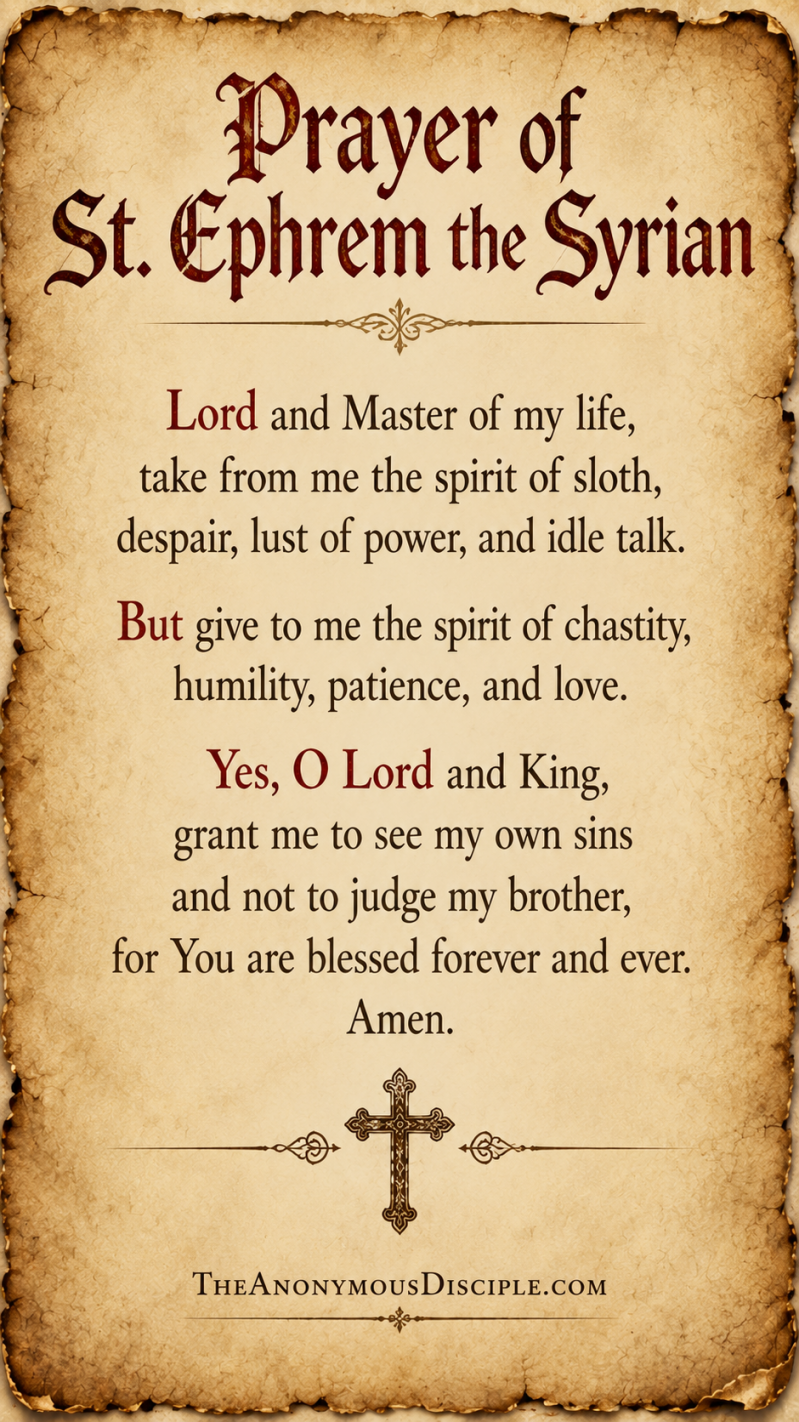
The Orthodox Church in America's familiar English form uses essentially the wording on our card: sloth, despair, lust of power, idle talk; chastity, humility, patience, and love.
So someone finding another translation online hasn't necessarily found a different prayer.
In simple biblical terms
I think I would summarize this prayer like this:
Lord, remove the attitudes that turn me inward toward selfishness, pride, hopelessness, control, and careless speech. Form in me purity, humility, patience, and love. And before I spend my time examining everyone else's sins, show me my own.
That's powerful.
And remarkably biblical.
Important note from The Anonymous Disciple
The Prayer of St. Ephrem is an extra-biblical Christian prayer, not Scripture and not a prayer Christians are commanded to use. It is traditionally attributed to Ephrem the Syrian, although its precise authorship is historically uncertain. Its value lies in how closely its petitions reflect biblical teachings about repentance, humility, self-examination, godly speech, patience, and love.
It doesn't really ask God to change our circumstances.
It asks God to change us.
That is a prayer worth sitting with. ❤️🙏✝️
Add comment
Comments