

St. Patrick’s Breastplate is fascinating, and this one needs a little more historical care because there are really three layers to separate: the ancient prayer, the tradition connecting it to Patrick, and the later English hymn most people know.
St. Patrick’s Breastplate
It is also called St. Patrick’s Lorica or The Deer’s Cry.
A lorica was literally a breastplate or piece of armor. In early Christian usage, the word came to describe a prayer for spiritual protection—almost like deliberately clothing oneself in the protection and truth of God.
So when the prayer repeatedly says, in various translations,
“I arise today…”
or
“I bind unto myself today…”
the idea is:
I am going into this day surrounded by the truth, presence, and power of God.
That immediately makes me think of:
Ephesians 6:10–11
“Finally, be strong in the Lord and in his mighty power. Put on the full armor of God…”
The Lorica isn't Paul's Armor of God passage rewritten, but the underlying spiritual posture is remarkably similar.
Did St. Patrick actually write it?
Here we need our little Anonymous Disciple history caution. 😊
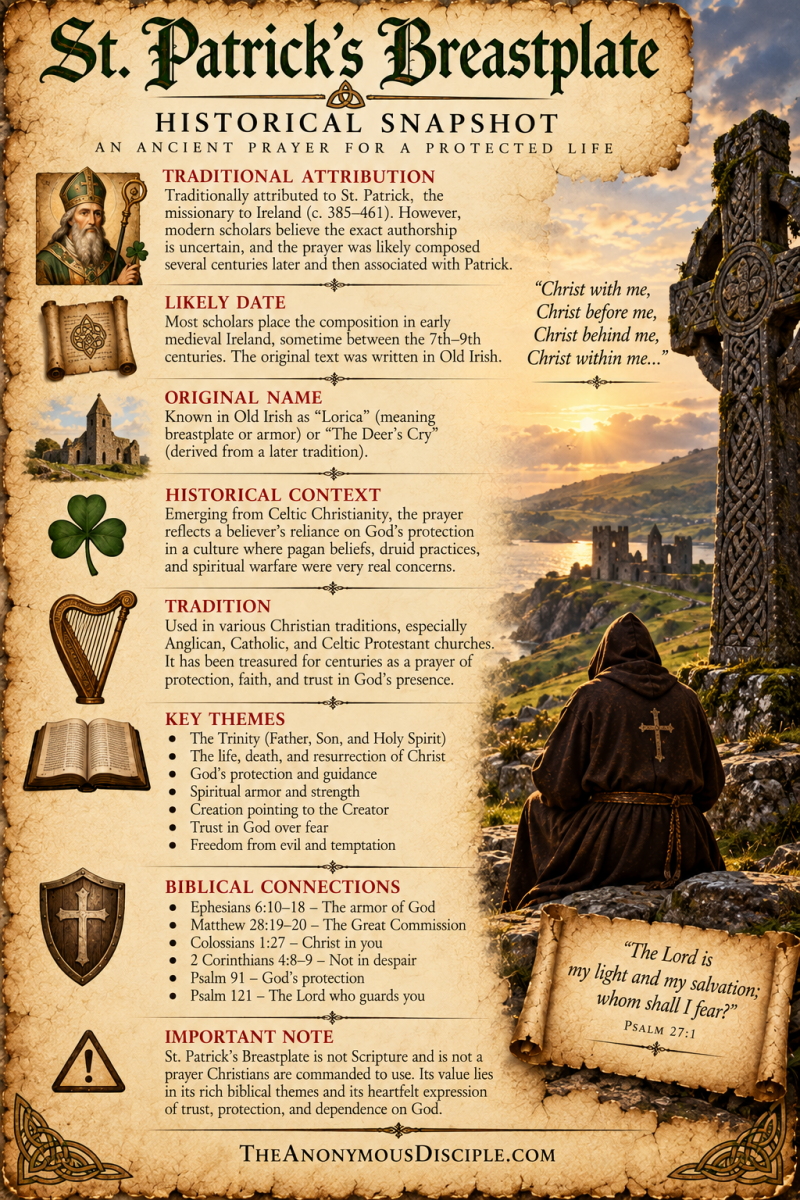
Traditional attribution: St. Patrick
Historical certainty: uncertain
Patrick lived in the 5th century, but modern scholars generally treat the Breastplate as a later Old Irish composition attributed to him, rather than something we can confidently identify as Patrick's own writing.
University College Cork describes it as an ancient Irish prayer from the 700s, while the newest Cambridge History of Irish Poetry likewise describes Atom-riug indiu—the Old Irish title generally associated with St. Patrick's Breastplate—as a poem attributed to Patrick.
So:
Traditionally attributed to St. Patrick, but probably composed several centuries later. Its exact author is unknown.
That's safer than confidently saying either “Patrick wrote it” or “Patrick absolutely did not.”
Then why is Patrick's name attached to it?
There is an old tradition that Patrick prayed it when going to confront the pagan king Lóegaire at Tara.
And this is where the name “The Deer’s Cry” comes in.
Later tradition tells a dramatic story that Patrick and his companions were being pursued, but God concealed them from their enemies so that the men appeared to their pursuers as a herd of deer.
Beautiful story.
Historically demonstrable event?
No. 😂❤️
I'd put that firmly in our traditional legend category, not historical fact.
Older sources record the association between the Breastplate and Patrick's confrontation at Tara, but even nineteenth-century scholarship acknowledged that proving Patrick himself composed the surviving text is difficult.
And I actually love including those distinctions on your site:
What Christians traditionally told.
What historians can establish.
What Scripture actually says.
Three different questions.
What does the prayer actually say?
The whole Breastplate is considerably longer than the famous portion most people know.
It moves through several declarations.
Patrick—or more precisely the person praying in Patrick's voice—“binds” himself to:
The Trinity
Christ's incarnation
Christ's baptism
Christ's crucifixion
Christ's resurrection
Christ's ascension
God's angels and faithful servants
God's wisdom, strength, guidance, and protection
God's created order
and ultimately:
Christ Himself surrounding the believer.
Then comes the section that became enormously famous:
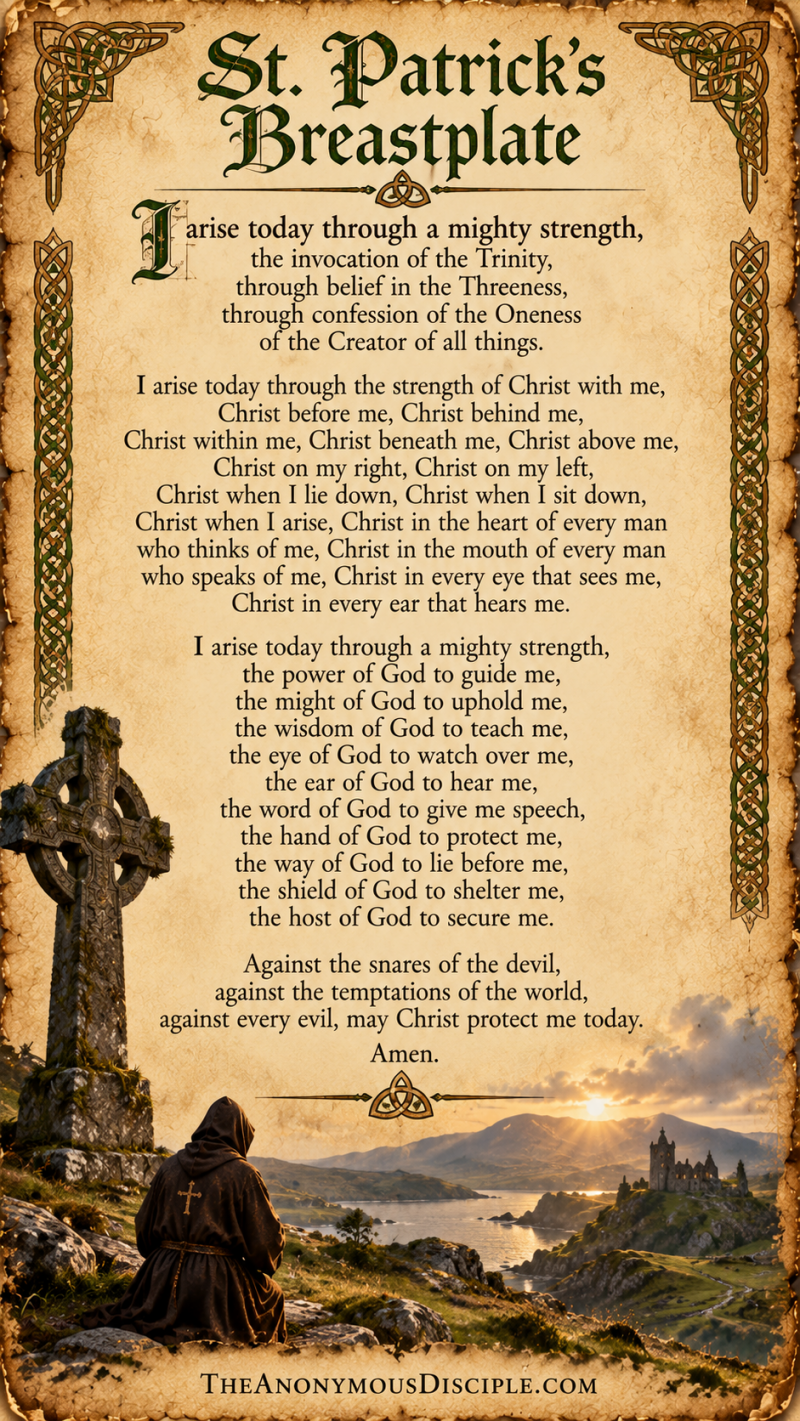
Christ with me, Christ before me,
Christ behind me…
Different English translations vary, but the idea continues:
Christ beneath me.
Christ above me.
Christ within me.
Christ beside me.
Christ in those who think of me.
Christ in those who speak to me.
❤️
That is the beating heart of the prayer.
“Christ with me”
That isn't merely poetic sentiment.
Jesus Himself promised:
Matthew 28:20
“And surely I am with you always, to the very end of the age.”
So when the prayer says:
Christ with me
there's solid biblical ground underneath it.
“Christ in me”
This gets even deeper.
Colossians 1:27
“Christ in you, the hope of glory.”
And:
Galatians 2:20
“I have been crucified with Christ and I no longer live, but Christ lives in me.”
The Christian isn't merely asking Jesus to walk beside him.
Christ dwells within His people through the Spirit.
The prayer begins with the Trinity
One of its strongest characteristics is its explicitly Trinitarian beginning.
It invokes the:
Father
Son
Holy Spirit
as Three in One and One in Three.
That naturally points us toward:
Matthew 28:19
“Baptizing them in the name of the Father and of the Son and of the Holy Spirit.”
Notice Jesus says “name”—singular—followed by Father, Son, and Spirit.
And:
2 Corinthians 13:14
“May the grace of the Lord Jesus Christ, and the love of God, and the fellowship of the Holy Spirit be with you all.”
So despite coming from ancient Celtic Christianity, this prayer is not vague Celtic spirituality.
It is aggressively Christian and Trinitarian.
Then we get some strange-sounding lines 😳
This is something I definitely want us to address on our page.
Depending upon the translation, you'll encounter language about binding oneself to the:
light of the sun
radiance of the moon
splendor of fire
speed of lightning
swiftness of wind
depth of the sea
stability of earth
firmness of rock
Someone reading it today might think:
Wait…are we invoking nature now?
No.
The surrounding prayer identifies God as Creator. These are poetic references to the strength and order God displays in His creation.
Compare:
Psalm 19:1
“The heavens declare the glory of God; the skies proclaim the work of his hands.”
And:
Psalm 121:1–2
“I lift up my eyes to the mountains—where does my help come from? My help comes from the LORD, the Maker of heaven and earth.”
Creation isn't the source of salvation.
Its Creator is.
That's an important distinction.
And then it gets even stranger 😂
The ancient text asks protection against things such as:
sorcery
spells
false prophets
pagan knowledge
druids
hostile spiritual powers
That tells us something about the world in which the prayer developed.
Christianity in early medieval Ireland existed in a culture where older pagan beliefs and fears were still very much alive.
The prayer isn't asking believers to practice magic.
It is doing the opposite:
Lord, protect me from it.
Biblically, that attitude aligns with Scripture's rejection of occult practices:
Deuteronomy 18:10–12
Scripture forbids divination, sorcery, mediums, and related practices.
And:
Ephesians 6:12
“For our struggle is not against flesh and blood, but against the rulers, against the authorities, against the powers of this dark world…”
So I'd explain those lines historically rather than remove them or pretend they aren't there.
They give us a window into what ancient Christians feared and prayed against.
The famous hymn isn't exactly the original prayer
Here's another interesting wrinkle. ❤️
When many English-speaking Christians hear St. Patrick's Breastplate, they're actually thinking of the hymn:
“I Bind Unto Myself Today”
That familiar English version was produced by Cecil Frances Alexander in 1889 from the ancient Irish material. Hymnals subsequently paired it with music, and it became particularly popular in Anglican worship.
Alexander's translation is also where many of us encounter that beautiful:
Christ with me
Christ before me
Christ behind me…
section.
So for our prayer card, I think we have a decision to make:
Use the ancient Breastplate in a direct prose translation
or
Use Cecil Frances Alexander's 1889 poetic version
For The Anonymous Disciple, I lean toward the older prayer in readable prose, with a small note afterward explaining that Alexander's famous hymn came from it.
That keeps this section focused on historic prayers, rather than gradually becoming a hymn collection.
Why “Breastplate”?
This might be my favorite conceptual piece.
The person praying isn't asking:
“God, make sure nothing unpleasant happens to me today.”
They're essentially saying:
Before I walk into whatever today contains, I am deliberately remembering who surrounds me.
Father.
Son.
Spirit.
Christ before me.
Christ behind me.
Christ beside me.
Christ within me.
God's wisdom to guide me.
God's strength to sustain me.
God's power to defend me.
It's spiritual armor.
Which brings us right back to:
Ephesians 6:13
“Therefore put on the full armor of God, so that when the day of evil comes, you may be able to stand your ground…”
Not magic.
Not a charm.
Not words that create an invisible force field.
Faith consciously placing itself under God.
That distinction should absolutely be in our study notes.
In simple biblical terms
I'd summarize St. Patrick's Breastplate this way:
Father, Son, and Holy Spirit, I belong to You. Surround me with Your presence, guide me with Your wisdom, strengthen me with Your power, guard me from evil, and let Christ be before me, behind me, beside me, and within me wherever I go.
Now THAT we can understand. ❤️
Traditional attribution: St. Patrick
Likely date: Early medieval Ireland, commonly placed around the 8th century
Also called: Lorica of St. Patrick / The Deer’s Cry
Biblical themes: Matthew 28:19–20 • Ephesians 6:10–18 • Galatians 2:20 • Colossians 1:27 • Psalm 91 • Psalm 121
Important note: A prayer of trust and protection—not a magical charm or formula.
Syriac/Eastern Christianity → Eastern monastic prayer → early Irish/Celtic Christianity. ❤️✝️
Add comment
Comments