

Luther’s Morning Prayer
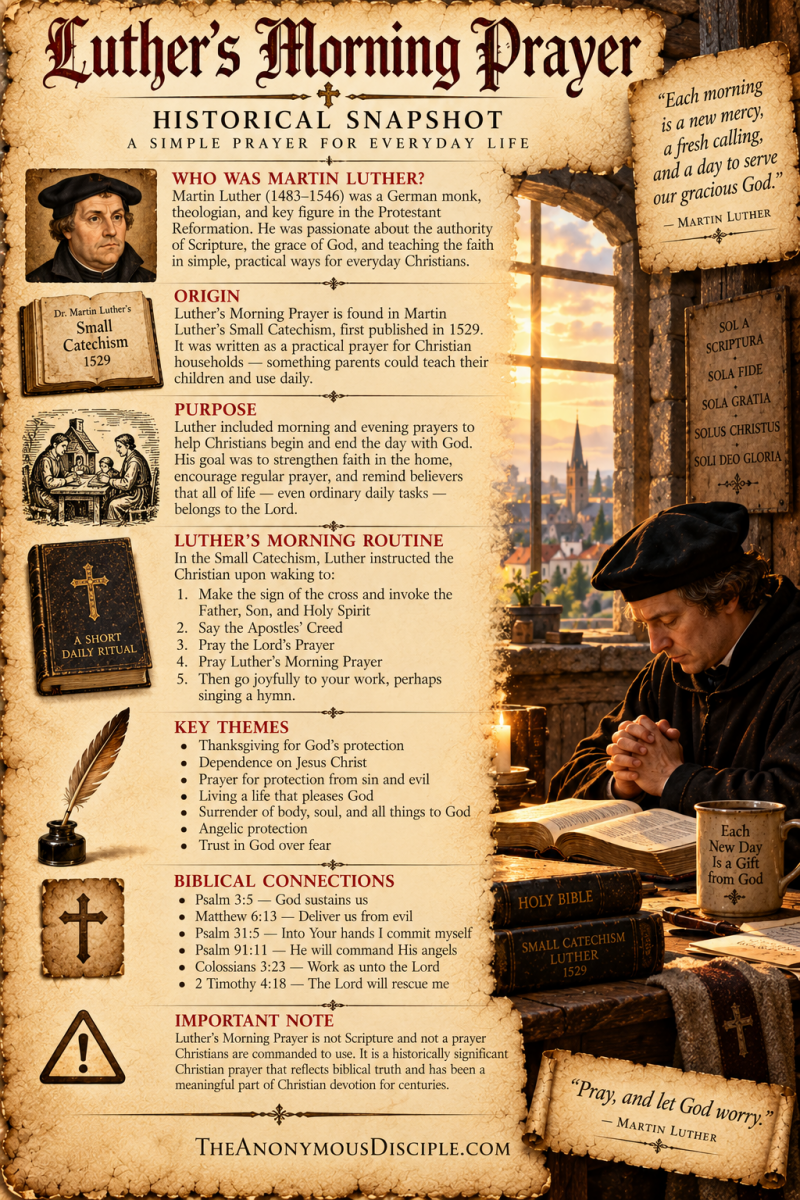
It appears in Martin Luther’s Small Catechism, published in 1529. Luther included morning and evening prayers as part of practical instruction for Christian households—something parents could teach their families and actually use every day.
The familiar prayer reads:
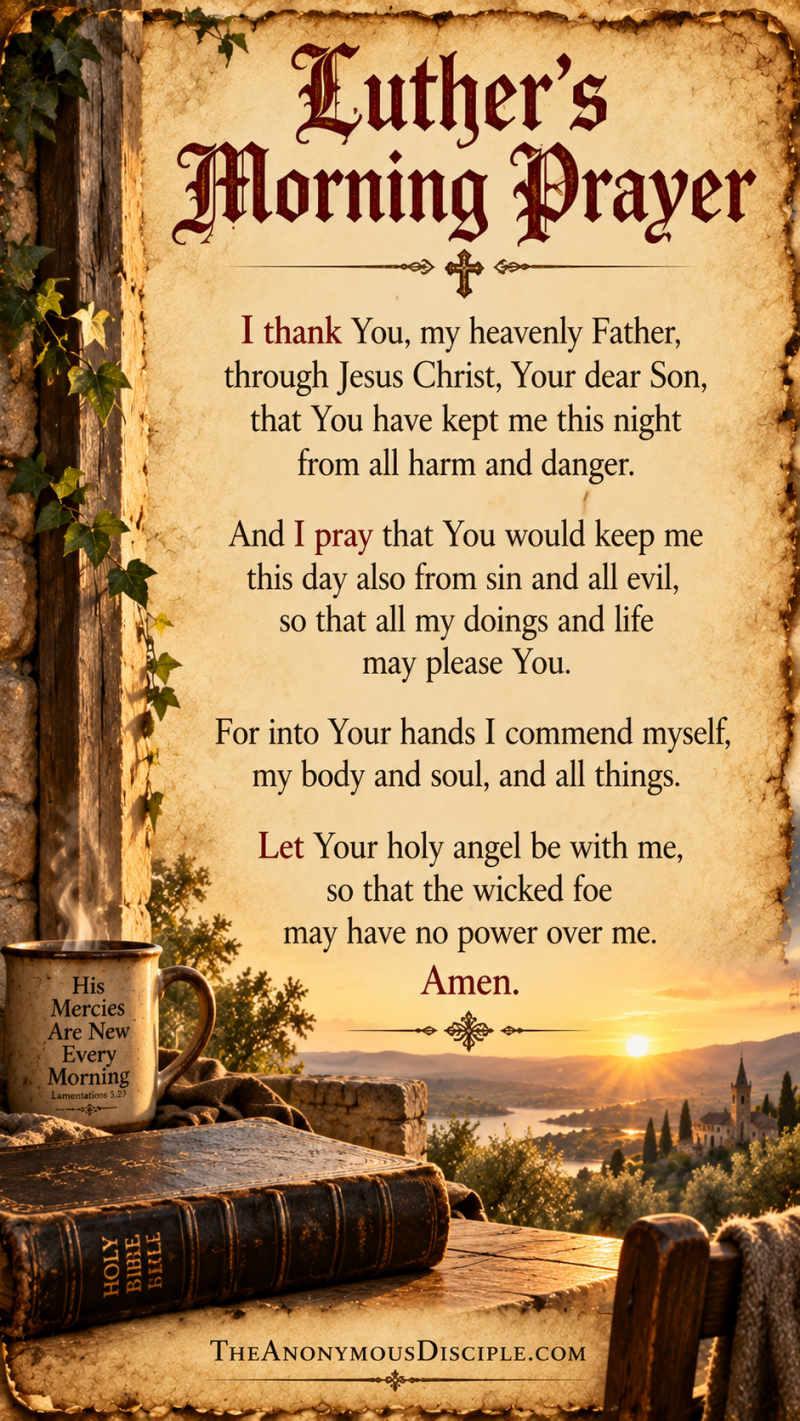
I thank You, my heavenly Father, through Jesus Christ, Your dear Son, that You have kept me this night from all harm and danger. And I pray that You would keep me this day also from sin and all evil, so that all my doings and life may please You. For into Your hands I commend myself, my body and soul, and all things. Let Your holy angel be with me, so that the wicked foe may have no power over me. Amen.
And there’s actually more to Luther’s morning routine than just that paragraph.
He instructed the Christian upon waking to:
make the sign of the cross → invoke the Father, Son, and Holy Spirit → say the Apostles’ Creed → pray the Lord’s Prayer → pray this little morning prayer → then go joyfully to work, perhaps singing a hymn.
I love that last part. 😂❤️ Luther essentially says:
Pray. Remember what you believe. Entrust yourself to God. Then get up and go do your work joyfully.
Why did Luther include prayers like this?
Luther had participated in church visitations and was disturbed by how little basic Christian teaching many ordinary people—and even some clergy—actually knew.
That helped drive him to produce the Small Catechism in an extremely simple form for use in homes, churches, and instruction of children.
So this wasn't intended as some elite monastery prayer.
It was basically:
Christianity at the kitchen table.
Parents teaching children:
Who is God?
What do we believe?
How do we pray?
How should we begin the day?
That makes it very different historically from the Jesus Prayer or St. Ephrem’s prayer.
“I thank You, my heavenly Father”
Notice where Luther begins:
Thanksgiving.
Before asking God for anything, the believer acknowledges that the night itself was lived beneath God's providence.
Psalm 3:5
“I lie down and sleep; I wake again, because the LORD sustains me.”
And:
Psalm 4:8
“In peace I will lie down and sleep, for you alone, LORD, make me dwell in safety.”
The thought is:
I woke up because God sustained me through another night.
That is a wonderful way to begin a morning.
“Through Jesus Christ, Your dear Son”
Luther immediately grounds access to the Father through Christ.
John 14:6
“Jesus answered, ‘I am the way and the truth and the life. No one comes to the Father except through me.’”
And:
Hebrews 7:25
“Therefore he is able to save completely those who come to God through him…”
The prayer isn't:
God, hear me because I've been good.
It is:
Father, I come to You through Your Son.
That is classic Reformation theology—and more importantly, thoroughly biblical.
“You have kept me this night from all harm and danger”
This shouldn't be understood as saying:
Nothing bad can happen to Christians because God protects them.
Obviously Scripture never promises that.
Rather, the prayer recognizes God's providential care.
Psalm 121:7–8
“The LORD will keep you from all harm—he will watch over your life; the LORD will watch over your coming and going both now and forevermore.”
Ultimately God's keeping extends beyond physical comfort to the believer's eternal security in Him.
2 Timothy 4:18
“The Lord will rescue me from every evil attack and will bring me safely to his heavenly kingdom.”
Paul wrote that while facing death.
So biblical protection doesn't mean:
I will never suffer.
It means:
Nothing can ultimately separate me from God's keeping hand.
“Keep me this day also from sin and all evil”
Here's something I really appreciate.
Luther doesn't only pray:
Protect me from bad things happening to me.
He prays:
Protect me from becoming involved in evil myself.
That distinction matters.
Sometimes we're much more concerned about what evil might do to us than about sin arising within us.
Jesus taught us to pray:
Matthew 6:13
“And lead us not into temptation, but deliver us from the evil one.”
So Luther is essentially extending a petition from the Lord's Prayer into the believer's morning.
“That all my doings and life may please You”
Now the prayer moves from protection into obedience.
Not:
Lord, make today convenient.
But:
Lord, let the way I live today please You.
Colossians 1:10
“So that you may live a life worthy of the Lord and please him in every way…”
And:
Romans 12:1
“Offer your bodies as a living sacrifice, holy and pleasing to God…”
This turns ordinary daily life into worship.
Laundry.
Work.
Driving.
Cooking.
Parenting.
Conversation.
Decisions.
All of it becomes:
Lord, let this please You.
❤️
“Into Your hands I commend myself”
That phrase has a very deep biblical history.
Psalm 31:5
“Into your hands I commit my spirit…”
Jesus Himself used those words on the cross:
Luke 23:46
“Father, into your hands I commit my spirit.”
Luther expands the idea:
myself, my body, my soul, and everything.
That's surrender.
Not just:
God, protect my soul.
But:
Everything I have is Yours today.
“My body and soul, and all things”
I love how comprehensive this is.
Romans 14:8
“If we live, we live for the Lord; and if we die, we die for the Lord.”
The Christian life isn't divided into:
spiritual things belonging to God
and
regular things belonging to me.
Everything belongs to Him.
“Let Your holy angel be with me”
Okay. 😄 Here's the line some Protestant readers may pause over.
Luther believed in angels quite seriously—as Scripture does.
He isn't praying to an angel.
He is asking God to send angelic protection.
That's an important distinction.
Psalm 91:11
“For he will command his angels concerning you to guard you in all your ways.”
And:
Hebrews 1:14
“Are not all angels ministering spirits sent to serve those who will inherit salvation?”
So the petition itself is biblically understandable:
God, send whatever protection You appoint.
The prayer remains directed completely to the Father through Jesus Christ.
“That the wicked foe may have no power over me”
By “wicked foe,” Luther means Satan/the devil.
That language fits very naturally with:
1 Peter 5:8–9
“Your enemy the devil prowls around like a roaring lion looking for someone to devour. Resist him, standing firm in the faith…”
And:
Ephesians 6:11
“Put on the full armor of God, so that you can take your stand against the devil’s schemes.”
Again, it isn't magical protection produced by reciting a formula.
The believer is acknowledging:
There is spiritual opposition, and I depend upon God rather than myself.
Then Luther says: go to work with joy 😊
This might honestly be my favorite part.
After all of that, Luther doesn't say:
Now sit around worrying whether the devil is nearby.
😂
He says essentially:
Go do your work joyfully.
The Christian has entrusted the day to God.
Now live it.
That fits beautifully with:
Colossians 3:23
“Whatever you do, work at it with all your heart, as working for the Lord…”
Prayer wasn't meant to remove us from ordinary life.
It prepares us to live ordinary life faithfully before God.
In simple biblical terms
I would summarize Luther’s Morning Prayer like this:
Father, thank You for bringing me safely through the night. Through Jesus Christ, guard me from sin and evil today. Let everything I do please You. I entrust my entire life to You. Protect me from the enemy, and help me walk faithfully through this day. Amen.
That's a very solid morning prayer. ❤️
Important note for our page
For The Anonymous Disciple, I'd put something like:
Luther’s Morning Prayer is an extra-biblical Christian prayer written for everyday household devotion. It appears in Martin Luther’s Small Catechism of 1529 and is particularly treasured in Lutheran Christianity. Christians are not commanded to use this exact prayer, but its petitions closely reflect biblical themes of thanksgiving, surrender, holiness, spiritual protection, and living each day to please God.
Add comment
Comments