

The Prayer of Humble Access comes from the Anglican tradition, especially the Book of Common Prayer, and it is prayed in connection with Communion.
Its whole posture is basically:
“Lord, I am not coming to Your table because I deserve to be here. I am coming because You are merciful.”
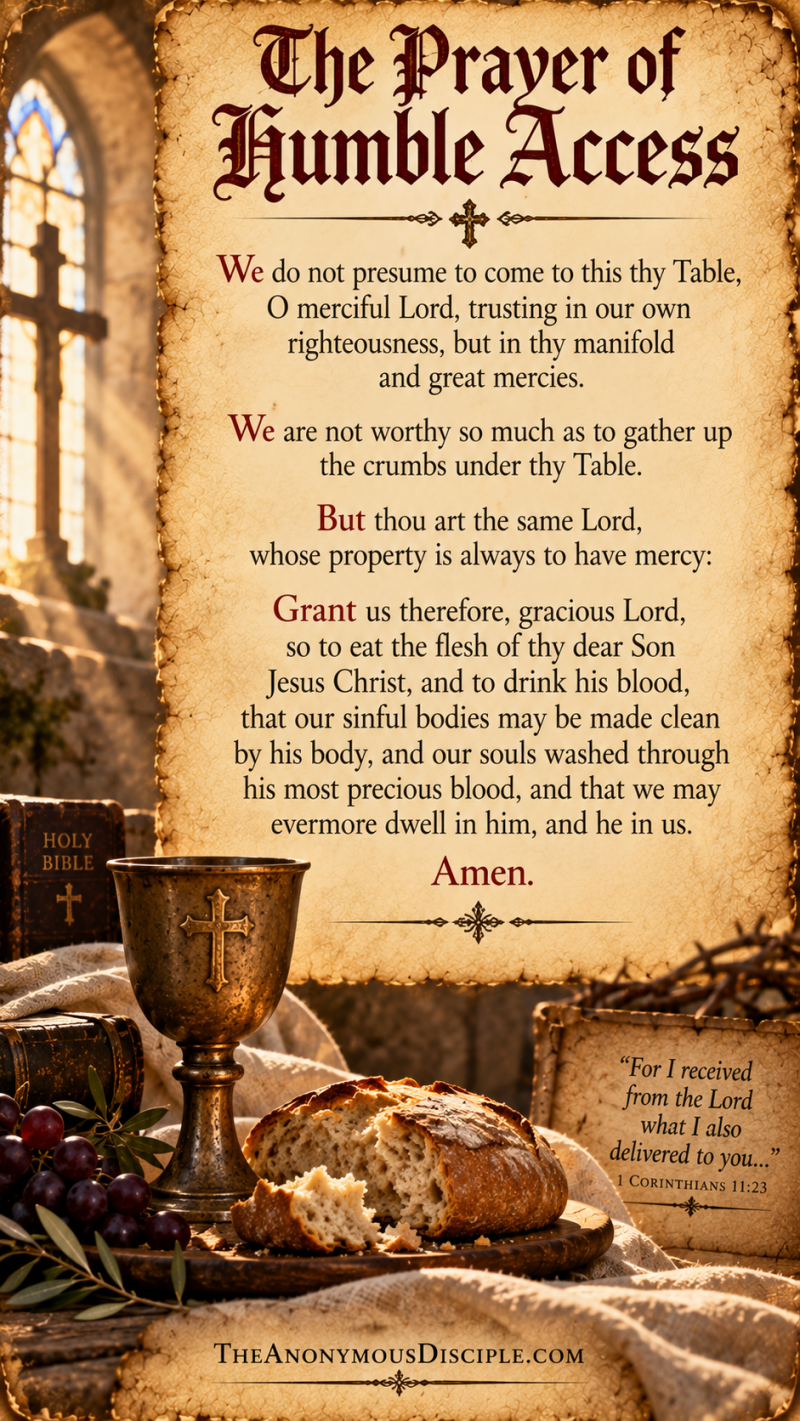
The Prayer of Humble Access
The traditional form says:
We do not presume to come to this thy Table, O merciful Lord, trusting in our own righteousness, but in thy manifold and great mercies.
We are not worthy so much as to gather up the crumbs under thy Table.
But thou art the same Lord, whose property is always to have mercy:
Grant us therefore, gracious Lord, so to eat the flesh of thy dear Son Jesus Christ, and to drink his blood, that our sinful bodies may be made clean by his body, and our souls washed through his most precious blood, and that we may evermore dwell in him, and he in us. Amen.
That is old Anglican English, so it sounds very formal—but the theology underneath it is very simple.
Where did it come from?
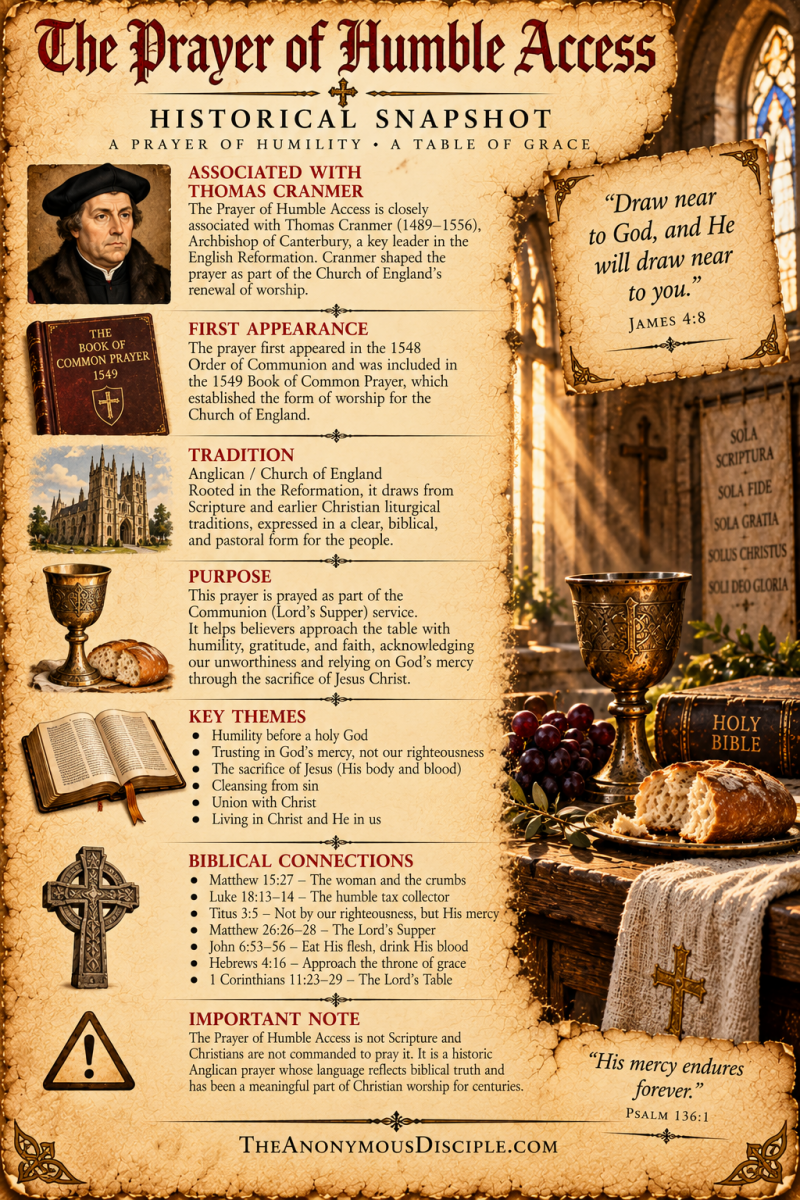
The prayer is closely associated with Thomas Cranmer, the Archbishop of Canterbury during the English Reformation.
It first appeared in the 1548 Order of Communion, and then in the 1549 Book of Common Prayer. Cranmer did not simply invent every thought from scratch; he drew from Scripture and from older Western Christian liturgical traditions, but he shaped the prayer into the form Anglicans came to know.
So unlike the Jesus Prayer or the Prayer of St. Ephrem, this one has a much more specific historical setting:
16th-century England.
The Reformation.
The Church of England.
Holy Communion.
“We do not presume…”
That word presume is important.
It means:
We do not assume we have a right to come before God because of our own goodness.
That echoes the Gospel very strongly.
Luke 18:13–14
“But the tax collector stood at a distance. He would not even look up to heaven, but beat his breast and said, ‘God, have mercy on me, a sinner.’
I tell you that this man, rather than the other, went home justified before God.”
The prayer begins exactly there:
Not my righteousness.
Your mercy.
And that is very Reformation.
Titus 3:5
“He saved us, not because of righteous things we had done, but because of his mercy.”
That could almost be the theological caption for the whole prayer.
“We are not worthy so much as to gather up the crumbs…”
Now here is the line that makes the prayer instantly biblical.
It comes from the woman who pleaded with Jesus for her daughter.
Matthew 15:26–27
Jesus said:
“It is not right to take the children’s bread and toss it to the dogs.”
And she replied:
“Yes it is, Lord. Even the dogs eat the crumbs that fall from their master’s table.”
She wasn't demanding something from Jesus.
She was appealing entirely to His mercy.
That is exactly what Cranmer is doing with this prayer.
And Jesus praised her faith.
Matthew 15:28
“Woman, you have great faith! Your request is granted.”
So the “crumbs” line isn't self-hatred.
It's humble dependence.
There is a big difference.
“Whose property is always to have mercy”
This sounds odd in modern English. 😂
“Property” here doesn't mean something God owns.
It means something more like:
It belongs to God's character to be merciful.
In other words:
Mercy is who He is.
Exodus 34:6
“The LORD, the LORD, the compassionate and gracious God, slow to anger, abounding in love and faithfulness.”
And:
Psalm 103:8
“The LORD is compassionate and gracious, slow to anger, abounding in love.”
That line in the prayer is saying:
Lord, I am not appealing to something outside Your character. I am appealing to who You have revealed Yourself to be.
❤️
Then it becomes a Communion prayer
This is where the Anglican setting really matters.
The prayer asks:
“Grant us therefore… so to eat the flesh of thy dear Son Jesus Christ, and to drink his blood…”
That language comes directly from Christ and the Lord's Supper tradition.
John 6:53–56
Jesus said:
“Whoever eats my flesh and drinks my blood has eternal life… Whoever eats my flesh and drinks my blood remains in me, and I in them.”
And during the Last Supper:
Matthew 26:26–28
“Jesus took bread… saying, ‘Take and eat; this is my body.’
Then he took a cup… ‘This is my blood of the covenant, which is poured out for many for the forgiveness of sins.’”
So Cranmer's prayer is deliberately connecting Communion to Christ's sacrificial death.
Does that make it Catholic theology?
Not necessarily—and this is where Anglicanism gets interesting.
Classical Anglicanism rejected Roman Catholic transubstantiation, but it did not treat Communion as meaningless symbolism either.
Historically, Anglican Christians have held a range of views about precisely how Christ is present in Communion.
Some emphasize a spiritual real presence.
Some Anglo-Catholics understand Christ's presence in a much stronger sacramental sense.
Some evangelical Anglicans emphasize remembrance and receiving Christ by faith.
So the Prayer of Humble Access has survived partly because Christians with somewhat different Eucharistic understandings can still pray its central truth:
I come to Christ's table dependent completely upon His mercy and His sacrifice.
“That we may evermore dwell in Him, and He in us”
And here the prayer ends in something bigger than Communion.
Union with Christ.
John 15:4
“Remain in me, as I also remain in you.”
And:
Colossians 1:27
“Christ in you, the hope of glory.”
The goal isn't merely:
I received Communion.
The prayer is asking:
Christ, let my life remain joined to Yours.
That’s beautiful.
The whole prayer has a movement
It starts very low:
I have no righteousness of my own to offer.
Then it looks upward:
But You are merciful.
Then it looks toward Christ:
His body. His blood. His sacrifice.
And finally:
Let me dwell in Him, and Him in me.
So the prayer doesn't leave the believer groveling.
It moves from unworthiness → mercy → Christ → communion with Christ.
That's important.
Biblical humility never ends with:
“I'm terrible.”
It ends with:
“Christ is sufficient.”
❤️
Why is it called “Humble Access”?
Because that's exactly what it describes:
How can a sinner approach a holy God?
Not arrogantly.
Not because of personal righteousness.
Not because we've earned a seat at the table.
But through Christ and the mercy of God.
Hebrews 4:16
And here is the wonderful balance:
“Let us then approach God’s throne of grace with confidence, so that we may receive mercy and find grace to help us in our time of need.”
Notice Scripture gives us both:
humility and confidence.
We come humbly because we have nothing to boast about.
But we come confidently because Christ has opened the way.
That is exactly where I would anchor this prayer biblically.
For our Prayers page
I would describe it something like this:
Tradition: Anglican / Church of England
Associated with: Thomas Cranmer
First appearance: 1548 Order of Communion; incorporated into the Book of Common Prayer
Setting: Holy Communion
Biblical roots: Matthew 15:27 • Luke 18:13–14 • Titus 3:5 • Matthew 26:26–28 • John 15:4 • Hebrews 4:16
Central message: We approach Christ not because we are worthy, but because God is merciful.
And our usual caution fits perfectly:
The Prayer of Humble Access is not Scripture and Christians are not commanded to pray it. It is a historic Anglican Communion prayer whose language reflects biblical themes of humility, mercy, Christ’s sacrifice, and abiding in Him.
Sherri, I think this is a very good one for the collection. It brings us squarely into the English Reformation, but the heart of it is something Christians across traditions immediately recognize:
“I am not trusting my righteousness. I am trusting Your mercy.”
Add comment
Comments