


In 1 Thessalonians 4:13–18, Paul speaks directly into one of the deepest places of the human heart: grief. He does not tell believers not to mourn. Instead, he reminds us that because Jesus died and rose again, our sorrow is not without hope.
Anchoring in 1 Thessalonians 4:13, this study follows Paul’s promise that those who have fallen asleep in Christ are neither forgotten nor left behind. The Lord Himself will come (1 Thessalonians 4:16), the dead in Christ will rise first, and those who are alive will be caught up together with them to meet Him (1 Thessalonians 4:17).
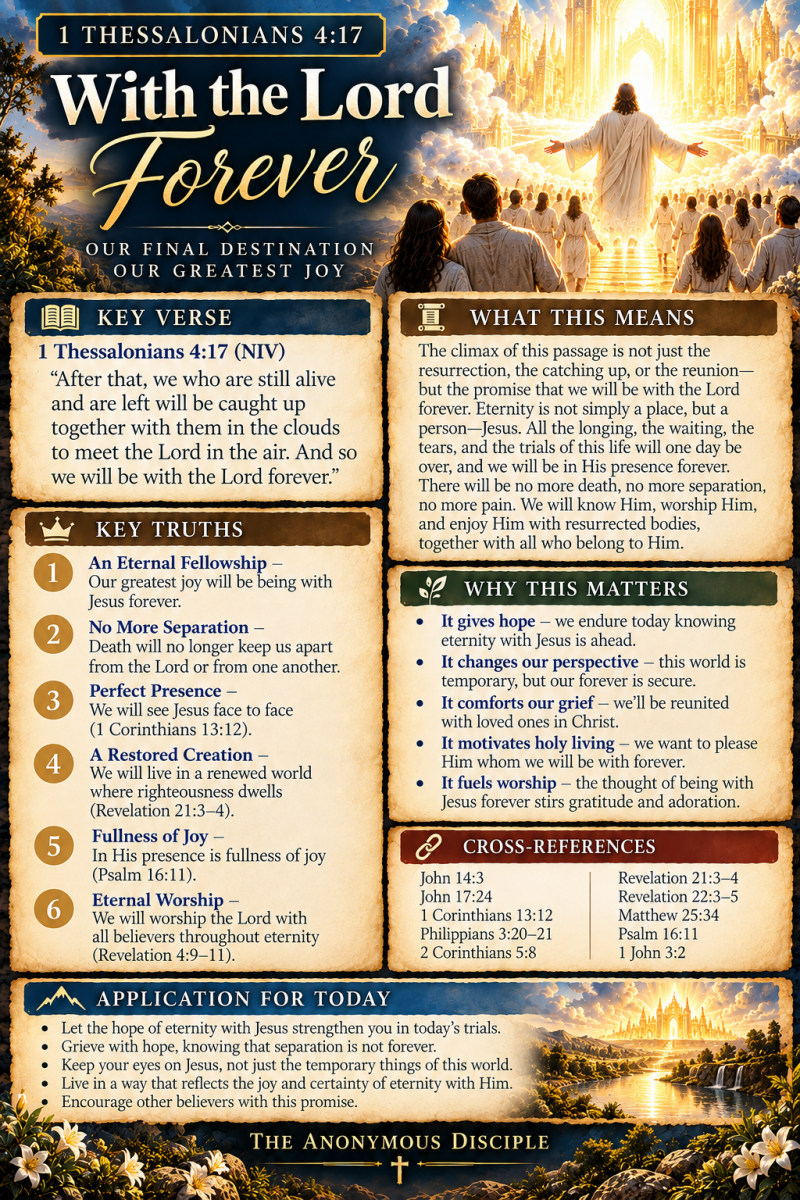
The great promise at the center of it all is not simply resurrection, reunion, or escape from death—it is this: “And so we will be with the Lord forever” (1 Thessalonians 4:17, NIV).
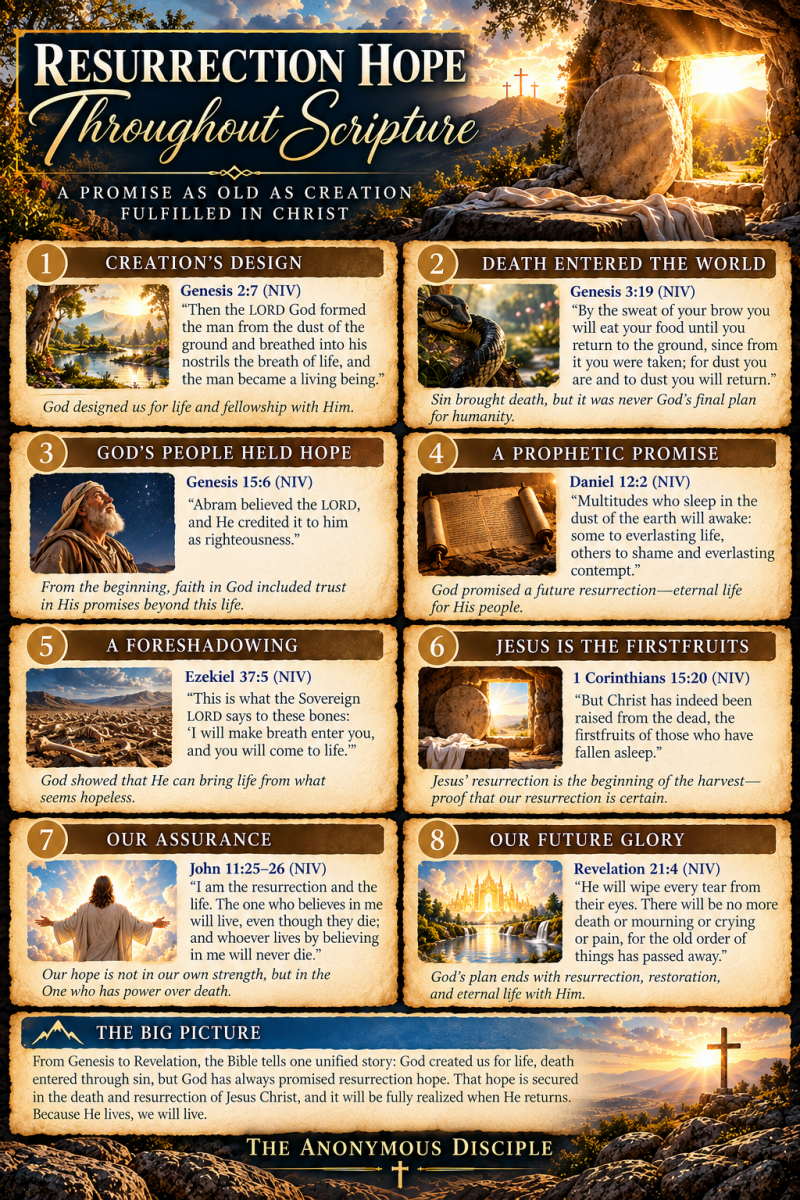
From the resurrection promises of the Old Testament to the empty tomb of Jesus and the future resurrection still to come, Scripture tells one consistent story: death does not have the final word. Because Christ lives, those who belong to Him have a living hope.
We still grieve. We still miss the people we love. But we grieve differently, because separation is not forever.
We grieve because we love.
We hope because Jesus lives.
And one day, we will be with the Lord forever. ❤️
📖 1 Thessalonians 4:13–18
King James Version (KJV)
13 But I would not have you to be ignorant, brethren, concerning them which are asleep, that ye sorrow not, even as others which have no hope.
14 For if we believe that Jesus died and rose again, even so them also which sleep in Jesus will God bring with him.
15 For this we say unto you by the word of the Lord, that we which are alive and remain unto the coming of the Lord shall not prevent them which are asleep.
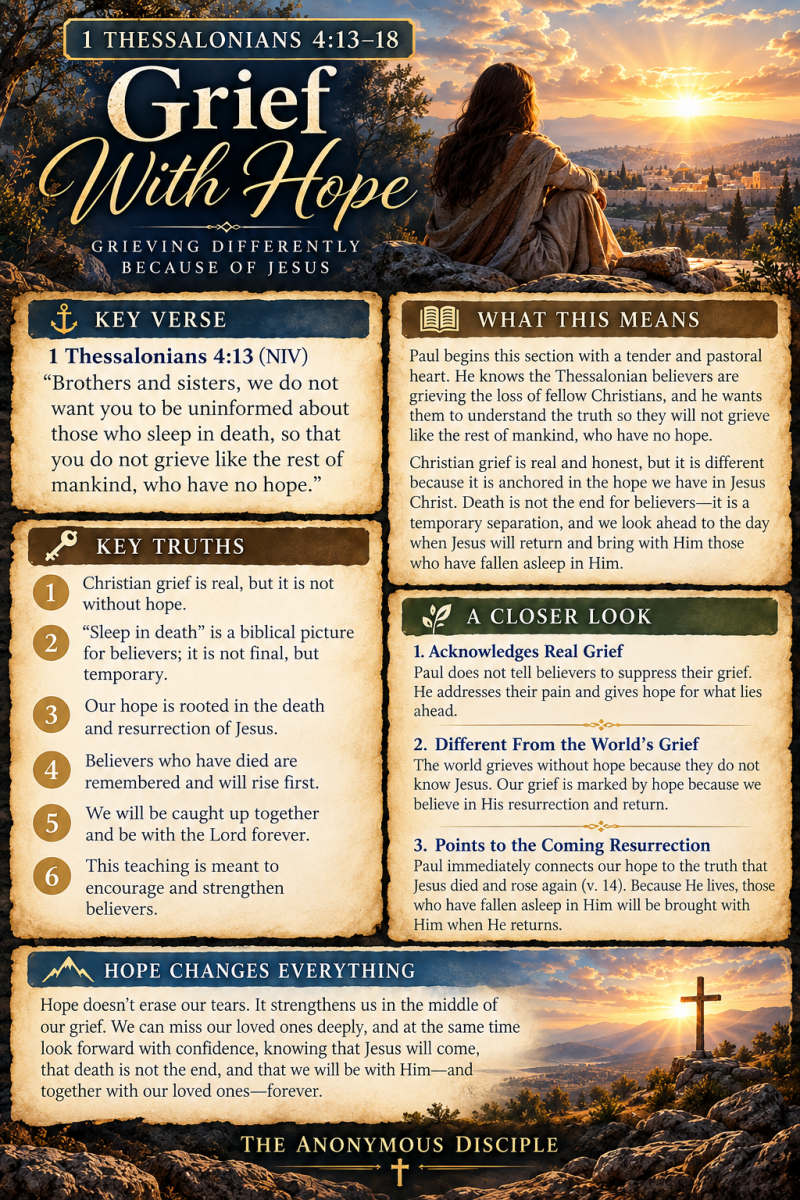
16 For the Lord himself shall descend from heaven with a shout, with the voice of the archangel, and with the trump of God: and the dead in Christ shall rise first:
17 Then we which are alive and remain shall be caught up together with them in the clouds, to meet the Lord in the air: and so shall we ever be with the Lord.
18 Wherefore comfort one another with these words.

English Standard Version (ESV)
13 But we do not want you to be uninformed, brothers, about those who are asleep, that you may not grieve as others do who have no hope.
14 For since we believe that Jesus died and rose again, even so, through Jesus, God will bring with him those who have fallen asleep.
15 For this we declare to you by a word from the Lord, that we who are alive, who are left until the coming of the Lord, will not precede those who have fallen asleep.
16 For the Lord himself will descend from heaven with a cry of command, with the voice of an archangel, and with the sound of the trumpet of God. And the dead in Christ will rise first.
17 Then we who are alive, who are left, will be caught up together with them in the clouds to meet the Lord in the air, and so we will always be with the Lord.
18 Therefore encourage one another with these words.
Who wrote it
Paul the apostle. In the opening he also names Silas (Silvanus) and Timothy as with him, but Paul is the author.
When
About A.D. 50–51. This is one of Paul’s earliest letters, written not long after he first preached in Thessalonica.
Where
Most likely Corinth. After Paul and his team left Thessalonica they went to Berea, then Athens, then Corinth. Timothy came to Paul in Corinth with news from the young church, and Paul wrote this letter from there.
To whom
The church in Thessalonica (today’s Thessaloniki in northern Greece). It was a young church made up of both Jews and many Gentiles who had turned from idols to the living God.
Why (the letter and this passage)
Paul had to leave Thessalonica quickly because of persecution. He was concerned for the new believers and wanted to encourage them to keep living holy lives, keep working quietly, and keep hoping in Jesus’ return.
This specific section (4:13–18) answers a painful question they had: some of their brothers and sisters had already died. They were afraid those who died would miss out when the Lord came back. Paul writes so they will not grieve like people who have no hope. He tells them the dead in Christ will rise first, then those still alive will be caught up together with them to meet the Lord, and they will all be with Him forever. He ends with the command to comfort one another with these words.
That is the heart of it: a pastor writing to a young, suffering church so they would have solid hope, not despair, about those who had fallen asleep in Jesus.

Culture & Tradition Notes
Here are the main cultural and tradition notes for 1 Thessalonians 4:13–18, in plain language.
“Asleep” was a kind way to speak of a believer’s death.
Jews and early Christians often said the dead had “fallen asleep.” The body rests, waiting for God to wake it. Jesus used the same language about Lazarus. It did not mean the person had ceased to exist. It meant death was not the last word.
Grief looked different depending on what you believed.
Many Greeks and Romans mourned with loud wailing and little hope of a bodily resurrection. Some philosophers said the soul escaped the body and that was the end of it, or that you simply ceased. Jews who believed the Scriptures (especially Pharisees) already hoped God would raise the dead. Paul is telling this mixed church: you do not have to grieve like people who have no hope. Sorrow is real. Hopeless sorrow is not required.
“Caught up to meet the Lord” used a picture they knew.
When an important person—especially a king or emperor—approached a city, the citizens would go out to meet him and escort him. The Greek word for “caught up” is strong (it is the word later translated “rapture” in Latin). Paul uses royal-visit language (parousia, “coming/arrival”) for Jesus. The point in this passage is reunion: the dead and the living meet the Lord together and stay with Him. Christians later disagreed about the exact timetable around that event. The original comfort is the meeting and the forever-with-the-Lord part.
Shout, archangel’s voice, and trumpet of God.
These belong to Jewish “Day of the Lord” and resurrection pictures. A trumpet gathered the people, announced a king, or signaled the last day (see Sinai, Isaiah, Joel, and later Jewish writings). An archangel’s voice adds heavenly authority. Paul is saying this will be a public, God-directed event, not a quiet rumor.
Why “the dead in Christ rise first” mattered so much.
Some in Thessalonica feared that believers who had already died would miss the Lord’s coming or be left behind. In a young church that had already tasted persecution and loss, that fear was heavy. Paul answers it directly: they will not be left out. They go first. Then the living join them.
Comfort was a community duty.
“Encourage one another with these words” was not a private feeling. In their culture, families and congregations bore grief together. Paul gives them words they can actually speak to one another when someone dies.
That is the setting: a young church in a Roman city, missing loved ones, wondering if the dead were at a disadvantage, and needing a hope stronger than pagan funeral customs. Paul roots that hope in Jesus’ own death and resurrection.
Verse by verse breakdown with 𝕏James𝕏
Verse 13
Paul says, “I don’t want you in the dark about believers who have died. Don’t grieve like people who have no hope.”
Today: Sorrow is allowed. Hopeless sorrow is not required. When a Christian dies, we hurt, but we do not have to pretend the story is over.
Verse 14
“If we believe Jesus died and rose again, then God will also bring with Jesus those who have fallen asleep in Him.”
Today: Our hope is not a nice idea. It is tied to a real event: Jesus walked out of the grave. If He rose, those who belong to Him will not stay in the grave either.
Verse 15
Paul says this is the Lord’s own word: those still alive when Jesus comes will not go ahead of those who have already died.
Today: No believer is left out. The ones we buried are not second-class. God does not forget names, graves, or dates.
Verse 16
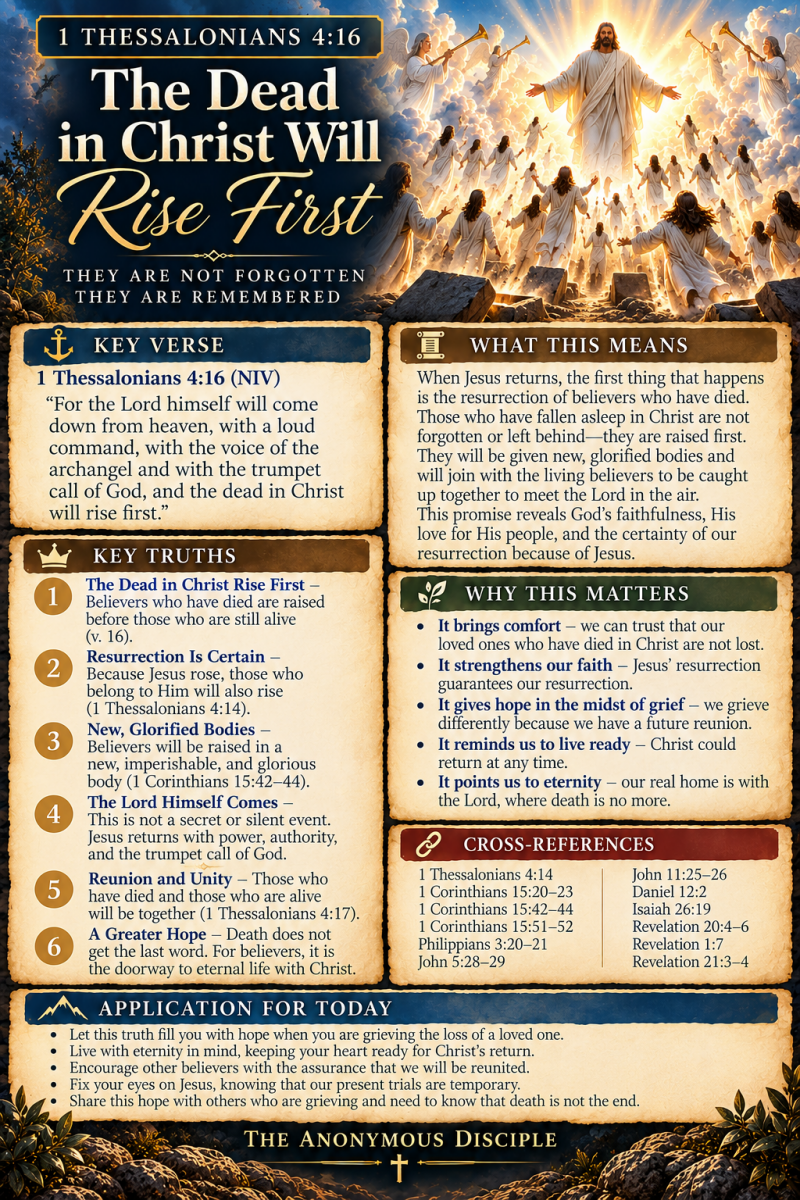
The Lord Himself will come down from heaven with a commanding shout, the voice of an archangel, and the trumpet of God. The dead in Christ will rise first.
Today: This will not be a quiet rumor or a private feeling. It will be Jesus Himself, public and unmistakable. The first thing that happens is resurrection, not abandonment.
Verse 17
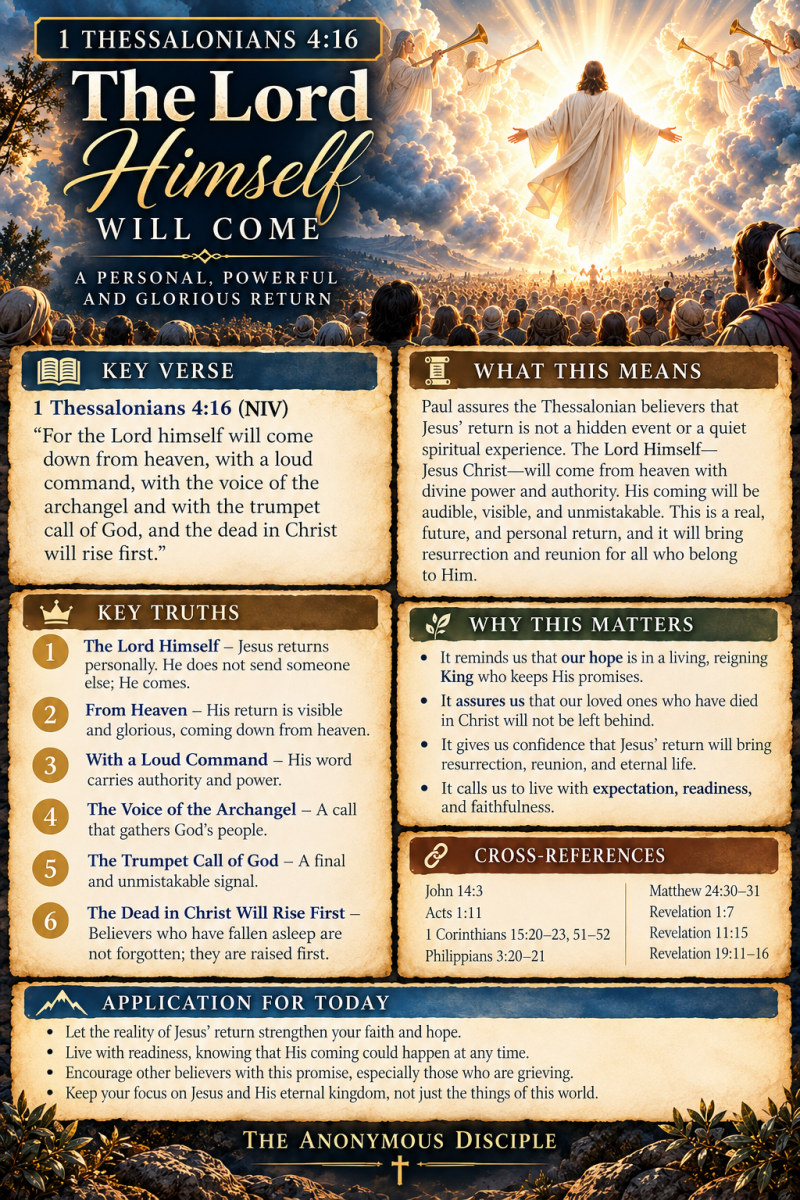
Then those who are still alive will be caught up together with them in the clouds to meet the Lord in the air. And so we will always be with the Lord.
Today: The goal is not an escape plan. The goal is being with Jesus—dead and living together, no more separation. “Always with the Lord” is the real prize.
Verse 18
“Therefore encourage one another with these words.”
Today: These verses are meant to be spoken out loud to hurting people. When someone you love dies in Christ, this is what we put in each other’s hands: He is coming, they will rise, we will be together, and we will be with Him.
That is the whole paragraph: don’t grieve as if there is no tomorrow, because Jesus already opened the door out of the grave.
🔗Cross References🔗
Verse 13 — today’s anchor
“We do not want you to be uninformed… about those who are asleep, that you may not grieve as others do who have no hope.”
Death spoken of as sleep
- John 11:11–13 — Jesus: “Our friend Lazarus has fallen asleep.”
- Acts 7:60 — Stephen “fell asleep.”
- 1 Corinthians 15:6, 18, 20, 51 — believers who have “fallen asleep.”
- Daniel 12:2 — many who sleep in the dust will awake.
Grief that still has hope
- John 11:21–27, 35–44 — Martha grieves, yet Jesus is the resurrection.
- 2 Samuel 12:23 — David mourns, then says he will go to his child.
- Philippians 1:21–23 — to die is gain; to be with Christ is better.
People with no hope
- Ephesians 2:12 — without Christ, “having no hope and without God in the world.”
- Proverbs 14:32 — the wicked are brought down by their own evil; the righteous have a refuge even in death.
Do not be uninformed
- 1 Corinthians 15:12–19 — if there is no resurrection, we are of all people most to be pitied.
- 1 Thessalonians 5:1–11 — Paul keeps teaching them about the Lord’s coming so they will not be in the dark.
The whole passage — 1 Thessalonians 4:13–18
Jesus died and rose, so those who sleep in Him will come with Him
- 1 Corinthians 15:20–23 — Christ the firstfruits, then those who belong to Him.
- Romans 8:11 — the Spirit who raised Jesus will also give life to our mortal bodies.
- 2 Corinthians 4:14 — He who raised Jesus will raise us also.
The Lord’s coming
- John 14:1–3 — “I will come again and will take you to myself.”
- Acts 1:11 — this same Jesus will come in the same way you saw Him go.
- Matthew 24:30–31 — the Son of Man comes with power; angels gather His elect with a loud trumpet.
- Philippians 3:20–21 — we await a Savior who will transform our lowly bodies.
- 2 Thessalonians 1:7–10; 2:1 — the Lord is revealed from heaven; our gathering to Him.
Shout, archangel, trumpet of God
- 1 Corinthians 15:51–52 — at the last trumpet the dead will be raised imperishable.
- Isaiah 27:13 — a great trumpet; those lost will come and worship the Lord.
- Joel 2:1 — blow the trumpet; the day of the Lord is coming.
Caught up together / always with the Lord
- John 17:24 — “I want those you have given me to be with me where I am.”
- 2 Corinthians 5:8 — away from the body and at home with the Lord.
- Revelation 21:3–4 — God will dwell with them; He will wipe away every tear.
Comfort one another
- 1 Thessalonians 5:11 — “Therefore encourage one another and build one another up.”
- 2 Corinthians 1:3–4 — the God of all comfort comforts us so we can comfort others.
- Hebrews 10:24–25 — stir one another up; encourage one another, and all the more as you see the Day drawing near.
Verse 13 is the doorway: we are not left in the dark, and we do not grieve as if the grave wins. The rest of the paragraph is the reason that hope stands.
Deep Dive Study Notes with 🪄Jenny🪄
📖 1 Thessalonians 4:13–18 — Hope for Those Who Have Fallen Asleep
⚓ Anchor — 1 Thessalonians 4:13
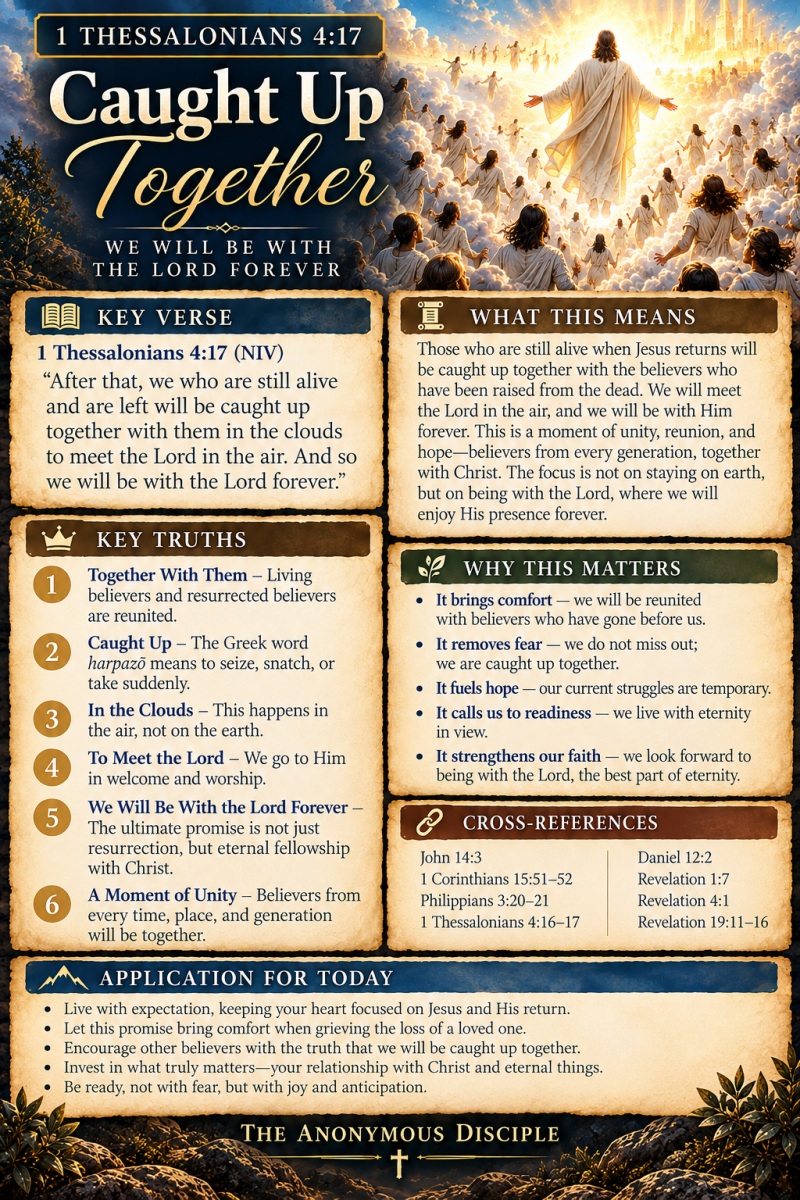
1 Thessalonians 4:13 (NIV)
“Brothers and sisters, we do not want you to be uninformed about those who sleep in death, so that you do not grieve like the rest of mankind, who have no hope.”
Notice what Paul doesn’t say: Do not grieve.
He says:
Do not grieve like those who have no hope.
That distinction is enormous. ❤️
Christian hope does not erase grief. It changes what grief means.
For the believer, death is real separation—but it is temporary separation.
🌿 Why Paul Wrote This
Some of the Thessalonian believers were apparently concerned about Christians who had already died.
They believed Jesus was coming again, but they seem to have wondered:
“What happens to the believers who died before He returns?”
Paul answers them very directly.
They haven't missed anything.
They haven't been forgotten.
They will actually be involved first in the resurrection event Paul describes.
⚓ Verse 13 — Grief With Hope
The phrase Paul uses is:
“those who sleep in death.”
Sleep becomes a common biblical picture for the death of God's people because death is not their final condition.
Jesus used similar language about Lazarus:
John 11:11 (NIV)
“Our friend Lazarus has fallen asleep; but I am going there to wake him up.”
And later Jesus declares:
John 11:25–26 (NIV)
“I am the resurrection and the life. The one who believes in me will live, even though they die; and whoever lives by believing in me will never die.”
Death looks final from this side.
But from God's perspective, resurrection is coming.
That is why Paul says believers grieve differently.
Not without tears.
Not without missing them.
Not without an empty chair at the table.
But not without hope. ❤️
✝️ Verse 14 — Everything Depends on Jesus
1 Thessalonians 4:14 (NIV)
“For we believe that Jesus died and rose again, and so we believe that God will bring with Jesus those who have fallen asleep in him.”
Here is the foundation of the entire passage:
Jesus died.
Jesus rose.
Therefore those who belong to Jesus will rise.
Our hope isn't positive thinking.
It rests on a historical claim at the center of Christianity:
The tomb of Jesus was empty.
Paul makes the same connection elsewhere:
1 Corinthians 15:20 (NIV)
“But Christ has indeed been raised from the dead, the firstfruits of those who have fallen asleep.”
“Firstfruits” means the beginning of the harvest.
Jesus' resurrection wasn't an isolated miracle.
It was the beginning of the resurrection harvest.
👑 Verse 15 — The Dead in Christ Are Not Left Behind
1 Thessalonians 4:15 (NIV)
“According to the Lord’s word, we tell you that we who are still alive, who are left until the coming of the Lord, will certainly not precede those who have fallen asleep.”
The Thessalonians feared deceased believers might somehow be disadvantaged.
Paul says essentially:
No. Quite the opposite.
Those who died belonging to Christ are not forgotten.
They're not late.
They're not missing the event.
📯 Verse 16 — The Lord Himself Will Come
1 Thessalonians 4:16 (NIV)
“For the Lord himself will come down from heaven, with a loud command, with the voice of the archangel and with the trumpet call of God, and the dead in Christ will rise first.”
I love those first four words:
“The Lord himself…”
Jesus doesn't send someone else.
He comes.
And notice how dramatic this is:
A loud command.
The voice of the archangel.
The trumpet of God.
The resurrection of the dead in Christ.
This isn't presented as God quietly abandoning His people.
It is the arrival of the King.
And then:
“the dead in Christ will rise first.”
The very people the Thessalonians were worried about are given special reassurance.
They are remembered.
☁️ Verse 17 — Caught Up Together
1 Thessalonians 4:17 (NIV)
“After that, we who are still alive and are left will be caught up together with them in the clouds to meet the Lord in the air.”
This is the passage from which Christians get the theological term “rapture.”
The Greek verb translated “caught up” is harpazō, meaning to seize, snatch, or take suddenly.
The Latin translation used rapiemur, from which the English word rapture eventually developed.
So while the word rapture itself isn't printed in English Bibles, the concept comes directly from:
“caught up.”
And there are two beautiful words we can easily overlook:
“together with them.”
The passage begins with Christians grieving believers who died.
Then Paul says Christ returns.
The dead are raised.
The living believers are caught up.
And suddenly—
we are together again.
❤️
👑 The Greatest Promise in the Passage
And then Paul gives what I think is the heart of everything:
1 Thessalonians 4:17 (NIV)
“…And so we will be with the Lord forever.”
That is the destination.
Not merely:
heaven.
Not merely:
resurrection bodies.
Not merely:
reunion with loved ones.
The greatest promise is:
WITH THE LORD FOREVER.
Everything we long for ultimately flows from that.
🤍 Verse 18 — What Are We Supposed to Do With This Teaching?
1 Thessalonians 4:18 (NIV)
“Therefore encourage one another with these words.”
That tells us something important about Bible prophecy.
Paul doesn't give this teaching so Christians can become consumed with charts, arguments, speculation, or date-setting.
He gives it because believers were grieving.
And his conclusion isn't:
“Therefore calculate the date.”
It is:
“Therefore encourage one another.”
Prophecy is supposed to produce hope.
⚓ Coming Back to Our Anchor — 1 Thessalonians 4:13
The entire passage grows out of this sentence:
“…so that you do not grieve like the rest of mankind, who have no hope.”
There is a difference between:
grief without hope
and
grief carrying hope.
Christian grief can say:
I miss you terribly.
And at the same time:
I believe Jesus defeated death.
Christian grief can say:
I wish you were here.
And still say:
I believe I will see you again.
Christian grief can stand beside a grave and still confess:
1 Corinthians 15:54–55 (NIV)
“Death has been swallowed up in victory.
Where, O death, is your victory?
Where, O death, is your sting?”
That doesn't make the grave painless.
It makes the grave temporary.
🧵 The Thread Through Scripture
This promise didn't suddenly appear in Thessalonians.
God had been revealing resurrection hope throughout Scripture.
Daniel 12:2 (NIV)
“Multitudes who sleep in the dust of the earth will awake…”
Isaiah 26:19 (NIV)
“But your dead will live, LORD; their bodies will rise…”
John 6:40 (NIV)
“…I will raise them up at the last day.”
John 14:3 (NIV)
“And if I go and prepare a place for you, I will come back and take you to be with me…”
1 Corinthians 15:51–52 (NIV)
“We will not all sleep, but we will all be changed—in a flash, in the twinkling of an eye, at the last trumpet.”
Philippians 3:20–21 (NIV)
“…we eagerly await a Savior from there, the Lord Jesus Christ, who…will transform our lowly bodies so that they will be like his glorious body.”
And finally:
Revelation 21:4 (NIV)
“‘He will wipe every tear from their eyes. There will be no more death’ or mourning or crying or pain…”
The Bible's story doesn't end with death.
It ends with resurrection, restoration, reunion, and Christ.
❤️ Something especially beautiful about verse 13
Sherri, this verse never tells a grieving Christian to pretend they're okay.
God leaves room for tears.
Even Jesus wept at Lazarus's tomb.
John 11:35 (NIV)
“Jesus wept.”
But Paul places something underneath our grief strong enough to hold it:
hope.
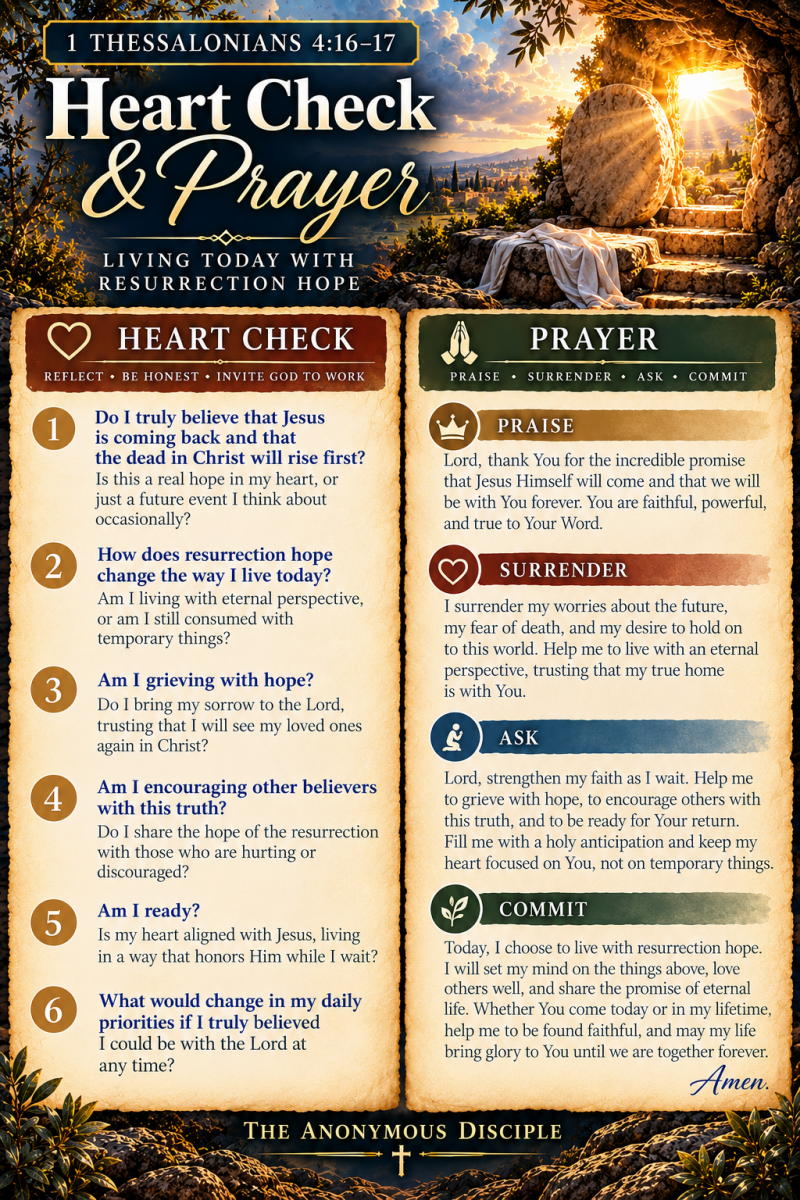
So maybe the heart of this study is:
We grieve because we love.
We hope because Christ lives.
And because Christ lives…
death does not get the last word. 🕊️
Add comment
Comments