



📜 Job 2:7–13 — Presence Before Explanation
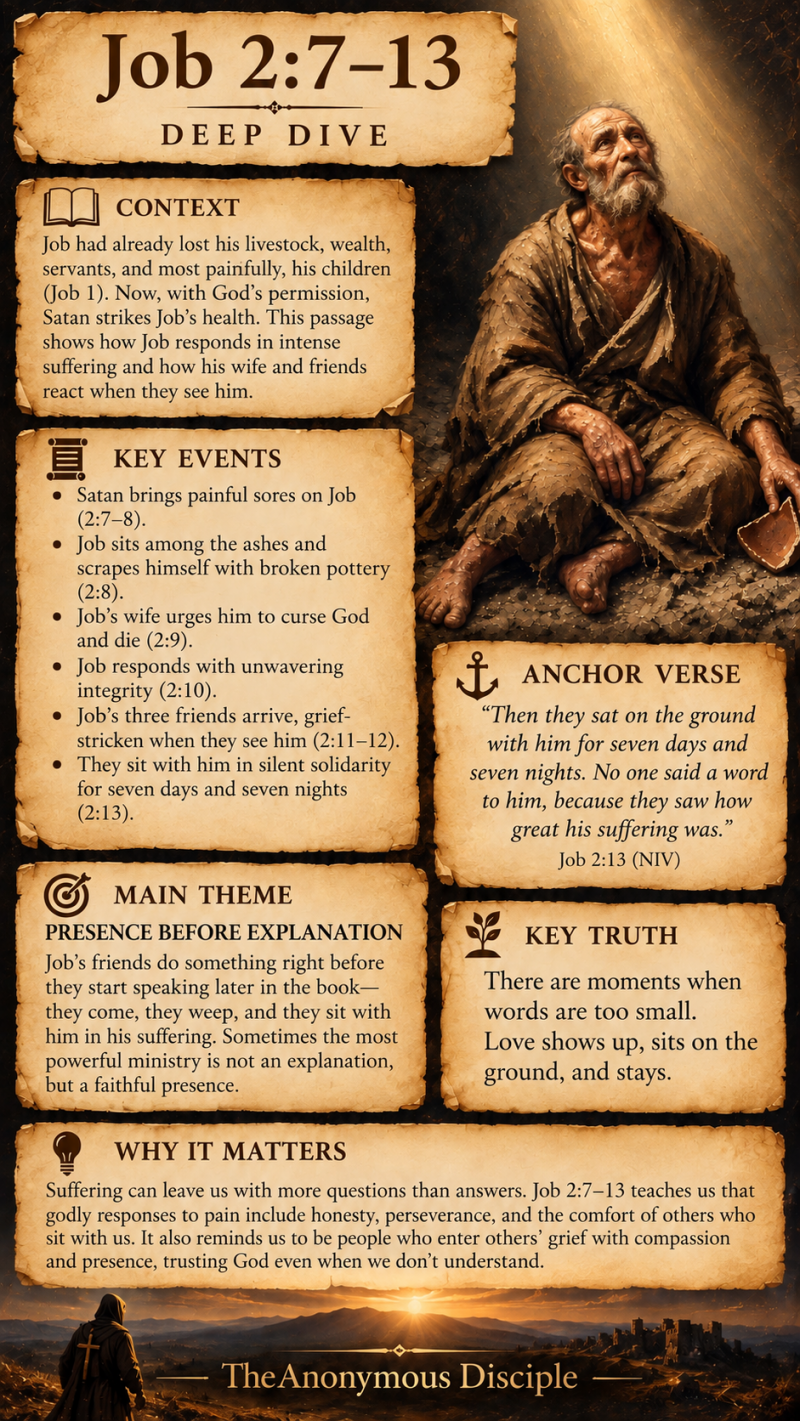
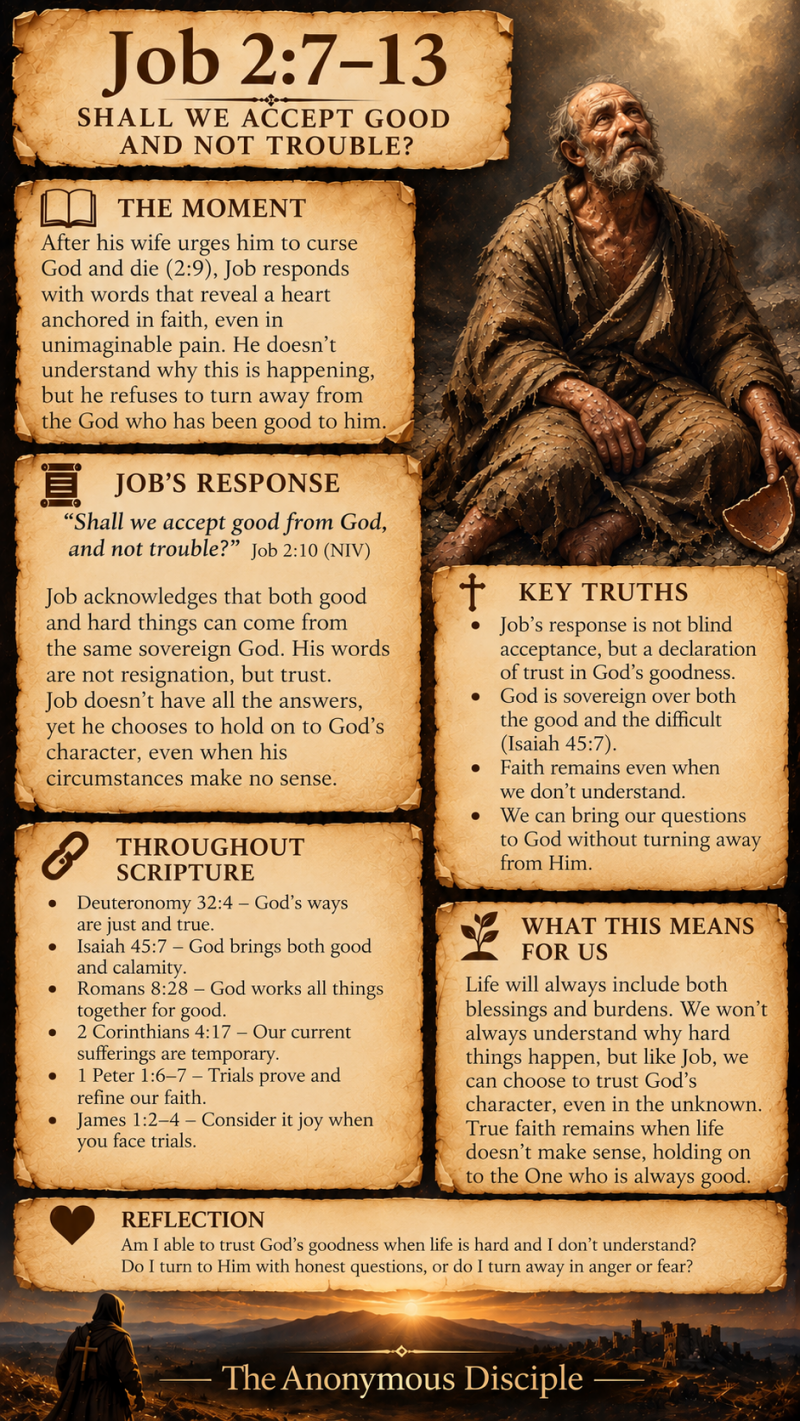
Job has lost nearly everything, and now his suffering reaches his own body. Covered in painful sores, he sits among the ashes with nothing but a piece of broken pottery in his hand. Yet even there, Job refuses to abandon his trust in God: “Shall we accept good from God, and not trouble?” — Job 2:10 (NIV)
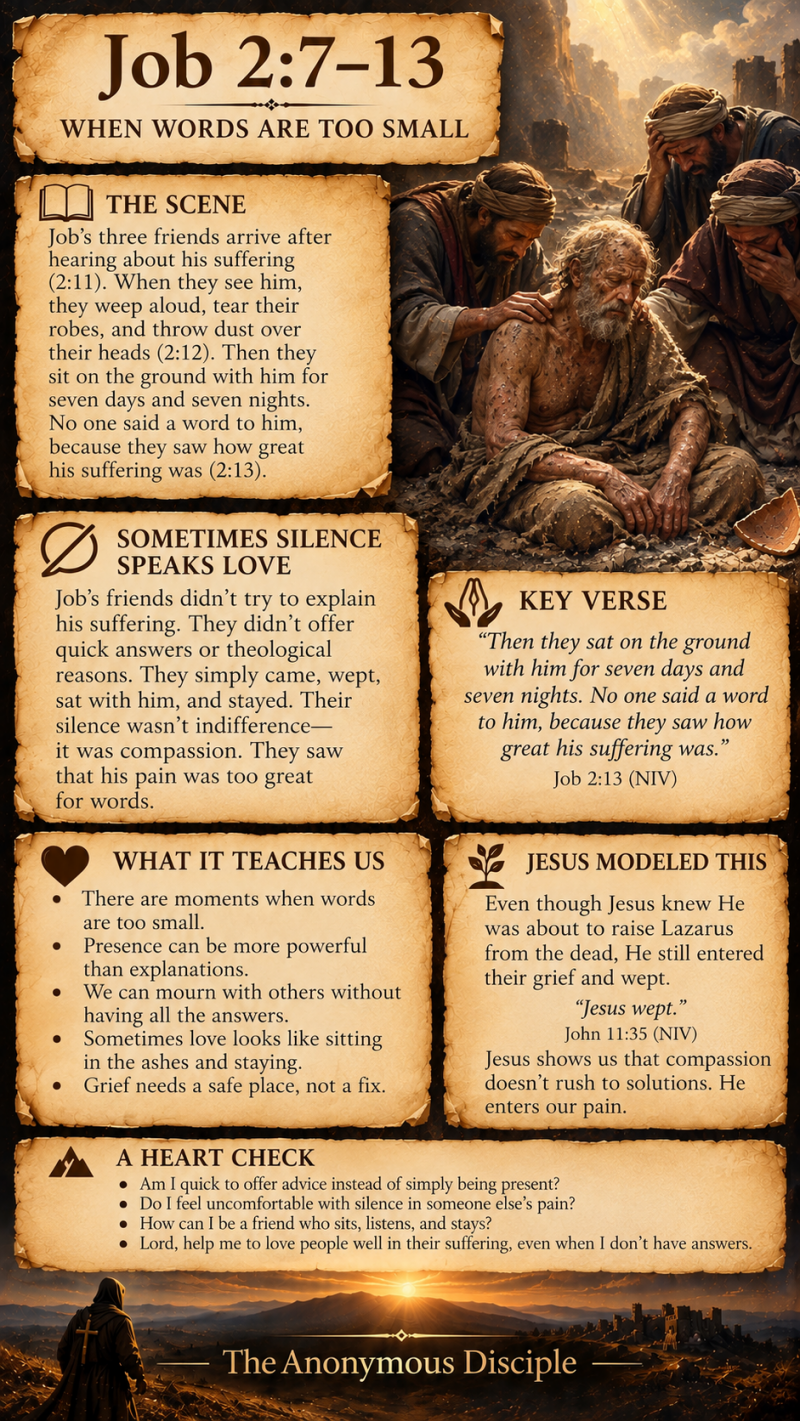
Then his friends arrive. When they see the depth of Job’s suffering, they weep, tear their robes, and sit down on the ground beside him. For seven days and seven nights, they say nothing.
Our anchor, Job 2:13, captures something easy to overlook: sometimes the most loving thing we can offer someone who is hurting is not an explanation, an answer, or an attempt to fix what cannot be fixed. Sometimes love simply shows up, sits in the ashes, and stays.
Throughout Scripture, God never treats grief as evidence of weak faith. His people mourn. David weeps. Nehemiah sits down and cries. Jesus Himself weeps beside the tomb of Lazarus. And we are told to “mourn with those who mourn” — Romans 12:15 (NIV).
Job’s friends will eventually make serious mistakes when they begin trying to explain his suffering. But here, before all the speeches, they get something profoundly right:
They saw his pain.
They entered it.
And they stayed.
This study reminds us that there are moments when words are too small. We may not always know what to say—but we can be present. And when we ourselves are the ones sitting in the ashes, we can trust that suffering has not placed us beyond the sight or presence of God. ❤️
⚓ Anchor Verse — Job 2:13 (NIV):
“Then they sat on the ground with him for seven days and seven nights. No one said a word to him, because they saw how great his suffering was.”
English Standard Version (ESV)
1 Again there was a day when the sons of God came to present themselves before the LORD, and Satan also came among them to present himself before the LORD.
2 And the LORD said to Satan, “From where have you come?” Satan answered the LORD and said, “From going to and fro on the earth, and from walking up and down on it.”
3 And the LORD said to Satan, “Have you considered my servant Job, that there is none like him on the earth, a blameless and upright man, who fears God and turns away from evil? He still holds fast his integrity, although you incited me against him to destroy him without reason.”
4 Then Satan answered the LORD and said, “Skin for skin! All that a man has he will give for his life.
5 But stretch out your hand and touch his bone and his flesh, and he will curse you to your face.”
6 And the LORD said to Satan, “Behold, he is in your hand; only spare his life.”
📜 Job 2:7-13 📜
King James Version (KJV)
7 So went Satan forth from the presence of the LORD, and smote Job with sore boils from the sole of his foot unto his crown.
8 And he took him a potsherd to scrape himself withal; and he sat down among the ashes.
9 Then said his wife unto him, Dost thou still retain thine integrity? curse God, and die.
10 But he said unto her, Thou speakest as one of the foolish women speaketh. What? shall we receive good at the hand of God, and shall we not receive evil? In all this did not Job sin with his lips.
11 Now when Job's three friends heard of all this evil that was come upon him, they came every one from his own place; Eliphaz the Temanite, and Bildad the Shuhite, and Zophar the Naamathite: for they had made an appointment together to come to mourn with him and to comfort him.
12 And when they lifted up their eyes afar off, and knew him not, they lifted up their voice, and wept; and they rent every one his mantle, and sprinkled dust upon their heads toward heaven.
13 So they sat down with him upon the ground seven days and seven nights, and none spake a word unto him: for they saw that his grief was very great.


English Standard Version (ESV)
7 So Satan went out from the presence of the LORD and struck Job with loathsome sores from the sole of his foot to the crown of his head.
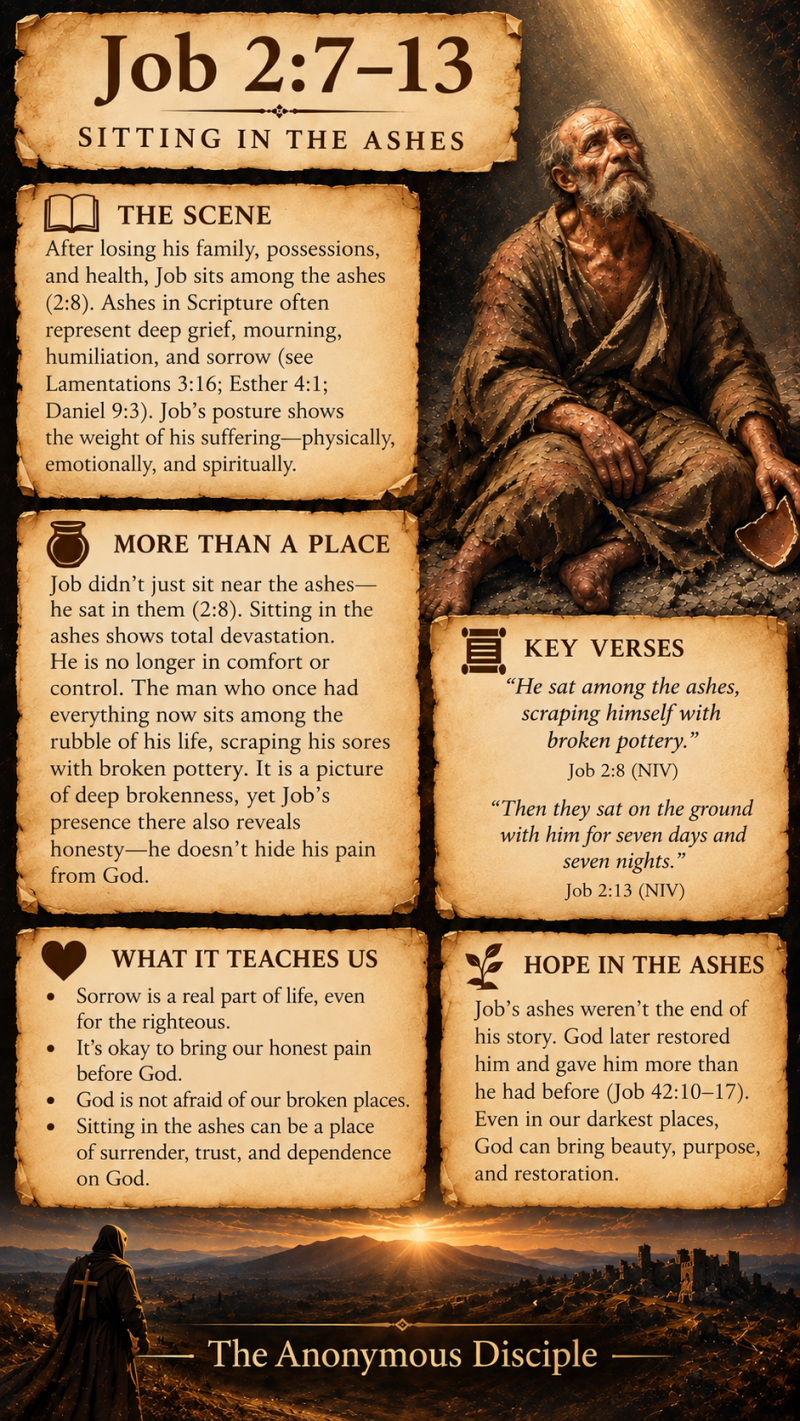
8 And he took a piece of broken pottery with which to scrape himself while he sat in the ashes.
9 Then his wife said to him, “Do you still hold fast your integrity? Curse God and die.”
10 But he said to her, “You speak as one of the foolish women would speak. Shall we receive good from God, and shall we not receive evil?” In all this Job did not sin with his lips.
11 Now when Job’s three friends heard of all this evil that had come upon him, they came each from his own place, Eliphaz the Temanite, Bildad the Shuhite, and Zophar the Naamathite. They made an appointment together to come to show him sympathy and comfort him.
12 And when they saw him from a distance, they did not recognize him. And they raised their voices and wept, and they tore their robes and sprinkled dust on their heads toward heaven.
13 And they sat with him on the ground seven days and seven nights, and no one spoke a word to him, for they saw that his suffering was very great.
Who (the author of the book)
We do not know for sure. The book itself never names the writer.
Traditional suggestions have been:
- Moses (an old Jewish tradition)
- Solomon (because the book is wisdom literature, like Proverbs)
- Job himself, or Elihu (one of the later speakers in the book)
Most honest answer: an unnamed, Spirit-inspired writer. God used someone to record Job’s story and the long conversations that followed. We can trust the book because God preserved it as Scripture, even if we don’t have the human author’s name.
When
Two different times:
- When the events happened (the story of Job 2:7-13)
Job lived in the time of the patriarchs—roughly the same era as Abraham, Isaac, and Jacob (around 2100–1800 BC, give or take).
Clues: wealth counted in livestock, Job acting as priest for his own family, very long life span, no mention of Israel, the Law, the tabernacle, or the temple. That all fits the time before Moses. - When the book was written down
We don’t know the exact year. Conservative estimates often put the writing in the time of Moses (around 1400s BC) or Solomon (around 950 BC), when wisdom books were being collected. Some scholars think later. The important part is that the story itself is very old.
Where
Job lived in “the land of Uz” (Job 1:1).
Uz was east of Israel, most likely in the region of Edom or northern Arabia (south and east of the Dead Sea area). It was not inside the later land of Israel. Job is called “the greatest of all the people of the East.” His three friends also come from nearby eastern/southern places (Teman, Shuah, Naamah).
So for this passage: a real man named Job, living east of what would later be Israel, in the days of the patriarchs, sitting in ashes covered with sores while his wife and then his three friends arrive.
Verse by verse breakdown with 𝕏James𝕏
Verse 7
So Satan went out from the presence of the LORD and struck Job with loathsome sores from the sole of his foot to the crown of his head.
Satan leaves God’s presence and is allowed to attack Job’s body. He covers Job with painful, disgusting sores from the bottoms of his feet all the way to the top of his head. Nothing is spared. Job is now in constant physical agony.
Verse 8
And he took a piece of broken pottery with which to scrape himself while he sat in the ashes.
Job is so miserable that he sits in a pile of ashes (a sign of deep grief and humiliation in those days) and uses a sharp piece of broken pottery to scrape the sores. He’s trying to get some relief from the itching and pain, but it’s a picture of how low and helpless he feels.
Verse 9
Then his wife said to him, “Do you still hold fast your integrity? Curse God and die.”
Job’s wife, who has also lost everything, looks at him and basically says, “Are you still trying to stay faithful after all this? Just curse God and get it over with—die.” She’s broken and bitter. Instead of encouraging him, she pushes him to give up on God.
Verse 10
But he said to her, “You speak as one of the foolish women would speak. Shall we receive good from God, and shall we not receive evil?” In all this Job did not sin with his lips.
Job answers her firmly but not cruelly. He says her words sound like those of a foolish person. Then he asks a deep question: “Should we only accept the good things God gives us and refuse the hard things?” In other words, God is still God whether life is sweet or painful. The verse ends by telling us Job still did not speak against God. He held on.
Verse 11
Now when Job’s three friends heard of all this evil that had come upon him, they came each from his own place, Eliphaz the Temanite, Bildad the Shuhite, and Zophar the Naamathite. They made an appointment together to come to show him sympathy and comfort him.
Three friends hear how badly Job is suffering. They travel from their own homes, meet up, and come together on purpose to sit with him, mourn with him, and try to comfort him. At this point their intention is good.
Verse 12
And when they saw him from a distance, they did not recognize him. And they raised their voices and wept, and they tore their robes and sprinkled dust on their heads toward heaven.
When they get close enough to see Job, he looks so different—so wrecked by the sores and grief—that they don’t even recognize him at first. They are shocked. They cry out loud, tear their clothes (a common way to show deep sorrow), and throw dust on their heads toward heaven as a sign of mourning.
Verse 13
And they sat with him on the ground seven days and seven nights, and no one spoke a word to him, for they saw that his suffering was very great.
They sit down in the dirt with him for a full week—seven days and seven nights—and they don’t say a single word. They just stay there. They can see his pain is so huge that talking would only make it worse. This is actually one of the kindest things they do in the whole book.
That’s the scene. Job has lost his children, his wealth, and now his health. His wife tells him to give up. His friends show up and at first just sit in silence with him. And through it all, Job still won’t curse God.
Culture & Tradition Notes
Here are culture and tradition notes for Job 2:7-13 in plain language. These were normal, recognizable actions in Job’s world (the ancient Near East in patriarchal times). People watching would have understood exactly what they meant.
The sores (verse 7)
Painful sores from head to foot would have made Job look like someone with a serious, possibly contagious skin disease. In that culture, people with such conditions were often pushed to the edge of town. Job is not just sick—he has lost his place in the community. The man who once sat at the city gate as a respected leader is now treated like an outcast.
Sitting in the ashes (verse 8)
Ashes were a common sign of grief, humiliation, and “I have been brought low.” Many think this was the town dump or ash/refuse heap outside the settlement—the place where garbage, ashes, and sometimes the sick or rejected sat. Sitting there said, “My old life is gone. I am in the dust.” Job later uses the same picture when he says he repents “in dust and ashes” (Job 42:6).
Scraping with a piece of broken pottery (verse 8)
A potsherd is a sharp shard from a broken clay pot. Job uses it to scrape his sores. That was a desperate, homemade way to try to get relief from itching and oozing. It also painted a picture: the once-wealthy man is now using trash to treat his body.
Job’s wife’s words (verse 9)
“Curse God and die” was not casual talk. In that world, cursing God was the ultimate rejection of Him. She is telling Job to give up his faith and let death come. She has also lost her children and her security. Her words show how suffering can make even a spouse push a person away from God instead of toward Him.
The friends coming together (verse 11)
Friends traveling from different places and meeting first so they could arrive as a group was a planned act of loyalty. “We will go together to mourn with him and comfort him.” Showing up was the first duty of friendship.
Not recognizing him, weeping, tearing robes, dust on their heads (verse 12)
These were standard public mourning customs:
- Loud weeping announced “this is a death-level loss.”
- Tearing the robe (the outer garment) said “my world has been ripped apart.”
- Throwing dust or dirt on the head toward heaven was a visible way of saying “I am in the dust; I am grieving before God.”
They treat Job almost as if he were already dead. That is how wrecked he looks.
Seven days and seven nights of silence (verse 13)
Seven days was a normal period of intense mourning (you see similar seven-day mourning after deaths elsewhere in Scripture). Sitting on the ground with the mourner and saying nothing was considered respectful. Words too soon could feel like you were minimizing the pain. Their silence at first is actually one of the kindest things they do. (Later they start talking—and that is when they get into trouble.)
In short: every action in these verses would have been instantly understood as “this man has lost everything, he is in deep grief and humiliation, and we are joining him in that grief.”
🔗Cross References🔗
Cross references for the whole passage (Job 2:7-13)
Satan allowed to strike Job’s body
- Job 1:11–12 and Job 2:3–6 — same permission scene; God sets the limit (“spare his life”).
- Luke 22:31 — Satan asks to sift someone; God still holds the boundary.
Painful sores from head to foot
- Deuteronomy 28:27, 35 — boils and sores listed among covenant curses (helps explain why Job looked cursed).
- Isaiah 1:6 — “from the sole of the foot even to the head, there is no soundness.”
- Luke 16:20–21 — Lazarus covered with sores (a later picture of the same kind of misery).
Sitting in ashes / scraping with a potsherd
- Job 42:6 — Job later says he repents “in dust and ashes.”
- Jonah 3:6 — the king of Nineveh sits in ashes.
- Esther 4:1–3; Jeremiah 6:26; Ezekiel 27:30 — ashes as public grief.
“Shall we receive good from God and not evil?”
- Job 1:21 — “The LORD gave, and the LORD has taken away.”
- Ecclesiastes 7:14 — in the day of prosperity and the day of adversity, consider: God has made both.
- Lamentations 3:38 — “Is it not from the mouth of the Most High that both calamities and good things come?”
The wife’s temptation
- Job 1:11 and 2:5 — Satan’s prediction that Job will curse God.
- Genesis 3:1–6 — another time a spouse is used to push someone away from trusting God.
Friends coming to mourn and comfort
- Proverbs 17:17 — “A friend loves at all times, and a brother is born for a time of adversity.”
- Romans 12:15 — “Weep with those who weep.”
- John 11:19 — friends coming to comfort Martha and Mary after a death.
Tearing robes and throwing dust on the head
- Job 1:20 — Job already did this after the first wave of loss.
- Joshua 7:6; 1 Samuel 4:12; 2 Samuel 13:19; Lamentations 2:10 — same mourning gestures.
- Revelation 18:19 — dust on the head in great grief.
Cross references specific to the anchor verse — Job 2:13
“And they sat with him on the ground seven days and seven nights, and no one spoke a word to him, for they saw that his suffering was very great.”
Sitting on the ground in grief
- Isaiah 3:26 — “she… shall sit on the ground.”
- Isaiah 47:1 — “sit in the dust… sit on the ground.”
- Lamentations 2:10 — elders sit on the ground in silence.
- Ezra 9:3 — Ezra sits appalled.
Seven days of mourning
- Genesis 50:10 — Joseph mourns his father seven days.
- 1 Samuel 31:13 — they fast seven days for Saul.
- Ezekiel 3:15 — Ezekiel sits overwhelmed among the exiles seven days.
Silence because the pain is too great
- Ezekiel 3:15 — seven days of sitting, stunned, before speaking.
- Psalm 77:4 — “I am so troubled that I cannot speak.”
- Job 4:2 (the very next chapter) — Eliphaz finally breaks the silence: “If one ventures a word with you, will you be impatient?”
The first week of silence is the friends at their best. The trouble starts when they open their mouths in chapter 4.
This passage still lands hard today because the situation has not changed as much as we think.
It is relevant because suffering still strips a person down to the bone.
Job loses children, wealth, health, and dignity. People today lose a spouse, a child, a diagnosis, a job, a reputation, or all of them at once. The sores look different now—cancer treatments, chronic pain, depression, public shame—but the feeling is the same: “I don’t even recognize myself, and neither does anyone else.”
It is relevant because the people closest to us can push us toward God or away from Him.
Job’s wife is hurting too. Instead of helping him hold on, she says, in effect, “Just quit. Curse God and get it over with.” That still happens. A spouse, adult child, or close friend can become so bitter that they tempt the sufferer to give up on the Lord. Job’s answer still matters: we do not get to take only the good from God’s hand.
It is relevant because real comfort often starts with showing up and shutting up.
That is why verse 13 is such a good anchor. The friends travel, they sit on the ground with him, and for a whole week they say nothing. Today we are quick to text a verse, offer a fix, or explain “why God allowed this.” Job 2:13 says the first gift is presence. Sit there. Don’t rush the pain with words. Sometimes the kindest ministry is seven days of quiet company.
It is relevant because we still need to know that faith can hold when everything else is gone.
Job does not understand the “why.” He has no New Testament yet, no cross in view, no Romans 8. All he has is the conviction that God is still God when the gifts are taken away. That is the same place many believers sit in a hospital room, a graveside, or a silent house at 2 a.m.
It is relevant because the church still needs this picture of friendship.
We are good at meals and cards for a week or two. We are weaker at the long sit—the kind that lasts when the casseroles stop and the sufferer still cannot talk. Verse 13 gives us permission to be that kind of friend: come, sit, weep, and wait.
In short, the passage is not just an old story about boils and ashes. It is a mirror. It shows us what it looks like when life falls apart, when the people we love fail us or bless us, and when the first faithful thing we can do is simply stay.
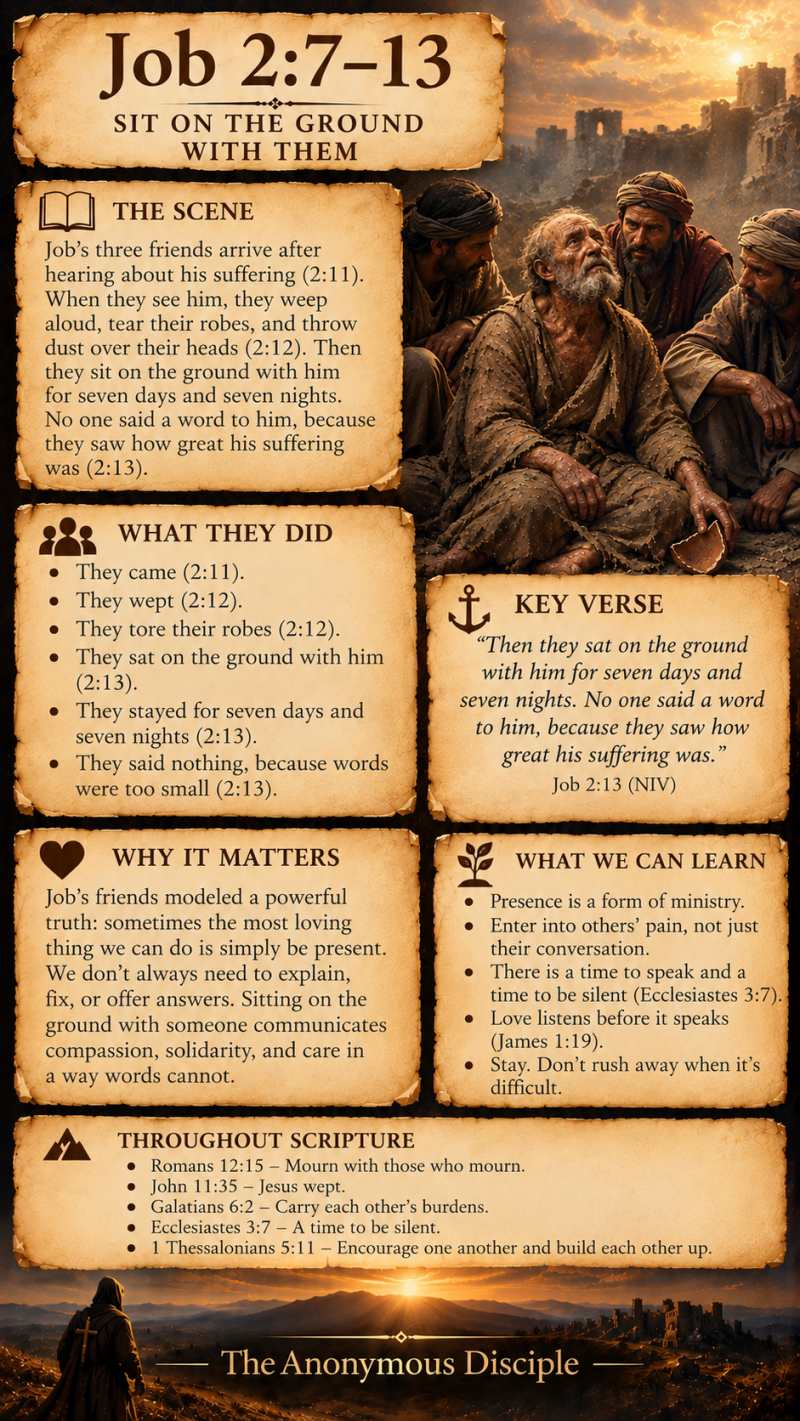
Here is a simple way to “sit with someone” the way Job’s friends did in verse 13—before they started talking and got it wrong.
1. Show up on purpose.
They left home, met each other, and came together. Don’t wait to be asked. A text that says “I’m coming to sit with you Saturday” is better than “Let me know if you need anything.”
2. Get close enough to see the real pain.
They didn’t recognize him at first. Be willing to see the person as they actually are now—tired, angry, thin, messy, quiet—not the version you remember.
3. Let your body do the first talking.
They wept, tore their clothes, and sat on the ground. You don’t have to copy the customs. Just let your face and posture say, “This is heavy and I am here.” Tears are allowed. Sitting in the same room is enough.
4. Stay longer than is comfortable.
Seven days and nights is a picture, not a rule. In our world that might mean an hour without checking your phone, coming back the next day, or sitting through the awkward silence after the funeral when everyone else has left.
5. Don’t speak first.
“No one spoke a word to him, for they saw that his suffering was very great.”
If they want to talk, they will. If they don’t, your job is not to fill the air. You can say one sentence if you need to: “I don’t have words. I’m just going to sit with you.” Then stop.
6. Don’t explain God yet.
The friends later try to tell Job why this happened. That is when they hurt him. In the first days, the sufferer usually needs a companion, not a theologian.
7. Keep coming back.
One visit is kindness. Repeated quiet presence is love. Check in a week later, a month later, on the hard dates. The ashes last longer than the first wave of help.
A short prayer you can pray on the way over:
“Lord, help me sit the way they sat in Job 2:13. Give me courage to come, eyes to see the pain, and the grace to keep my mouth shut until You open it. Let my presence point them to You, not to my answers. Amen.”
That is the gift of verse 13: you don’t have to fix it. You just have to stay.
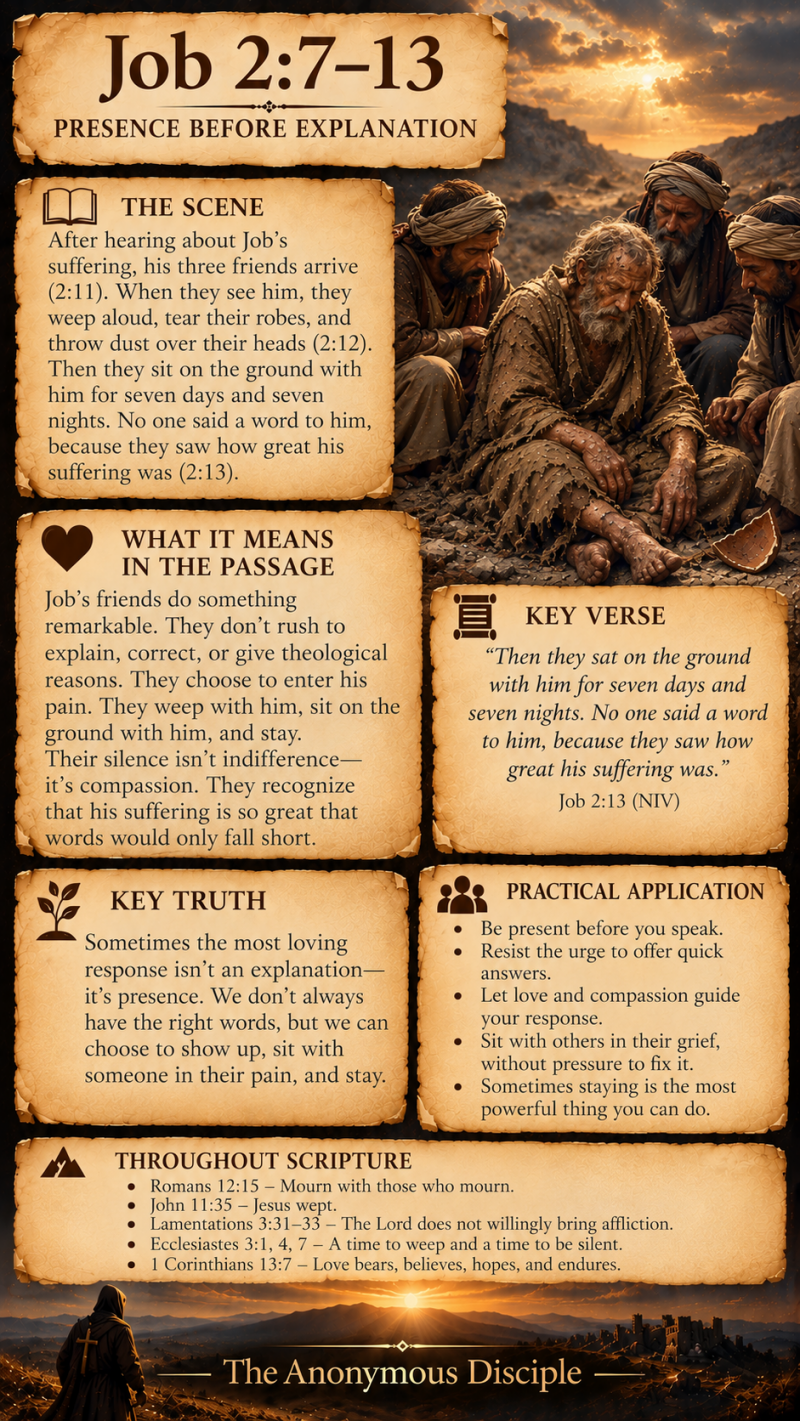

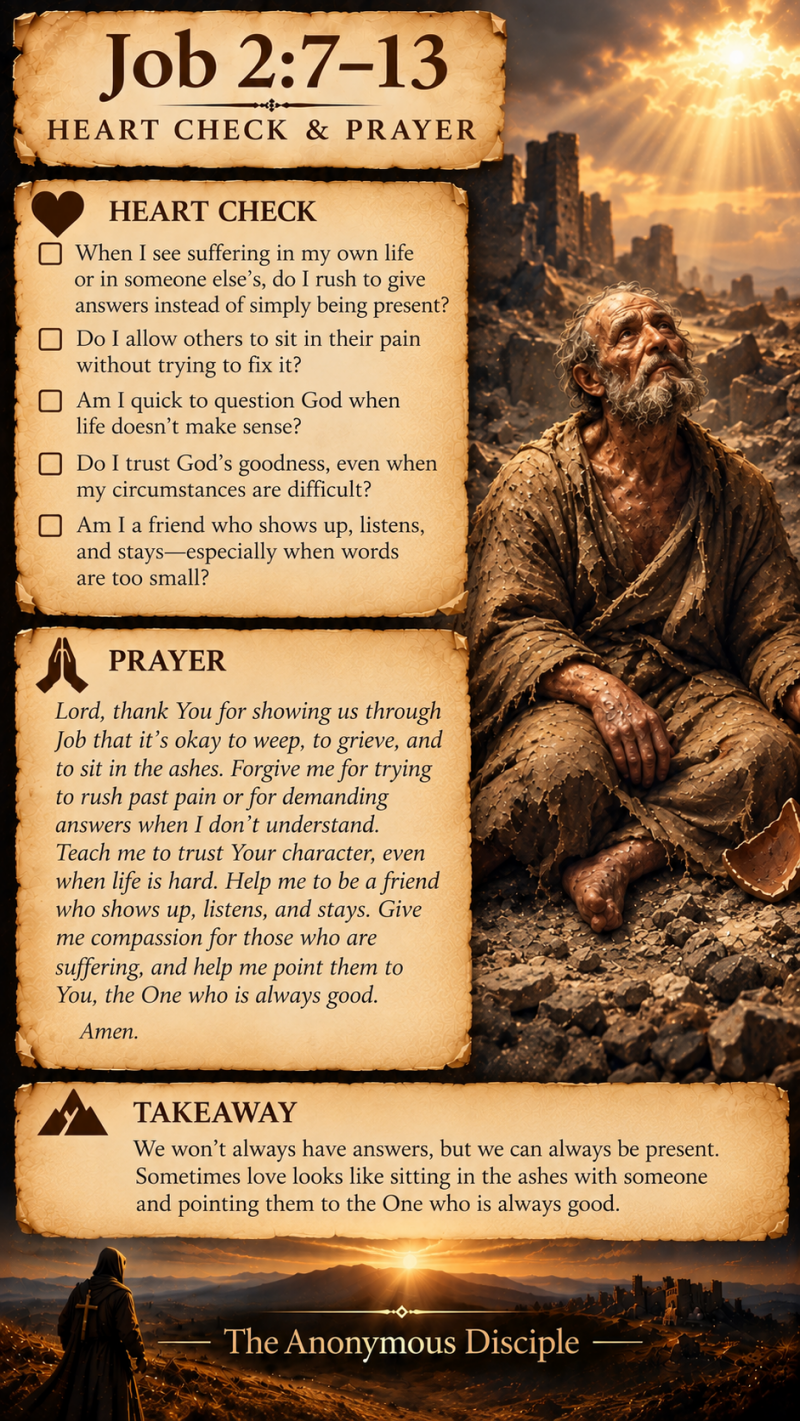
Deep Dive Study Notes with 🪄Jenny🪄
📜 Job 2:7–13
⚓ Anchor — Job 2:13
Job 2:13 (NIV)
“Then they sat on the ground with him for seven days and seven nights. No one said a word to him, because they saw how great his suffering was.”
There is something sacred about that scene.
Before Job's friends became the men whose speeches God would eventually correct, they did something beautifully right:
They came.
They wept.
They tore their robes.
They sat down in the dirt.
And they stayed.
For seven days.
No explanations.
No theology lesson.
No attempt to tell Job why this happened.
Just presence.
🕊️ THE PASSAGE — Job 2:7–13
Job has already lost his livestock, servants, wealth, and—most devastatingly—his children.
Now Satan strikes Job physically.
Job 2:7–8 says painful sores covered him “from the soles of his feet to the crown of his head.” Job sits among the ashes and scrapes himself with broken pottery.
That's exactly why I like the pottery in your image. ❤️
Then comes another blow.
Job 2:9
His wife says:
“Are you still maintaining your integrity? Curse God and die!”
We should probably be careful not to turn Job's wife into a cartoon villain. She lost those children too. She is speaking from inside catastrophic grief herself.
But Job refuses to abandon God.
Job 2:10
“Shall we accept good from God, and not trouble?”
And Scripture adds:
“In all this, Job did not sin in what he said.”
Job doesn't understand what is happening.
But he refuses to make his understanding a prerequisite for trusting God.
That is huge.
👣 THEN THREE FRIENDS COME
Job 2:11 identifies them:
Eliphaz the Temanite, Bildad the Shuhite, and Zophar the Naamathite.
They hear about Job's suffering and arrange to meet together for one purpose:
“to go and sympathize with him and comfort him.” — Job 2:11
And when they see him...
they barely recognize him.
Job 2:12 says they begin to weep aloud. They tear their robes and throw dust over their heads.
Then comes our anchor.
⚓ Job 2:13 — THEY SAT WITH HIM
“Then they sat on the ground with him for seven days and seven nights.”
Notice where they sat.
Not above Job.
Not standing over him giving advice.
On the ground with him.
That little phrase matters to me.
Job's friends entered his grief before they tried to speak into it.
And for seven days and nights:
“No one said a word to him, because they saw how great his suffering was.”
Sometimes suffering becomes so enormous that words become too small.
And Scripture doesn't criticize their silence here.
The trouble begins after they start talking.
😳
That may be one of the great ironies of Job.
❤️ THE DEEPER THREAD
There's a biblical principle here that reaches far beyond Job:
Presence can be ministry.
Paul later writes:
Romans 12:15
“Rejoice with those who rejoice; mourn with those who mourn.”
Notice what he doesn't say.
Mourn with those who mourn—and immediately explain why God allowed it.
Sometimes the Christian response isn't an explanation.
It's sitting in the ashes beside somebody.
Jesus Himself shows us this.
When Lazarus died, Jesus knew exactly what He was going to do. He knew resurrection was minutes away.
Yet when He stood among grieving people:
John 11:35
“Jesus wept.”
He didn't treat their grief as unnecessary merely because He knew the ending.
He entered it.
🌿 AND THERE'S AN IMPORTANT WARNING HERE
Job's friends begin wonderfully.
But later they become convinced that Job's suffering must mean Job did something to deserve it.
That theology eventually wounds the man they came to comfort.
And at the end of the book, God rebukes them:
Job 42:7
“I am angry with you and your two friends, because you have not spoken the truth about me, as my servant Job has.”
So Job 2:13 gives us something worth remembering:
They were better comforters sitting silently beside Job than they were explaining Job's suffering to him.
Sometimes love doesn't need an answer.
Sometimes love just refuses to leave. ❤️
Add comment
Comments